
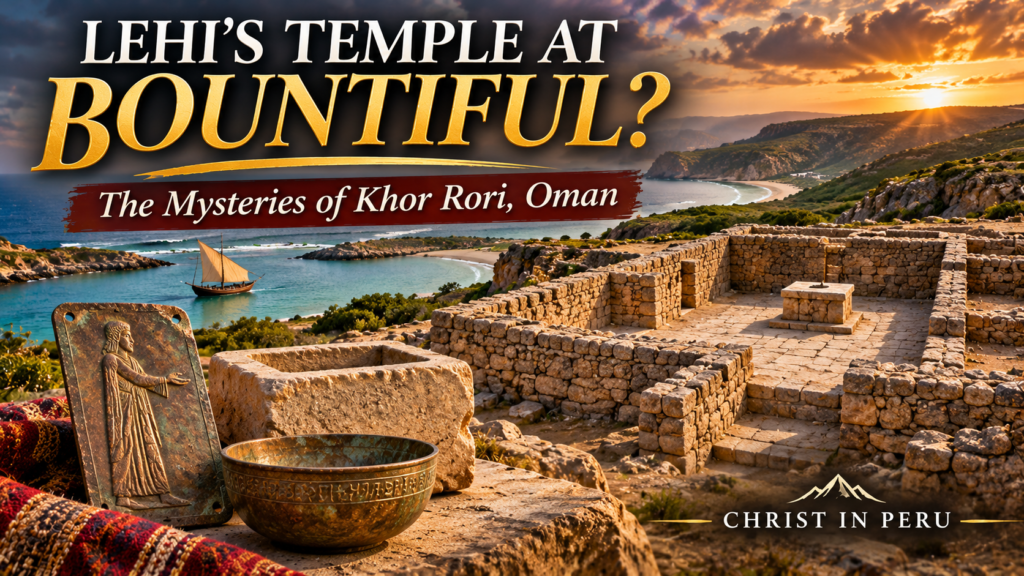
Lehi’s Temple at Bountiful? Exploring the Ancient Mysteries of Khor Rori, Oman
By Christ in Peru | Featuring research and commentary by George Potter
Could the ruins of an ancient temple overlooking the Arabian Sea hold clues to one of the most extraordinary journeys described in the Book of Mormon?
Along the southern coast of Oman, near the modern city of Salalah, lies an ancient harbor known as Khor Rori.
Surrounded by rugged hills, historic trade routes, and the waters of the Indian Ocean, this remarkable archaeological landscape was once home to the ancient port of Sumhuram.
Today, its surviving ruins reveal a fascinating chapter in Arabian history.
For Book of Mormon researcher and author George Potter, however, the area raises additional questions.
Could Khor Rori have been connected to the land of Bountiful described by Nephi? And could its ancient religious structures provide insights into the traditions of people who once lived along this coast?
In a new episode of Discovering the Book of Mormon Through Science and Exploration, Potter explores these questions through archaeological findings, ancient religious practices, and his interpretation of the Book of Mormon.
The Search for Nephi’s Harbor
In 1 Nephi 17, Nephi describes arriving with his family in a fertile coastal region called Bountiful.
There, according to the account, the Lord commanded him to construct a ship that would eventually carry his family across the ocean.
But where was this ancient harbor?
Researchers have proposed several locations along the southern Arabian coast.
George Potter has extensively investigated Khor Rori, arguing that its natural harbor and surrounding environment make it an intriguing candidate.
In his book Voyages of the Book of Mormon, Potter discusses the area’s potential advantages for ancient shipbuilding, including access to maritime knowledge, natural resources, and sheltered waters.
Although these geographical comparisons are thought-provoking, they do not independently establish that Khor Rori was Nephi’s harbor.
An Ancient Port with a Remarkable History
Khor Rori is associated with the ancient city of Sumhuram, an important center of the Arabian frankincense trade.
Its archaeological remains form part of Oman’s UNESCO-listed Land of Frankincense.
Excavations have revealed fortified structures, residential buildings, workshops, and religious architecture.
The port’s strategic location connected southern Arabia with the wider commercial networks of the Indian Ocean.
For centuries, merchants and sailors traveled through this region, exchanging valuable goods and contributing to a vibrant maritime culture.
The ancient ruins provide valuable evidence of the commercial and religious life of southern Arabia.
The Temple at Khor Rori
Among the discoveries that George Potter finds especially intriguing are the remains of a religious building at Sumhuram.
In his presentation, Potter describes a temple structure featuring three rooms, including an inner area associated with an altar.
He considers whether aspects of this architecture might interest readers familiar with ancient Israelite worship.
The Book of Mormon describes Lehi building an altar during his journey through the wilderness.
Later, after reaching the promised land, Nephi built a temple patterned after the Temple of Solomon, as recorded in 2 Nephi 5:16.
Potter raises an intriguing question:
Could Lehi or his family have encountered temple traditions along the southern Arabian coast?
His hypothesis invites discussion about the religious environment of ancient Arabia and the possible experiences of Lehi’s family.
However, no archaeological evidence currently establishes that Lehi constructed, visited, or officiated in the excavated temple at Khor Rori.
Metal Artifacts and Ancient Inscriptions
Another fascinating aspect of the site is the discovery of metalworking evidence and inscribed artifacts.
Archaeological research at Sumhuram has revealed objects associated with trade, craftsmanship, and the cultural traditions of ancient southern Arabia.
George Potter’s presentation highlights several discoveries that he considers particularly interesting to Latter-day Saint audiences.
These include engraved metal objects, a metal bowl with writing, and a small plaque depicting a human figure.
Potter examines the figure’s clothing and hand positions and raises questions about whether the object could have served a religious or instructional purpose.
Such interpretations remain speculative.
The existence of metal artifacts and inscriptions demonstrates the craftsmanship and literacy traditions of the ancient region, but it does not establish a connection with the Book of Mormon.
The Mystery of the Stone Box
One of the most unusual objects described in Potter’s documentary is a stone box associated with the temple ruins.
For Latter-day Saint viewers, the discovery naturally invites comparisons with scriptural accounts involving sacred records and their preservation.
Potter asks whether the box might once have contained metal records or other religious objects.
The question is intriguing, but its original purpose has not been established by the information presented in the documentary.
There is currently no demonstrated connection between the stone box and any Book of Mormon record.
Nevertheless, the object offers an opportunity to explore how ancient societies preserved religious and cultural materials.
Could Lehi Have Built a Temple at Bountiful?
This question forms the central mystery of George Potter’s documentary.
The Book of Mormon describes Lehi’s devotion to worship and sacrifice, and it records Nephi’s later construction of a temple in the promised land.
Potter proposes that Lehi’s family may have encountered or participated in religious practices during their years in Arabia.
He further considers whether converts or other worshippers could have formed a community near the harbor where Nephi constructed his ship.
These possibilities are imaginative and thought-provoking, but they are not established by the archaeological record.
There is also an important chronological challenge.
The ancient city of Sumhuram is generally dated to the final centuries before Christ, whereas Lehi’s departure from Jerusalem is traditionally placed around 600 BC.
This difference means that the known remains of Sumhuram cannot presently be identified as structures built by Lehi’s family.
Earlier human activity in the wider region is a separate archaeological question that would require its own evidence.
Archaeology, Faith, and the Continuing Search
Khor Rori remains an extraordinary archaeological destination regardless of its proposed Book of Mormon connections.
Its ancient harbor, religious structures, inscriptions, and material culture offer valuable insights into life along the southern Arabian coast.
George Potter’s research encourages viewers to consider the geographical descriptions of the Book of Mormon alongside the history of Arabia.
At the same time, archaeological discoveries must be interpreted within their documented historical and chronological contexts.
Several researchers have proposed alternative candidates for the land of Bountiful, including Khor Kharfot.
No location has been conclusively established as the harbor described by Nephi.
Watch the Documentary: Lehi’s Temple at Bountiful?
Join George Potter as he examines the ancient temple, fascinating artifacts, and unanswered questions surrounding Khor Rori.
Discover the archaeology of southern Arabia and explore one researcher’s interpretation of the Book of Mormon’s journey through the wilderness.
[EMBED YOUTUBE VIDEO HERE]
Continue Exploring with Christ in Peru
At Christ in Peru, we share educational documentaries and historical investigations exploring ancient civilizations, archaeology, religious traditions, and Book of Mormon geography.
Our mission is to encourage curiosity, thoughtful research, and meaningful conversations about the ancient world.
Discover more documentaries, research, and educational travel experiences at Christ in Peru.
This article presents George Potter’s interpretations for educational discussion. No archaeological evidence has established that Khor Rori’s temple was constructed or used by Lehi or Nephi. These theories should not be understood as official positions of The Church of Jesus Christ of Latter-day Saints.