
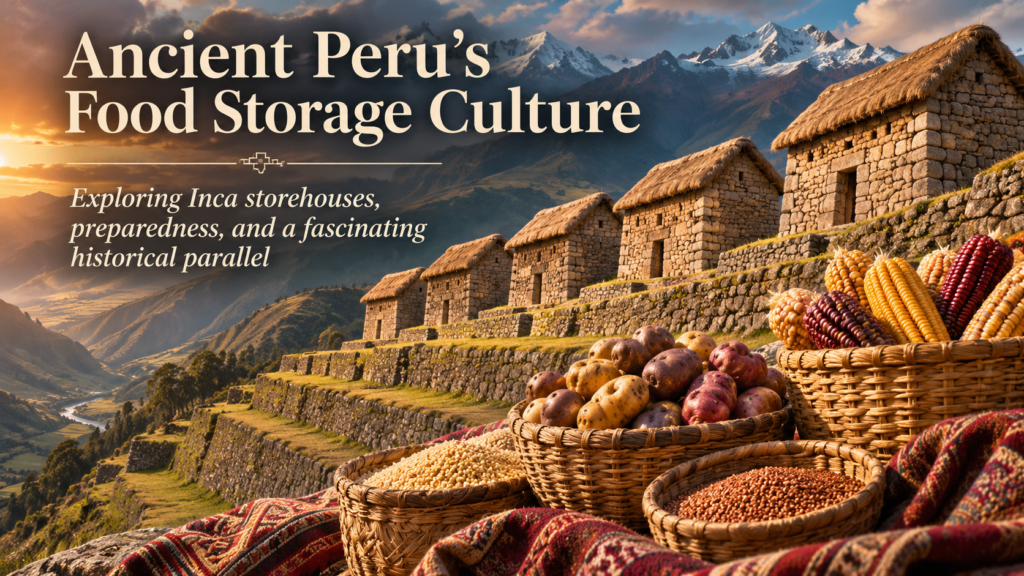
The Incas’ Remarkable Food Storage System: An Ancient Parallel to Latter-day Saint Preparedness?
Could the extraordinary food storage traditions of ancient Peru reveal a surprising connection to principles taught in the Book of Mormon and practiced by Latter-day Saints today?
High in the Andes Mountains, long before modern refrigeration, supermarkets, and emergency preparedness programs, the Inca civilization developed one of the most remarkable systems of food preservation and distribution in the ancient Americas.
Thousands of storehouses helped sustain communities, support armies, and provide essential resources across an empire stretching through much of western South America.
But beyond the ingenuity of this system lies a fascinating question: Why do some of these ancient practices resemble modern principles of preparation, self-reliance, and caring for those in need?
In a new episode of Discovering the Book of Mormon Through Science and Exploration, researcher and author George Potter examines these remarkable similarities and their possible spiritual significance.
An Empire Prepared for Difficult Times
The Incas understood that food security was essential to the survival of their civilization.
Across the Andes, they constructed special storage buildings, often called qullqas or colcas, designed to preserve agricultural products and other essential supplies.
Many were positioned in cool, elevated, well-ventilated areas where environmental conditions helped protect food from moisture and spoilage.
These storehouses contained important resources such as potatoes, maize, preserved foods, textiles, and other necessities.
The scale and organization of this system impressed early Spanish observers, whose accounts describe an empire capable of maintaining extensive reserves and transporting supplies between regions.
Ancient Food Storage and the Book of Mormon
One of the most intriguing parallels explored by George Potter appears in the Book of Mormon.
In 3 Nephi 4:18, the Nephites successfully resisted a prolonged siege because they had previously accumulated provisions.
This account highlights the importance of preparation, organization, and maintaining sufficient supplies during uncertain times.
Could the food storage traditions of ancient Peru offer an interesting cultural parallel to the practices described in this scriptural account?
While such similarities do not establish a historical connection between the Incas and Book of Mormon peoples, they invite fascinating discussion about how civilizations prepared for adversity.
Viracocha and the Traditions of Ancient Peru
Ancient Andean traditions describe Viracocha as an important creator deity associated with civilization and the ordering of the world.
George Potter explores accounts connecting Viracocha with agricultural knowledge and food preservation.
He also considers whether these traditions could hold spiritual significance for readers interested in the Book of Mormon.
Some religious interpretations have proposed parallels between Viracocha and Jesus Christ. These comparisons remain matters of interpretation rather than established historical or archaeological conclusions.
Nevertheless, the traditions provide an intriguing opportunity to explore the religious heritage of the Andes.
Caring for the Poor: An Unexpected Parallel
Perhaps one of the most remarkable characteristics of the Inca storage system was its role in supporting society.
Historical accounts describe provisions being distributed to people in need and to communities facing shortages.
The empire also maintained logistical networks that supported travelers, workers, and armies.
For members of The Church of Jesus Christ of Latter-day Saints, these practices may sound familiar.
Modern Church teachings encourage families to prepare according to their circumstances, become self-reliant, and care for people experiencing hardship.
The Church’s welfare and humanitarian efforts reflect the importance of these principles.
Although the two systems emerged in very different historical contexts, their shared emphasis on preparation and community support offers a thought-provoking comparison.
A Question Worth Exploring
Were the similarities between Inca food storage practices and modern Latter-day Saint principles simply practical responses to human needs?
Or could they suggest a deeper spiritual tradition that deserves further exploration?
George Potter invites viewers to consider these questions through historical accounts, ancient Andean traditions, and passages from the Book of Mormon.
Rather than providing a definitive archaeological conclusion, this exploration opens the door to meaningful conversations about faith, history, and ancient civilization.
Watch the Documentary: Ancient Peru’s Food Storage Culture
Discover the remarkable engineering, extensive storehouses, and fascinating religious parallels explored in this episode of Discovering the Book of Mormon Through Science and Exploration.
[EMBED YOUTUBE VIDEO HERE]
Discover Ancient Peru with Christ in Peru
At Christ in Peru, we believe that understanding ancient civilizations can deepen our appreciation for history, culture, and the spiritual traditions of the Americas.
Through educational documentaries, historical exploration, and specially designed tours, we invite you to experience the extraordinary heritage of Peru.
Explore more discoveries and upcoming tours at Christ in Peru.
Historical and religious interpretations discussed in this article are presented for exploration and discussion and should not be understood as official positions of The Church of Jesus Christ of Latter-day Saints.