
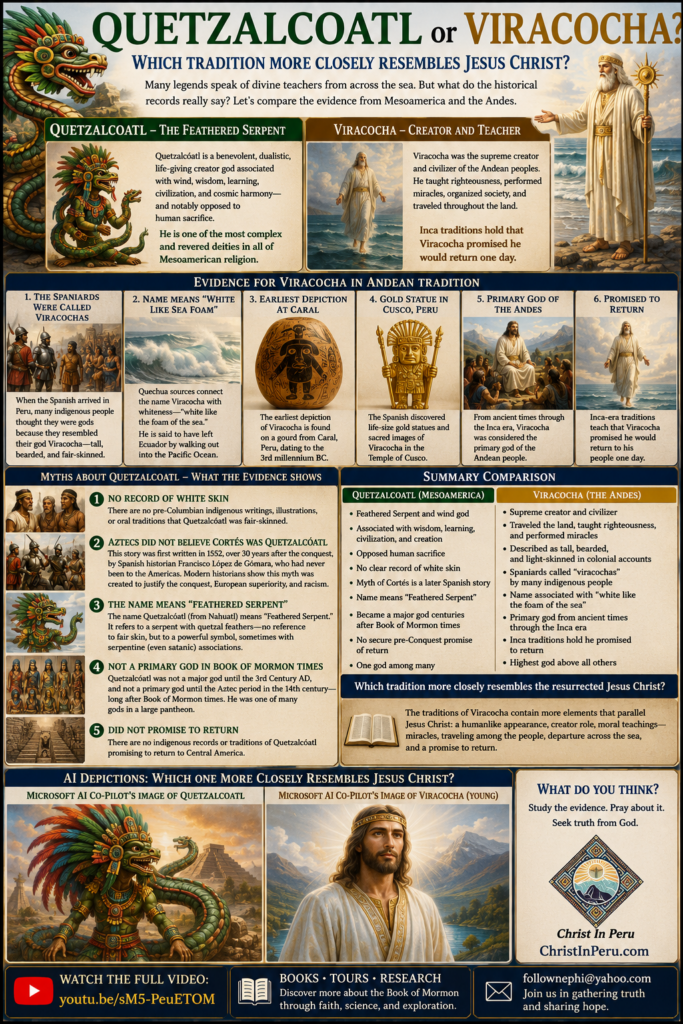
For generations, some Latter-day Saint writers have suggested that ancient American traditions about Quetzalcoatl may preserve a memory of Jesus Christ’s ministry in the Americas.
Quetzalcoatl was an important Mesoamerican deity associated with wind, wisdom, learning, creation, and civilization. He was also represented as the Feathered Serpent.
Yet many popular claims about Quetzalcoatl—especially that he was a white, bearded god who promised to return—do not appear clearly in pre-Columbian Indigenous sources.
George Potter argues that the South American tradition of Viracocha offers a closer comparison with the resurrected Jesus Christ described in the Book of Mormon.
Why Compare These Traditions?
The Book of Mormon teaches that Jesus Christ appeared to peoples in the Americas following His resurrection.
Because written records from many ancient American cultures were lost or destroyed, researchers have sometimes examined Indigenous traditions for possible memories of that ministry.
Two divine figures frequently enter the discussion:
- Quetzalcoatl in Mesoamerica
- Viracocha in the Andes
Both were connected with creation, civilization, sacred knowledge, and religious authority.
However, their traditional representations and historical development were not identical.
Who Was Quetzalcoatl?
The name Quetzalcoatl comes from Nahuatl and is generally translated as “Feathered Serpent.”
The figure developed through several historical forms.
Quetzalcoatl could appear as:
- A feathered serpent
- Ehecatl, the wind god
- A creator or civilizing deity
- A patron of knowledge, calendars, and priests
- A legendary priest-ruler associated with the Toltec tradition
In some traditions, he opposed or limited human sacrifice and preferred other kinds of offerings.
This made him one of the most ethically distinctive divine figures in Mesoamerican religion.
Was Quetzalcoatl Described as White?
One of the most common modern claims is that Quetzalcoatl was remembered as a white-skinned or European-looking god.
The evidence for this claim is weak.
Pre-Columbian codices and Indigenous artistic representations generally depict Quetzalcoatl as a feathered serpent, a masked wind deity, or a priestly figure.
They do not clearly describe him as having white skin.
Descriptions of Quetzalcoatl as pale or bearded appear mainly in colonial-era writings recorded after the Spanish conquest.
Those accounts may reflect a mixture of Indigenous traditions, Christian interpretation, European symbolism, and later retelling.
Did the Aztecs Believe Cortés Was Quetzalcoatl?
Another famous story claims that the Aztec ruler Moctezuma believed Hernán Cortés was Quetzalcoatl returning from across the sea.
Modern historians generally treat this story with skepticism.
The idea was not clearly documented during the conquest itself.
One influential version appeared decades later in the writings of Francisco López de Gómara, who had never personally visited the Americas.
The story became useful because it portrayed the Spanish victory as inevitable and divinely ordained.
It also suggested that the Indigenous population surrendered because of religious confusion rather than because of military violence, political alliances, disease, and internal conflict.
A Colonial Narrative That Justified Conquest
The Cortés-as-Quetzalcoatl story served several purposes.
It allowed European writers to portray the conquest as:
- Peaceful
- Predestined
- Religiously justified
- Welcomed by Indigenous people
- The fulfillment of an ancient prophecy
This narrative minimized the brutality of the invasion and portrayed Native Americans as passive or naïve.
It also supported European racial ideas about mysterious white visitors supposedly responsible for Indigenous civilization.
Modern scholarship has challenged that interpretation and emphasized the complexity of the conquest.
Did Quetzalcoatl Promise to Return?
The claim that Quetzalcoatl promised to return is also difficult to establish from authentic pre-Columbian sources.
Some later traditions concern the departure of the Toltec ruler Topiltzin Quetzalcoatl, but these should not automatically be treated as prophecies of a returning white god.
There is no clearly documented pre-Conquest Indigenous prophecy stating that Quetzalcoatl would return as a European man.
The familiar version appears to have developed largely through colonial and modern retellings.
When Did Quetzalcoatl Become a Major God?
Feathered-serpent imagery has ancient roots in Mesoamerica.
However, Quetzalcoatl’s position and identity changed considerably over time.
Early serpent imagery may have appeared among Preclassic cultures, but Quetzalcoatl became especially prominent during and after the rise of Teotihuacan.
The Temple of the Feathered Serpent at Teotihuacan dates to the early centuries AD.
The deity later became highly important in Toltec religion and remained a major figure in the Aztec pantheon.
This chronological development matters because much of Quetzalcoatl’s best-known religious prominence occurred after the main period covered by the Book of Mormon.
Quetzalcoatl Was One God Among Many
By the Aztec period, Quetzalcoatl was unquestionably important.
However, he existed within a large pantheon that included gods such as:
- Huitzilopochtli
- Tezcatlipoca
- Tlaloc
- Xipe Totec
- Coatlicue
- Tonatiuh
Quetzalcoatl was not always worshipped as the single supreme creator in the same way Jesus Christ is understood in Christianity.
Different cities and historical periods also emphasized different forms and aspects of the deity.
This makes any simple one-to-one identification difficult.
Who Was Viracocha?
Viracocha was one of the most important divine figures of the Andes.
He was associated with:
- Creation
- Order
- Light
- Civilization
- Teaching
- Miraculous power
- The origin of humanity
- The organization of the world
Early Spanish chroniclers recorded traditions portraying Viracocha as a powerful humanlike visitor who traveled among the people and taught them how to live.
Some accounts describe him as tall, bearded, light-skinned, or dressed in long garments.
These descriptions were recorded after the conquest and must also be evaluated carefully.
Nevertheless, Potter argues that the Viracocha tradition contains more elements resembling the Christian description of Christ than the traditional imagery of Quetzalcoatl.
The Meaning of the Name Viracocha
Potter’s script connects the name Viracocha with the image of whiteness resembling sea foam.
This interpretation has appeared in some traditional and popular explanations of the name.
Quechua etymology is complex, however, and scholars do not all agree on one precise translation.
The name has been interpreted in several ways involving water, foam, fat, abundance, or a sacred lake.
Therefore, the linguistic argument should not be treated as definitive proof that Viracocha was literally identified as a white-skinned person.
Early Andean Representations
The script associates very early Peruvian religious imagery with Viracocha, including an image found on an ancient gourd from Caral.
Andean archaeology does contain extremely early representations of supernatural figures with staffs, rays, fangs, animal features, and complex ceremonial symbolism.
However, archaeologists cannot always identify every early figure by the later Inca name Viracocha.
Religious symbols changed across thousands of years.
A figure later compared with Viracocha may originally have carried a different name or meaning.
Still, the ancient depth of creator and staff-bearing divine imagery in the Andes is significant.
Viracocha as the Creator
Unlike the Feathered Serpent’s shifting roles across different Mesoamerican cultures, Viracocha was widely described in Inca-era accounts as a supreme creator or organizer.
He was credited with:
- Creating the world
- Bringing forth light
- Creating or organizing humanity
- Teaching civilization
- Traveling through the land
- Establishing moral order
These characteristics provide a stronger conceptual comparison with Jesus Christ as Creator and divine teacher.
They do not prove that Viracocha was Christ, but they help explain why some Latter-day Saint researchers favor that identification.
A Humanlike Divine Visitor
Many Quetzalcoatl images emphasize serpentine or masked characteristics.
By contrast, colonial accounts of Viracocha often describe a figure who appeared in human form.
He traveled, spoke, taught, performed wonders, and interacted directly with communities.
Some traditions say that he walked across or departed upon the sea.
For Potter, these human characteristics resemble the resurrected Christ appearing bodily among the people.
Viracocha and the Spanish
When Spaniards arrived in the Andes, some Indigenous people reportedly referred to them as viracochas.
One explanation is that the foreigners’ appearance—beards, clothing, and unfamiliar complexion—reminded local people of descriptions associated with Viracocha.
Another possibility is that the word became a broader title for powerful outsiders, nobles, or Europeans.
Colonial testimony is complicated because it was recorded through translators and after Indigenous societies had already begun adapting to Spanish power.
The reports remain important, but they should not be read as perfectly preserved pre-Conquest statements.
A Golden Image in Cusco
Spanish chroniclers reported important temples, statues, shields, and sacred objects associated with Viracocha.
Some accounts refer to a humanlike image kept in an important temple in Cusco.
The script describes a life-size golden representation.
The exact appearance and identity of surviving or recorded statues remain debated because many sacred objects were destroyed, melted, removed, or reinterpreted during the conquest.
The existence of important images does demonstrate that Viracocha occupied a significant place in Andean religion.
Did Viracocha Promise to Return?
Potter argues that Andean traditions included a promise that Viracocha would return.
Some colonial accounts do describe the divine visitor leaving the people and contain expectations of future change or renewed contact.
However, as with Quetzalcoatl, the exact wording and antiquity of a return prophecy can be difficult to establish.
Oral traditions changed over time and were recorded within a Christian colonial environment.
The return tradition is therefore suggestive but not conclusive.
Moral Teachings Associated With Viracocha
Some traditions recorded by Spanish chroniclers describe Viracocha teaching people:
- To love one another
- To practice charity
- To avoid harming others
- To live peacefully
- To behave with goodness
These moral teachings strongly resemble principles taught by Jesus Christ.
Quetzalcoatl was also associated with learning, order, and opposition to some forms of human sacrifice.
Both figures therefore contain ethical elements.
Potter’s argument is that Viracocha’s human appearance, creator role, teachings, miracles, and travels form the closer overall parallel.
Five Major Differences
The video presents five reasons for questioning the identification of Quetzalcoatl with Christ.
1. No Clear Pre-Columbian Record of White Skin
Authentic Indigenous depictions do not clearly show Quetzalcoatl as a white European-looking god.
2. The Aztecs Did Not Clearly Identify Cortés as Quetzalcoatl
The famous story appears primarily in later Spanish accounts.
3. His Name Means Feathered Serpent
The name itself refers to quetzal feathers and a serpent, not whiteness.
4. His Greatest Prominence Came Later
Quetzalcoatl became especially important during Teotihuacan, Toltec, and Aztec periods, much of which followed the Book of Mormon era.
5. No Secure Pre-Conquest Promise of Return
The returning-white-god narrative is not clearly supported by early Indigenous sources.
Is a Serpent Symbol Automatically Negative?
The image of a serpent may seem incompatible with Jesus Christ to some Christian readers.
However, biblical symbolism is more complicated.
The serpent can symbolize evil, as in the Garden of Eden.
Yet Moses also raised a brass serpent in the wilderness as a means of healing, and the Gospel of John compares that event with Christ being lifted up.
Therefore, Quetzalcoatl’s serpent symbolism does not automatically disqualify every possible Christian comparison.
The stronger objections involve chronology, historical development, and the lack of clear pre-Conquest traditions concerning whiteness and return.
The Danger of Comparing AI Images
The script proposes comparing AI-generated images of Quetzalcoatl and Viracocha and asking which looks more like Jesus Christ.
Such images may be visually interesting, but they are not historical evidence.
AI-generated artwork reflects:
- The wording of the prompt
- Modern artistic conventions
- Internet imagery
- Christian iconography
- Cultural stereotypes
- The model’s training data
An AI image of Viracocha resembling Jesus does not prove that ancient Andean people portrayed him that way.
Likewise, a monstrous image of Quetzalcoatl may exaggerate animal characteristics.
Historical comparison should depend on primary sources, archaeology, and Indigenous art—not on which generated image feels more familiar.
A More Responsible Comparison
A careful comparison asks separate questions.
What do the earliest sources say?
Pre-Columbian images and early colonial accounts should receive the greatest weight.
How did the traditions change?
Both Quetzalcoatl and Viracocha were interpreted differently across regions and centuries.
What came from Spanish influence?
Christian missionaries and chroniclers often translated Indigenous ideas into European religious language.
Which features genuinely resemble Christ?
Creator status, human ministry, moral teachings, healing, compassion, resurrection, and promises of return are relevant points of comparison.
Which claims are later inventions?
The white Quetzalcoatl and Cortés-return myth should not be repeated uncritically.
Could Either Tradition Preserve a Memory of Christ?
From a strictly archaeological perspective, neither tradition can currently be identified conclusively with Jesus Christ.
Religious traditions are complex.
They can preserve ancient memories while also absorbing later symbolism and reinterpretation.
From a Latter-day Saint faith perspective, it remains possible that stories of divine visitors preserve echoes of Christ’s ministry in the Americas.
Potter concludes that Viracocha offers a stronger candidate because of the combined traditions of:
- Humanlike appearance
- Creator status
- Miraculous power
- Moral teaching
- Travel among the people
- Departure across the water
- A possible promise to return
What the Evidence Establishes
Historical evidence establishes that:
- Quetzalcoatl was an important Feathered Serpent and wind deity.
- He was associated with civilization, wisdom, and creation.
- Pre-Columbian sources do not clearly describe him as white-skinned.
- The Cortés-as-Quetzalcoatl story is a later colonial narrative.
- Viracocha was an important Andean creator deity.
- Early colonial sources describe Viracocha as a traveling divine teacher.
- Some accounts attribute humanlike or bearded features to him.
- Both traditions changed through time and colonial contact.
What the Evidence Does Not Establish
The evidence does not prove that:
- Quetzalcoatl was Jesus Christ.
- Viracocha was Jesus Christ.
- Every colonial description reflects an untouched pre-Conquest tradition.
- Skin color establishes divine identity.
- AI-generated artwork can determine historical truth.
- Similar religious themes require direct historical contact.
These identifications remain theological interpretations.
Why the Distinction Matters
Correcting myths about Quetzalcoatl is not an attack on Mesoamerican religion.
On the contrary, it respects the tradition by allowing it to be understood on its own terms rather than reshaping it into a European Christian story.
Likewise, the Viracocha tradition deserves careful study without exaggeration.
Faith-based arguments become stronger when they acknowledge uncertainty and avoid repeating claims that historical evidence does not support.
Quetzalcoatl or Viracocha?
Potter’s answer is Viracocha.
He believes the Andean creator and teacher more closely resembles the Jesus Christ described in the Book of Mormon.
Readers may reach different conclusions.
The most important lesson is that comparisons should be based on reliable historical evidence rather than popular legends repeated so often that they begin to sound factual.
Both Quetzalcoatl and Viracocha were profound sacred figures within their respective civilizations.
Understanding them accurately allows for a more thoughtful and respectful discussion of the Book of Mormon and ancient American religion.
Watch the Full Video
To learn more about Quetzalcoatl, Viracocha, the white-god traditions, the Cortés myth, and the proposed connection with Jesus Christ, watch the complete video:
Quetzalcoatl or Viracocha? — Watch on YouTube
You can also visit ChristInPeru.com to explore our books, research, videos, and tours connected with Book of Mormon history.