
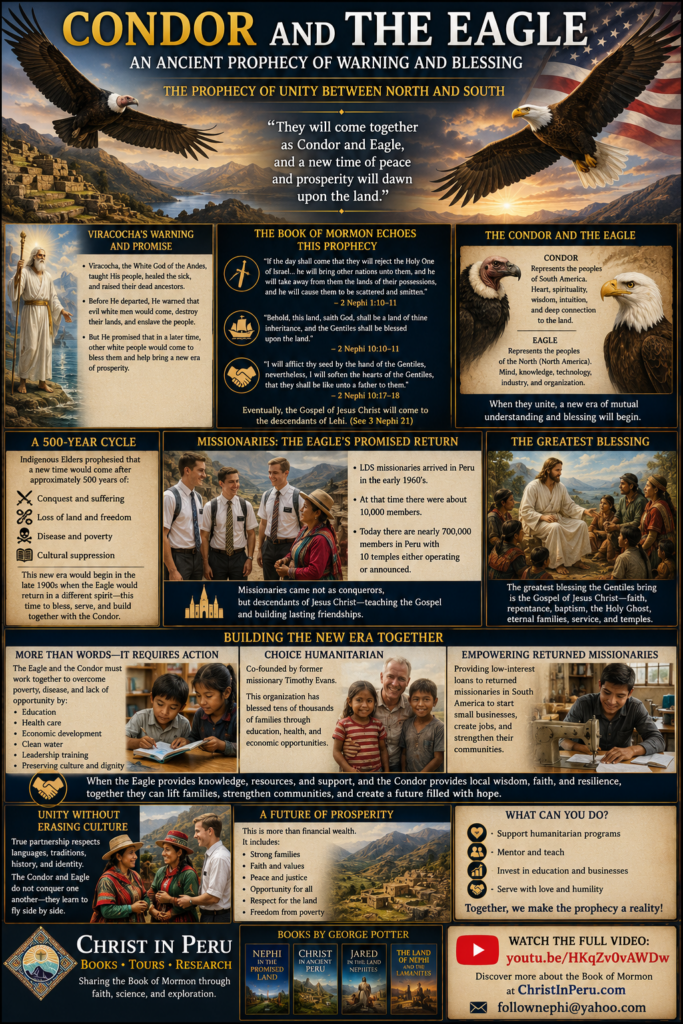
Across the Andes and the Amazon, Indigenous traditions speak of a future time when two great peoples would come together.
The Condor, representing the peoples of South America, and the Eagle, representing the peoples of the North, would reunite after centuries of separation, suffering, and misunderstanding.
Their union would begin a new period of cooperation, healing, and prosperity.
George Potter connects this tradition—commonly known as the Prophecy of the Condor and the Eagle—with promises found in the Book of Mormon and with the arrival of Latter-day Saint missionaries and humanitarian workers in South America.
Viracocha’s Warning and Promise
According to Andean traditions discussed in the video, Viracocha—the divine white teacher remembered throughout the Andes—warned the people that white foreigners would eventually arrive from across the sea.
The first group would not come to bless them.
They would conquer their lands, exploit the people, destroy sacred traditions, and impose foreign rule.
Potter interprets this warning as a reference to the Spanish conquistadors, whose arrival brought warfare, forced labor, disease, cultural destruction, and profound suffering throughout Central and South America.
However, the tradition reportedly included a second promise.
At a later time, other visitors from the North would come—not to conquer, but to help.
These people would work with the Indigenous nations and participate in a new era of mutual blessing.
The Condor and the Eagle
The condor is one of the most powerful symbols of the Andes.
It is among the world’s largest flying birds and has long represented spiritual power, the heavens, wisdom, and the peoples of South America.
The eagle is closely associated with North America, particularly the United States.
Within modern versions of the prophecy:
- The Condor represents the heart, intuition, spirituality, Indigenous wisdom, and the peoples of the South.
- The Eagle represents the mind, technology, organization, industry, and the peoples of the North.
The prophecy teaches that neither bird can create the desired future alone.
The new era begins when they learn to fly together.
A Prophecy of Five Hundred Years
Several modern versions of the tradition state that Indigenous spiritual leaders foresaw a period of approximately five hundred years following the arrival of the Europeans.
During that era, the peoples of the South would experience conquest, displacement, poverty, misunderstanding, and cultural fragmentation.
At the end of the cycle, however, the Condor and the Eagle would begin to reunite.
Potter connects the late twentieth century with this proposed fulfillment.
He particularly associates it with the arrival of North American Latter-day Saint missionaries in Peru and other South American nations.
Missionaries did not come as soldiers or colonizers. They came to preach the gospel, serve communities, learn local languages, and invite people to follow Jesus Christ.
The Book of Mormon’s Warning
Potter sees strong parallels between the Andean tradition and the prophecies of Lehi.
Lehi warned his descendants that if they rejected the Messiah, other nations would receive power over them.
He taught that they would lose lands, be scattered, and experience suffering:
“If the day shall come that they will reject the Holy One of Israel, the true Messiah, their Redeemer and their God, behold, the judgments of him that is just shall rest upon them. Yea, he will bring other nations unto them, and he will give unto them power, and he will take away from them the lands of their possessions, and he will cause them to be scattered and smitten.”
—2 Nephi 1:10–11
Potter compares this passage with the Indigenous warning that foreign invaders would come and take possession of the people’s lands.
The Arrival of the Gentiles
The Book of Mormon describes Gentile nations crossing the waters and becoming established in the Americas.
Some of these newcomers would participate in the scattering and affliction of Lehi’s descendants.
Yet the record also promises that the Gentiles could later become a source of blessing.
God declared that the land would become an inheritance for them and that they would be blessed upon it.
The relationship between the Gentiles and the descendants of Lehi would therefore contain both tragedy and hope.
“Like Unto a Father to Them”
One of the most hopeful Book of Mormon promises states that God would soften the hearts of the Gentiles.
Though the descendants of Lehi would initially be afflicted, some Gentiles would later care for them:
“I will afflict thy seed by the hand of the Gentiles; nevertheless, I will soften the hearts of the Gentiles, that they shall be like unto a father to them.”
—2 Nephi 10:18
Potter connects this promise with the second part of the Condor and Eagle tradition.
The people from the North would eventually return in a different spirit—not to dominate the Indigenous population, but to cooperate, teach, serve, and support them.
The Gospel as the Greatest Blessing
From a Latter-day Saint perspective, the greatest blessing brought by the Gentiles is the restored gospel of Jesus Christ.
Missionaries entered South America teaching:
- Faith in Jesus Christ
- Repentance
- Baptism
- The gift of the Holy Ghost
- Eternal families
- Personal revelation
- Temple worship
- Service to others
Potter interprets this missionary movement as an important part of the promised reunion between North and South.
The Eagle did not return only with technology, money, or political influence. It returned with a spiritual message centered on Jesus Christ.
The Growth of the Church in Peru
When Potter began serving as a missionary in Peru, the Church was still relatively small in the country.
The script states that Peru had approximately 10,000 Latter-day Saints at that time.
Since then, membership has increased dramatically, and temples have been constructed or announced in multiple parts of the nation.
Potter sees this growth as evidence of a spiritual transformation.
The expansion of congregations, temples, missionary service, education, and humanitarian work represents more than institutional development.
For him, it reflects the Condor and the Eagle beginning to fly together.
Because membership figures and temple counts change, current totals should be verified before publication if exact contemporary statistics are added to the article.
More Than Missionary Work
The prophecy is not fulfilled simply by preaching.
Potter argues that genuine cooperation requires action.
The people of the North must help address challenges such as:
- Poverty
- Limited access to education
- Preventable disease
- Unemployment
- Lack of affordable credit
- Weak infrastructure
- Economic exclusion
Missionaries who return home after serving in Latin America often maintain a deep love for the people and cultures of their mission countries.
Some later establish nonprofit organizations, educational programs, medical missions, and business initiatives.
These efforts can transform a temporary missionary experience into decades of continued service.
Choice Humanitarian
The script highlights Choice Humanitarian, an organization co-founded by one of Potter’s former missionary companions, Timothy Evans.
The organization has supported projects intended to help communities overcome extreme poverty through locally directed development.
Such work may include:
- Education
- Health
- Economic development
- Agriculture
- Leadership training
- Clean water
- Community organization
Potter offers this as an example of how former missionaries can continue blessing the people and lands where they once served.
The goal is not to impose solutions from outside.
It is to work with local communities and help them develop their own sustainable path forward.
Small-Business Loans for Returned Missionaries
The script also describes a proposed project involving low-interest business loans for returned missionaries in developing countries.
Many young missionaries return home with leadership experience, discipline, language skills, faith, and a desire to provide for their families.
However, they may lack access to conventional financing.
Affordable loans could allow them to:
- Start small businesses
- Create local jobs
- Support their families
- Build credit
- Strengthen their communities
- Become economically self-reliant
Potter sees these projects as a practical expression of the prophecy.
The Eagle brings access to resources, capital, organization, and professional networks.
The Condor brings local knowledge, faith, resilience, relationships, and cultural wisdom.
Together, they can build something neither could accomplish alone.
Unity Without Cultural Erasure
A healthy union between the Condor and the Eagle does not require the peoples of the Andes to abandon their identity.
True partnership respects:
- Indigenous languages
- Local leadership
- Traditional knowledge
- Community relationships
- Historical memory
- Cultural dignity
The tragedy of conquest occurred partly because Europeans assumed that their power gave them the right to control and redefine Indigenous societies.
The prophecy points toward a different relationship.
The Eagle must not attempt to replace the Condor.
They must learn to fly side by side.
The Heart and the Mind
Many interpretations of the prophecy describe the Condor and Eagle as symbols of two ways of understanding the world.
The Eagle represents analytical thought, science, technology, commerce, and organization.
The Condor represents spiritual awareness, connection with nature, communal responsibility, intuition, and the heart.
Modern society often separates these qualities.
Technology advances while relationships weaken. Economic growth occurs while the environment suffers. Religious feeling exists without practical organization.
The prophecy suggests that humanity needs both.
Knowledge without compassion can become destructive.
Compassion without effective action may remain only a good intention.
The future requires the union of heart and mind.
A Book of Mormon Parallel
Potter argues that Joseph Smith could not have known the ancient Andean oral traditions concerning Viracocha or the Condor and Eagle.
Yet the Book of Mormon contains a similar pattern:
- The people reject divine teachings.
- Foreign nations cross the sea.
- The Indigenous descendants are scattered and afflicted.
- The Gentiles are established in the land.
- Their hearts are later softened.
- The gospel returns to the descendants of Lehi.
- The two groups can participate in God’s work together.
For believers, this parallel adds meaning to both the prophecy and the Book of Mormon.
It suggests that the painful history of conquest was not intended to be the final chapter.
From Conquest to Cooperation
The history of the Americas includes deep wounds.
Indigenous peoples experienced:
- Loss of land
- Forced conversion
- Enslavement
- Disease
- Cultural suppression
- Racial discrimination
- Political exclusion
A prophecy of unity must not ignore this history.
Reconciliation requires honesty.
The Condor and Eagle cannot fly together if one denies the suffering caused by the other.
Modern cooperation becomes meaningful when it acknowledges past injustice and chooses a different future.
How Individuals Can Participate
Potter’s message is ultimately practical.
People do not need to create a major international organization to participate in the prophecy.
They can:
- Support responsible humanitarian programs
- Mentor young entrepreneurs
- Provide scholarships
- Learn Indigenous history
- Treat immigrants and minority communities with dignity
- Volunteer in education and health initiatives
- Support local rather than imposed solutions
- Maintain relationships formed during missionary service
- Help families become self-reliant
The prophecy becomes real through individual acts of cooperation.
A New Era of Prosperity
The promised new era should not be understood only as financial prosperity.
True prosperity includes:
- Strong families
- Education
- Health
- Faith
- Opportunity
- Peace
- Cultural respect
- Community stability
- Freedom from exploitation
The Condor and Eagle fly together when progress benefits both sides.
North Americans can receive spiritual wisdom, cultural understanding, gratitude, resilience, and a deeper sense of community.
South Americans can gain access to resources, networks, technology, education, and investment.
The relationship is meant to be mutual.
Oral Tradition and Historical Caution
The Prophecy of the Condor and Eagle exists in several versions.
Its precise origin, wording, and date are difficult to document.
Some forms may reflect ancient Indigenous traditions, while others may have been expanded or popularized in recent decades.
It should therefore not be presented as a single standardized prophecy accepted identically by every Andean or Amazonian nation.
Likewise, the identification of the later northern visitors specifically as Latter-day Saint missionaries is Potter’s faith-based interpretation.
The broader message of reconciliation and cooperation, however, remains powerful regardless of how each detail is understood.
The Responsibility of the Eagle
If the Eagle represents the peoples of North America, the prophecy carries a serious responsibility.
It is not enough to arrive with good intentions.
Those who serve must avoid repeating old patterns of paternalism.
They should:
- Listen before acting
- Work with local leaders
- Respect community priorities
- Avoid creating dependency
- Measure long-term outcomes
- Be transparent
- Recognize local expertise
- Build sustainable institutions
Being “like unto a father” should mean protection, encouragement, and love—not control.
The Strength of the Condor
The Condor is not a passive recipient of outside help.
The peoples of the Andes possess:
- Ancient civilizations
- Sophisticated agriculture
- Engineering traditions
- Rich spiritual heritage
- Strong family networks
- Indigenous environmental knowledge
- Artistic and linguistic diversity
- Extraordinary endurance
The prophecy is not about rescuing a helpless people.
It is about partnership between peoples with different strengths.
Fulfilling the Prophecy
Potter concludes by inviting viewers to become actively involved in humanitarian service.
In his interpretation, those who serve are participating in two connected promises:
- The blessing given by the White God to the ancient Andean peoples
- The Prophecy of the Condor and the Eagle
Every school built, business financed, illness prevented, family strengthened, and friendship created becomes part of that reunion.
The prophecy is not fulfilled by symbolism alone.
It is fulfilled when people choose to serve one another.
Watch the Full Video
To learn more about Viracocha’s warning and promise, the Prophecy of the Condor and the Eagle, Book of Mormon prophecies concerning the Gentiles, and modern humanitarian efforts in South America, watch the complete video:
The Prophecy of the Condor and the Eagle — Watch on YouTube
You can also visit ChristInPeru.com to explore our books, research, videos, and opportunities to support meaningful projects in Latin America.