
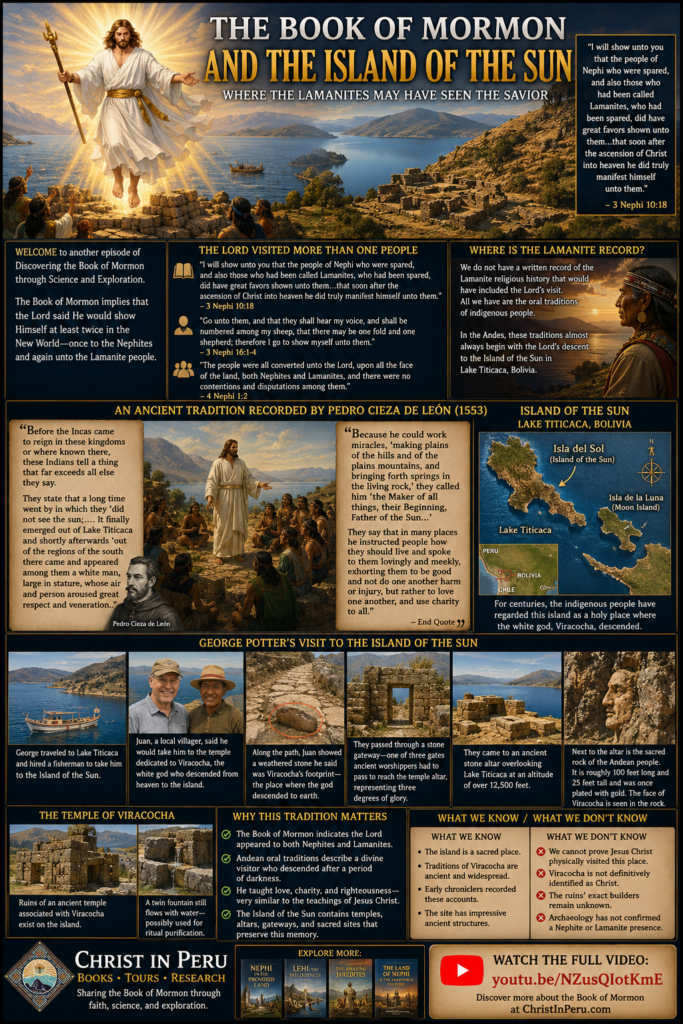
After the death and resurrection of Jesus Christ, the Book of Mormon records that the Savior appeared to the surviving Nephites at the temple in Bountiful.
But the text may also imply that Christ manifested Himself to other peoples in the Americas, including those who had been known as Lamanites.
George Potter proposes that one of those visits may be remembered in the ancient traditions of the Island of the Sun, located in Lake Titicaca in present-day Bolivia.
For centuries, Indigenous Andean communities have regarded this island as one of the holiest places in South America. Their traditions describe a divine figure who appeared after a period of darkness, descended among the people, performed miracles, taught them to love one another, and became known as the Maker of all things.
Could these traditions preserve a distant memory of Jesus Christ’s ministry among the Lamanites?
Did Christ Visit More Than One Group in the Americas?
The Book of Mormon describes Christ’s appearance to the Nephites in great detail.
However, it also contains language suggesting that other peoples would hear His voice.
Jesus told the Nephites:
“Go unto them, and that they shall hear my voice, and shall be numbered among my sheep, that there may be one fold and one shepherd; therefore I go to show myself unto them.”
—3 Nephi 16:1–4
Another passage states that both the people of Nephi and those who had been called Lamanites received great favors and that Christ manifested Himself to them after His ascension.
Potter interprets these verses as evidence that the Savior’s ministry in the New World may have involved more than a single appearance at Bountiful.
The Missing Lamanite Record
The Book of Mormon is primarily a Nephite religious history.
Its writers preserved the Nephite account of Christ’s appearance at the temple in Bountiful.
The Lamanites, however, remained a distinct people during much of this period. In some cases, the Book of Mormon even describes them as more righteous than the Nephites.
If Christ also ministered among them, where is their record?
Potter argues that their religious history may not have survived in written form.
Instead, possible memories of the event may have been preserved through Indigenous oral traditions.
Across the Andes, many stories describe a powerful divine visitor who appeared among ancient peoples and instructed them in righteous living.
A Period of Darkness
One of the most striking elements in Andean tradition is the description of a prolonged period without sunlight.
Early Spanish chronicler Pedro Cieza de León recorded a tradition from Indigenous informants concerning a time before the Inca Empire.
They reportedly said that the people endured a long period during which they did not see the sun.
The sun later emerged from Lake Titicaca, and shortly afterward a remarkable man appeared from the south.
The tradition described him as white, large in stature, and possessing an appearance that inspired respect and reverence.
For Book of Mormon readers, the sequence is immediately suggestive:
- Darkness covered the land.
- A divine figure appeared afterward.
- He taught the people.
- He demonstrated miraculous power.
This resembles the sequence described in 3 Nephi surrounding the death and appearance of Jesus Christ.
The Maker of All Things
According to the tradition recorded by Cieza de León, the divine visitor possessed extraordinary power.
He was said to have transformed hills into valleys, raised mountains from plains, and caused water to flow from stone.
The people called him:
- The Maker of all things
- Their Beginning
- Father of the Sun
He traveled among the people, teaching them how to live.
The chronicler’s account states that he spoke lovingly and meekly, encouraged them to be good, told them not to harm one another, and taught them to practice love and charity.
These teachings resemble central principles of the ministry of Jesus Christ.
The Island of the Sun
The Island of the Sun lies in the southern part of Lake Titicaca.
It stands at more than 12,500 feet above sea level and is surrounded by deep blue water and the snow-covered peaks of the Andes.
For Indigenous Andean communities, the island has long been associated with sacred beginnings.
In Inca tradition, it was linked with the appearance of the sun, the origin of rulers, and the earliest stages of civilization.
Potter proposes that the island may also have been the location where Christ appeared to a Lamanite population.
This remains a religious interpretation, but the island’s sacred reputation makes the comparison especially compelling.
Viracocha and the Divine Visitor
The divine figure in many Andean traditions is known as Viracocha.
Viracocha was remembered as a creator, teacher, and civilizing figure.
Some traditions describe him as a bearded or light-skinned man who came from elsewhere, taught the people, performed wonders, and then departed.
Potter identifies Viracocha with Jesus Christ.
Mainstream archaeology and history do not make this identification, but many Latter-day Saint researchers see meaningful parallels between the two traditions.
Potter’s Journey to the Island
Potter traveled to the Island of the Sun to investigate the local traditions personally.
He hired a fisherman to take him across the lake and asked to visit the temple associated with Manco Capac.
A local man named Juan agreed to guide him.
Without being prompted about the Book of Mormon, Juan explained that the temple had been dedicated to Viracocha, the white god who descended from heaven to the island.
For Potter, hearing this tradition directly from an Indigenous resident was especially meaningful.
It suggested that the story remained alive in the cultural memory of the island.
Viracocha’s Footprint
As Potter and his son walked toward the temple, Juan stopped and pointed to a weathered stone along the path.
He identified a depression in the stone as Viracocha’s footprint.
According to the local tradition, this marked the place where the god descended to earth.
Potter acknowledges his own skepticism about the physical mark.
A weathered depression cannot be authenticated as a literal divine footprint.
Its importance lies instead in what the tradition reveals: generations of local people believed that a heavenly figure descended at that place.
Three Sacred Gateways
The path to the temple passed through a stone gateway.
Juan explained that ancient worshippers had to pass through three gates before reaching the altar.
Potter interprets these gates as a possible reflection of three degrees of glory or stages of sacred progression.
That interpretation is theological rather than archaeological.
Still, the existence of a ritual approach involving multiple gateways suggests that the temple area was carefully organized and symbolically significant.
The Ancient Altar
At the sacred area, Potter encountered a simple altar made from uncut stones.
The altar stood in the open air overlooking Lake Titicaca and the surrounding mountains.
The dramatic setting included:
- The vast lake to the north
- Snow-covered Andean peaks to the east
- Ancient stone structures
- Sacred pathways
- A traditional place of worship
For Potter, this landscape brought the Book of Mormon account to life.
A high mountain island, an ancient altar, a tradition of divine descent, and a sacred gathering place created a powerful setting for considering a possible visit of Christ.
The Sacred Rock
Near the altar stands one of the most important sacred features of the island.
The rock face is approximately one hundred feet long and reaches around twenty-five feet in height.
According to traditions cited in the script, the rock was once covered or plated with gold.
The slope descending toward the lake was also said to have been covered with a massive cloth made from fine vicuña wool.
Potter saw in the rock a natural shape that local people interpreted as the face of Viracocha.
Juan pointed out what appeared to be:
- A crown
- Eyes
- A nose
- A mouth
- A beard
The image on page 3 of the script shows how these facial features are interpreted within the rock formation.
The Temple of Viracocha
A short distance from the sacred rock are ruins traditionally associated with the temple of Viracocha.
Potter identifies this structure with a temple that Nephi may have constructed when his people lived on an island before establishing the city of Nephi.
The ruins include several rooms and a twin fountain that still produces water.
Potter interprets the fountain as a possible place for ritual washing before entering sacred rooms.
The Book of Mormon does not identify the Island of the Sun by name, so this connection remains speculative.
Nevertheless, the combination of a temple, sacred water, gateways, altar, and divine traditions makes the location particularly interesting.
Manco Capac and Nephi
Potter also connects the Island of the Sun with Manco Capac, the legendary founder of the Inca civilization.
In Andean tradition, Manco Capac emerged from the Lake Titicaca region and became a founding ruler.
Potter proposes that Manco Capac and Nephi may have been the same historical figure.
He bases this theory on similarities involving:
- Leadership
- Migration
- Sacred authority
- Teaching
- Settlement
- Founding a new society
This identification is not accepted by mainstream historians, but it forms an important part of Potter’s proposed South American Book of Mormon geography.
An Island in the Sea
The Book of Mormon contains a statement in which Jacob describes his people as living upon an island of the sea.
Potter interprets this language as possibly referring to an island within Lake Titicaca.
Modern readers usually think of the sea as an ocean, but ancient or translated language can sometimes use the term more broadly for a large body of water.
Under Potter’s theory, Nephi’s people may have spent time on the Island of the Sun before moving into the Cusco Valley.
Ruins Beneath Lake Titicaca
The script also mentions reports of submerged ruins near the island.
Structures have reportedly been identified beneath the waters of Lake Titicaca.
Potter raises the possibility that these ruins could be connected with a city destroyed or submerged during the natural disasters associated with Christ’s crucifixion.
Underwater remains in Lake Titicaca are real, but their precise age, function, and relationship to Book of Mormon events remain uncertain.
No archaeological consensus identifies them as a Nephite or Lamanite city.
Christ’s Teachings and Andean Tradition
The divine visitor described in the Andean account did not merely perform miracles.
He taught the people how to live.
He encouraged them:
- To be good
- Not to injure one another
- To love one another
- To show charity
These teachings strongly resemble the message of Jesus Christ.
They also fit the social transformation described in 4 Nephi, when the people became united and ceased fighting among themselves.
The Book of Mormon states:
“The people were all converted unto the Lord, upon all the face of the land, both Nephites and Lamanites, and there were no contentions and disputations among them.”
—4 Nephi 1:2
Potter sees the spread of these teachings across the Andes as evidence that Christ may have ministered to multiple populations.
What the Evidence Establishes
The evidence supports several historical facts:
- The Island of the Sun was sacred before the Spanish conquest.
- Indigenous traditions connected it with divine origins.
- Early chroniclers recorded stories of darkness and a divine visitor.
- The visitor was described as a creator and teacher.
- He reportedly taught love, goodness, and charity.
- The island contains ancient religious ruins, gateways, altars, and sacred water features.
- Local oral traditions continue to associate the island with Viracocha’s descent.
These are meaningful cultural and historical observations.
What the Evidence Does Not Prove
The evidence does not establish that:
- Jesus Christ physically appeared on the Island of the Sun.
- Viracocha was definitively Christ.
- Manco Capac was Nephi.
- The temple ruins were built by Nephites.
- The footprint belonged to a divine visitor.
- The underwater ruins were destroyed at the time of Christ’s crucifixion.
Those conclusions belong to Potter’s faith-based interpretation.
They may be meaningful to believers, but they should not be presented as established archaeological facts.
Why the Island Matters
The Island of the Sun is important because it brings together several unusual elements:
- A tradition of darkness
- The appearance of a white or radiant divine figure
- Miraculous power
- Teachings of love and charity
- A descent from heaven
- A temple
- Sacred gateways
- An altar
- Ritual water
- A revered rock formation
- Stories preserved through generations
Few places in the Andes contain such a concentrated collection of traditions associated with a divine visitor.
For this reason, the island deserves attention from anyone exploring possible Book of Mormon settings in South America.
A Sacred Place of Reflection
Even without accepting every proposed identification, the Island of the Sun remains one of the most spiritually powerful landscapes in the Andes.
Its beauty, altitude, silence, ancient ruins, and Indigenous traditions create a profound sense of sacred history.
Standing there invites visitors to consider the possibility that the story of Christ’s ministry in the Americas may have extended beyond the Nephite account preserved in the Book of Mormon.
Watch the Full Video
To learn more about the Island of the Sun, Viracocha, Manco Capac, local oral traditions, sacred ruins, and the proposed visit of Jesus Christ to the Lamanites, watch the complete video:
The Book of Mormon and the Island of the Sun — Watch on YouTube
You can also visit ChristInPeru.com to explore our books, research, videos, and tours connected with Book of Mormon history.