
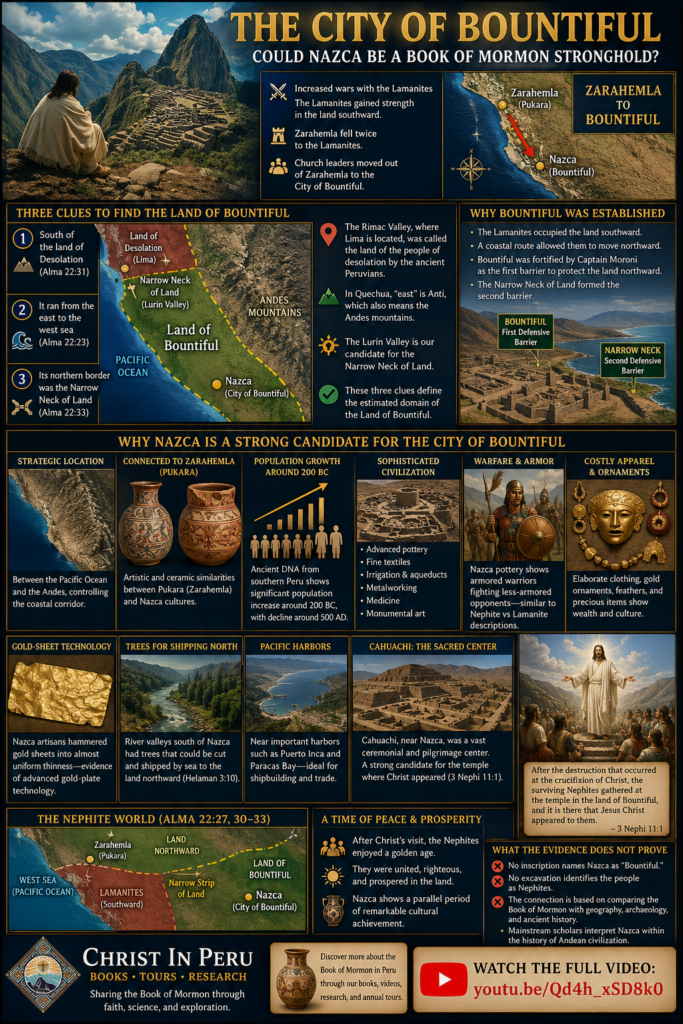
During the century before the birth of Jesus Christ, the Nephite world became increasingly dangerous.
Wars between the Nephites and Lamanites intensified. Zarahemla, once the center of Nephite government and religion, fell more than once. As the Lamanites gained strength in the land southward, the Nephites needed a safer defensive position.
The Book of Mormon identifies that strategic region as the land of Bountiful.
George Potter proposes that the ancient Nazca region of southern Peru may provide a compelling candidate for the Book of Mormon land and city of Bountiful.
His argument brings together geography, military strategy, archaeology, population history, metallurgy, clothing, maritime access, and the great ceremonial center of Cahuachi.
Three Geographical Clues to the Land of Bountiful
The Book of Mormon provides three important clues concerning Bountiful.
First, the land of Bountiful was located south of the land of Desolation.
Second, it extended from the east toward the west sea.
Third, its northern border was associated with the narrow neck of land.
Potter’s proposed Peruvian model identifies:
- The Lima and Rímac region with the land of Desolation
- The Lurín Valley with the narrow neck of land
- The Pacific Ocean with the west sea
- The Andes with the eastern boundary
- The territory south of Lima with the land of Bountiful
Under this interpretation, Bountiful would have stretched between the Pacific coast and the Andes, south of the proposed narrow neck.
The maps in the presentation place Nazca within this proposed territory and identify it as a candidate for the city of Bountiful.
Why Was Bountiful Established?
The city of Bountiful appears to have served an important military purpose.
The Nephites and Lamanites were separated by a narrow strip of land. The Lamanites occupied much of the land southward, while the Nephites controlled territories farther north.
A major coastal route would have allowed Lamanite armies to move northward.
The city of Bountiful therefore functioned as part of a defensive barrier designed to prevent the Lamanites from entering the land northward.
Captain Moroni fortified Bountiful and neighboring cities. Farther north, the narrow neck of land provided another strategic obstacle.
Together, the city and the narrow neck formed layers of defense along the Pacific corridor.
Nazca as a Strategic Location
Nazca lies on Peru’s southern coast between the Pacific Ocean and the Andes.
Its geography includes:
- Broad desert plains
- Fertile river valleys
- Nearby mountain ranges
- Coastal travel routes
- Access to Pacific harbors
- Natural barriers to movement
This setting fits the idea of a fortified region controlling passage between southern and northern lands.
Nazca was also one of the most important ancient centers south of the proposed Lurín narrow neck.
Potter argues that if the city of Bountiful was established as a military and religious center south of that boundary, Nazca is a strong candidate.
From Zarahemla to Bountiful
As pressure increased around Zarahemla, the Nephites had several possible responses.
They could move west into Bountiful, migrate farther north into former Jaredite territories, or leave by sea.
The Book of Mormon records significant Nephite movement into lands north of Bountiful.
It also describes Hagoth launching ships near Bountiful, Desolation, and the narrow neck of land.
Potter suggests that the Church’s administrative and religious center may also have shifted from Zarahemla to Bountiful during this dangerous period.
This would explain why Bountiful later became the location of the temple where the surviving Nephites gathered after the death of Christ.
Pukara and Nazca
Potter identifies Pukara, near Lake Titicaca, as a proposed candidate for Zarahemla.
Archaeological research has identified cultural connections between Pukara and early Nazca society.
The script notes similarities in artistic techniques and painted ceramics, suggesting that Nazca developed during a period of influence or interaction with Pukara.
Potter interprets this as evidence that the two regions may have been political or cultural allies.
Within his model, this relationship parallels the proposed connection between Zarahemla and Bountiful.
The archaeological evidence confirms contact and artistic influence. The identification of those sites with Book of Mormon cities remains interpretive.
Population Growth Around 200 BC
The script cites ancient DNA research involving more than 200 human samples from southern Peru.
According to the summary presented, the Nazca region experienced notable population growth beginning around 200 BC.
Potter connects this increase with Nephite expansion into Bountiful.
The research also identified a later population decline or genetic disruption around the fifth century AD.
The original researchers considered environmental and demographic explanations and stated that factors such as mass mortality could not be excluded.
This does not prove Nephite migration or destruction. Still, Potter considers the chronology interesting because it overlaps with the broad period in which the Book of Mormon describes growth and eventual collapse.
A Sophisticated Ancient Society
The Nazca civilization was highly accomplished.
Its people developed expertise in:
- Pottery
- Textile production
- Irrigation
- Metallurgy
- Medicine
- Architecture
- Music
- Religious ceremony
- Desert engineering
Nazca pottery is especially famous for its vivid colors and complex imagery.
Artisans could use many pigments on a single vessel and produce highly polished surfaces.
Nazca weavers also created exceptionally fine textiles, while engineers constructed underground aqueduct systems that brought water into extremely dry valleys.
Potter argues that this level of technological and artistic development resembles the prosperous society described in the Book of Mormon.
The Nazca Lines
The Nazca Lines remain among the most famous archaeological features in the world.
They include enormous figures of animals, plants, geometric forms, and straight lines created across the desert surface.
Their precise purposes remain debated.
Interpretations include:
- Ritual pathways
- Astronomical alignments
- Water-related ceremonies
- Pilgrimage routes
- Landscape markers
- Religious symbols
Potter compares the Nazca geoglyph tradition with similar large desert constructions found in parts of the Middle East.
He suggests that the practice may preserve a distant cultural connection, though archaeology does not establish that Nazca geoglyphs came directly from Israel or Arabia.
Armor and Warfare
The Book of Mormon describes Nephite soldiers wearing breastplates, shields, head protection, and thick clothing.
This has sometimes raised questions about the availability of metals and armor in ancient America.
The script notes the discovery of a pre-Columbian iron ore mine near Nazca dating back approximately two thousand years.
This confirms that ancient people in the region extracted iron-rich material, although the exact industrial uses of that ore remain debated.
Nazca pottery also depicts warfare.
Some scenes show fully clothed warriors confronting opponents wearing little more than loincloths.
Potter compares these images with Book of Mormon descriptions of armored Nephites fighting more lightly clothed Lamanites.
The resemblance is visually interesting, but pottery scenes cannot independently identify the individuals as Nephites or Lamanites.
Costly Apparel
The Book of Mormon frequently connects wealth and pride with costly apparel.
Nazca society produced elaborate clothing and personal ornaments.
Men wore:
- Tunics
- Mantles
- Turbans
- Headcloths
- Decorative bands
Women wore long mantles, tunics, pins, feathers, and gold ornaments.
Archaeological excavations have uncovered gold forehead pieces, mouth masks, earrings, pendants, bracelets, plaques, and other luxury items.
These finds confirm that Nazca society used clothing and adornment to communicate wealth, rank, identity, and religious meaning.
Gold-Sheet Technology
The Book of Mormon originated from a record written on metal plates.
Any proposed Nephite setting should therefore contain evidence that local artisans possessed the ability to produce thin metal sheets.
Nazca excavations have uncovered gold sheets hammered to nearly uniform thinness.
This demonstrates that people in the region possessed the technical knowledge needed to produce plate-like metal objects.
It does not prove that the Book of Mormon plates were created there, but it establishes the technological plausibility of metal-sheet production in ancient southern Peru.
Timber for the Land Northward
Helaman 3 describes timber being shipped from Bountiful into the land northward.
At first glance, the dry Nazca desert might seem unlikely to provide wood.
However, the river valleys south of Nazca contained trees and agricultural resources.
Timber could have been harvested in fertile valleys and transported toward nearby ports.
Potter argues that this wood could then have been loaded onto vessels and carried northward along the Pacific coast.
Access to Pacific Harbors
A maritime Bountiful would have required access to ports.
The broader region proposed by Potter included at least two significant Pacific harbors:
- Puerto Inca
- Paracas Bay
Puerto Inca lies relatively close to Nazca, while Paracas is one of the largest natural harbors on the Peruvian coast.
These ports would have supported travel, trade, shipbuilding, and the transportation of timber.
Their existence also fits the account of Hagoth launching ships near Bountiful and the narrow neck.
Bountiful and Hagoth
The Book of Mormon places Hagoth’s shipbuilding activities near:
- The land of Bountiful
- The land of Desolation
- The narrow neck of land
Potter’s map places Nazca south of the narrow neck and Paracas close to the proposed boundary with Desolation.
From this part of South America, a ship traveling toward Hawaii or eastern Polynesia would take a generally northward course.
This is consistent with the Book of Mormon statement that Hagoth’s travelers sailed northward.
The identification remains speculative, but the geography creates a coherent maritime model.
Cahuachi: The Sacred Center of Nazca
Near Nazca lies Cahuachi, one of the most important ceremonial centers of ancient Peru.
Cahuachi extended across approximately forty hills capped with adobe structures.
Archaeologists describe it as a pilgrimage center rather than a conventional city.
Hundreds of worshippers traveled there for:
- Religious ceremonies
- Animal sacrifices
- Music
- Dancing
- Feasting
- Prayer
- Seasonal gatherings
Potter identifies Cahuachi as a proposed candidate for the temple at Bountiful.
After the destruction surrounding Christ’s death, the Book of Mormon says the survivors gathered at the temple in Bountiful and witnessed Christ descend among them.
Cahuachi was active during that same general period and was large enough to accommodate substantial gatherings.
Christ’s Appearance and the Nazca Golden Age
The Book of Mormon describes an extraordinary period of peace and prosperity following the ministry of Christ.
The people became united, shared their goods, and experienced generations of righteousness.
Potter argues that Nazca culture reached a remarkable period of artistic, technological, and religious development during the Book of Mormon era.
Nazca accomplishments included:
- Masterful textiles
- Advanced pottery
- Metalworking
- Irrigation systems
- Medical procedures
- Massive pilgrimage gatherings
- Monumental geoglyphs
He interprets this flourishing as a possible reflection of the Nephite golden age.
Archaeology confirms the sophistication of Nazca civilization, but it does not attribute that development to Christ’s ministry.
Was Nazca the City of Bountiful?
The proposed identification rests on a broad pattern.
Nazca was:
- South of the proposed land of Desolation
- South of the proposed narrow neck
- Located between the Pacific and the Andes
- Positioned on a strategic coastal corridor
- A major ancient center
- Connected culturally with Pukara
- Active during the relevant period
- Associated with warfare and fortification
- Skilled in metallurgy and gold-sheet production
- Rich in textiles and costly apparel
- Near important Pacific harbors
- Home to the great ceremonial center of Cahuachi
These characteristics make Nazca an intriguing candidate within Potter’s model.
What the Evidence Does Not Prove
No archaeological inscription identifies Nazca as “Bountiful.”
No accepted excavation has identified its residents as Nephites.
The proposed connection is based on a comparison between the Book of Mormon text and the archaeology and geography of southern Peru.
Mainstream scholars interpret Nazca within the history of Andean civilization rather than Book of Mormon geography.
Recognizing those limits allows the argument to be explored without presenting speculation as established fact.
Why Nazca Deserves Attention
Even apart from the Book of Mormon question, Nazca is one of the most extraordinary civilizations of the ancient Americas.
Its people transformed a harsh desert environment through engineering, agriculture, ritual, and artistic creativity.
They developed a society capable of monumental gatherings, long-distance exchange, metalwork, complex textiles, and religious expression.
For readers interested in a possible South American setting for the Book of Mormon, Nazca offers a rare combination of geography, chronology, technology, and ceremonial importance.
Watch the Full Video
To learn more about the land and city of Bountiful, the Nazca civilization, Cahuachi, Hagoth’s voyages, ancient metallurgy, and Potter’s proposed Peruvian geography, watch the complete video:
Book of Mormon Bountiful — Watch on YouTube
You can also visit ChristInPeru.com to explore our books, research, videos, and annual tours to Peru.