
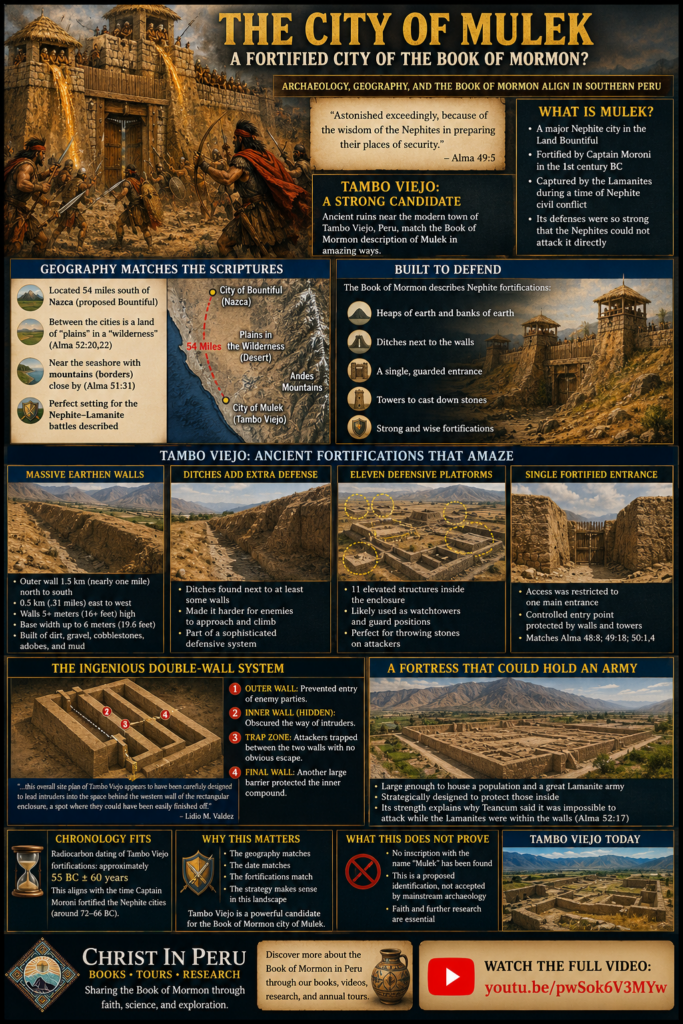
The Book of Mormon describes the city of Mulek as one of the strongest fortified locations in the Nephite world.
Its defenses were so impressive that when the Lamanites captured the city, Nephite commanders concluded that attacking it directly would be nearly impossible.
George Potter proposes that the archaeological site of Tambo Viejo, located on the southern coast of Peru, may provide a compelling candidate for this fortified city.
The proposed identification is based on geography, chronology, defensive construction, walls of earth, ditches, towers, a restricted entrance, and an ingenious system designed to trap enemy soldiers.
Mulek and the Nephite Defensive System
During the first century BC, the Nephites faced repeated attacks from Lamanite armies.
Captain Moroni responded by transforming the defensive organization of Nephite cities.
The Book of Mormon describes fortifications that included:
- Banks and heaps of earth
- Walls of stone
- Ditches
- Defensive towers
- Guarded gates
- Restricted entrances
- Elevated positions for throwing stones
- Carefully planned areas of security
These defenses were so effective that the Lamanite commanders were:
“Astonished exceedingly, because of the wisdom of the Nephites in preparing their places of security.”
—Alma 49:5
The city of Mulek became especially important because its fortifications later protected the very Lamanite army that had captured it.
A Neighboring City to Bountiful
The Book of Mormon places Mulek near the city of Bountiful.
Potter proposes Nazca, Peru, as a possible candidate for Bountiful and Tambo Viejo as a neighboring candidate for Mulek.
The ruins of Tambo Viejo are located approximately 54 miles south of Nazca.
The region contains several geographical features that Potter compares with the Book of Mormon account:
- A broad coastal plain
- Desert wilderness
- Fertile valleys
- Nearby mountains
- Proximity to the Pacific seashore
- A north–south travel corridor
The script notes that the terrain between Bountiful and Mulek is described as plains within a wilderness.
Hugh Nibley argued that the Book of Mormon often uses the word wilderness in the biblical sense of an arid or desert region.
That description fits the coastal desert of southern Peru remarkably well.
Mountains, Plains, and the Seashore
Before the battle for Mulek, Nephite and Lamanite armies camped near borders associated with the seashore.
Potter interprets “borders” as mountainous terrain.
Tambo Viejo rests within a fertile valley between the dry Pacific coastal plain and the Andes.
This geography creates a setting in which an army could move along the coast while other forces occupied mountain or valley positions nearby.
The map included on page 2 of the script shows the proposed relationship between Nazca, the desert plains, the Andes, and Tambo Viejo.
How the Lamanites Captured Mulek
The city was not captured because its walls were weak.
It fell during a period of Nephite civil conflict.
While Moroni was occupied fighting the king-men in the land of Zarahemla, the Lamanite army attacked the eastern Nephite territories.
The Lamanites captured Mulek and several neighboring fortified cities.
Once inside, they gained the protection of fortifications originally designed by Captain Moroni.
This created a serious military dilemma.
The Nephites needed to recover the city, but its defensive system made a direct assault extremely dangerous.
Fortifications Built Quickly
The Book of Mormon chronology suggests that the defenses of Mulek may have been constructed within a relatively short period.
This helps explain why Moroni’s forces relied heavily on readily available materials.
The record describes:
- Earth cast up around cities
- Banks of soil
- Dug ridges
- Walls
- Ditches
- Timber defenses
- Towers
These were not necessarily monumental cut-stone fortresses.
They were military earthworks designed for rapid construction and maximum defensive value.
This description is important because the walls at Tambo Viejo were also built primarily from earth, gravel, cobblestones, adobe, and mud.
The Date of Tambo Viejo
One of the most interesting elements of the comparison is chronology.
According to the script, archaeological research dates the fortifications of Tambo Viejo to approximately 55 BC, plus or minus 60 years.
The Book of Mormon places Moroni’s fortification program during approximately the same general period.
The wide radiocarbon range does not establish an exact match, but it places the site within the relevant broad era.
Potter considers this chronological overlap one of the strongest arguments for examining Tambo Viejo as a possible candidate.
Massive Earthen Walls
Archaeologists found that Tambo Viejo was surrounded by substantial defensive walls.
The outer enclosure extended approximately:
- 1.5 kilometers from north to south
- 0.5 kilometers from east to west
The walls reportedly stood around five meters—or more than sixteen feet—high in some sections.
Their bases could reach approximately six meters, or nearly twenty feet, in width.
A compound of this size could have contained a significant settlement and a large occupying army.
The defensive scale is consistent with a site intended to protect more than a small village.
Ditches Beside the Walls
At least some fortified sites in the Acarí Valley contained ditches beside their walls.
These ditches may initially have formed when workers removed soil to construct the earthworks.
Whether intentional or incidental, they made the walls more difficult to approach and climb.
This closely resembles Book of Mormon descriptions of defensive earthworks accompanied by trenches or excavated areas.
An attacker would first need to cross the ditch and then climb the steep earthen barrier while exposed to defenders above.
Eleven Defensive Platforms
The script states that Tambo Viejo contained eleven elevated artificial platforms.
These may have functioned as:
- Watchtowers
- Guard positions
- Observation platforms
- Places for counterattack
- Elevated positions for launching projectiles
The Book of Mormon likewise describes towers from which Nephite soldiers could defend cities and throw stones against attacking armies.
The exact function of every platform at Tambo Viejo remains an archaeological question, but their placement within a fortified enclosure strengthens the defensive interpretation.
A Single Fortified Entrance
One of the most distinctive features of Moroni’s defensive designs was a limited place of entrance.
Rather than allowing attackers to approach through multiple gates, a fortified city could funnel them toward one carefully controlled access point.
The Book of Mormon repeatedly emphasizes a singular or restricted entrance protected by defenders.
Potter argues that Tambo Viejo displays the same general principle.
Its walls directed entry through a carefully guarded access area associated with towers and additional interior barriers.
The Ingenious Double-Wall System
Archaeologist Lidio M. Valdez described two parallel defensive walls on the western side of Tambo Viejo.
The outer wall was intended to prevent entry.
The inner wall was likely hidden from attackers approaching from outside.
An enemy who successfully crossed the outer barrier would suddenly encounter another wall.
The attackers could then become trapped in the narrow area between the two defenses.
Valdez explained that the system may have been designed to confuse intruders, slow their escape, and expose them to defenders.
A Carefully Designed Death Trap
The defensive system became even more dangerous farther inside.
After overcoming the first two walls, attackers still faced another substantial barrier before reaching the protected central compound.
According to Valdez, the site plan appears to have guided intruders into an enclosed space behind the western wall.
There, trapped soldiers could have been attacked from elevated defensive positions and “easily finished off.”
This helps explain why the Nephites considered it impossible to retake Mulek while the Lamanite army remained inside.
The city was not protected by a single wall. It contained multiple defensive layers designed to turn a breakthrough into a trap.
Why Teancum Refused to Attack
When the Nephite commander Teancum examined the occupied city, he concluded that he could not overpower the Lamanites within the fortifications.
He abandoned the immediate assault and returned to Bountiful.
This was not a sign of weakness.
It was an intelligent recognition of the city’s defensive strength.
Potter argues that if Tambo Viejo was Mulek, Teancum would have understood that his soldiers could be trapped between its parallel walls, exposed from towers, and destroyed within the inner defensive zones.
The archaeology makes his caution militarily understandable.
A Fortress Capable of Holding a Great Army
The Book of Mormon describes the Lamanite force at Mulek as exceptionally large.
The city therefore needed enough space to accommodate:
- Soldiers
- Commanders
- Weapons
- Food supplies
- Defensive positions
- Captives
- Support personnel
Tambo Viejo’s large enclosure could have housed a substantial population and military force.
Its size distinguishes it from smaller ceremonial or agricultural compounds that could not reasonably contain an entire army.
Comparison With Other American Sites
Potter argues that Tambo Viejo is unusual because of its combination of date, scale, and defensive design.
Many well-known fortified cities in Mesoamerica date centuries after the Book of Mormon period.
Important North American sites such as Cahokia also reached their greatest development much later.
Hopewell earthworks overlap part of the Book of Mormon chronology, but Potter argues that many were too small or served ceremonial purposes rather than functioning as fortified cities capable of housing large armies.
This does not make ancient North American or Mesoamerican sites unimportant.
It simply means they may not fit the specific description of Mulek as closely as Tambo Viejo appears to.
What Makes Tambo Viejo an Interesting Candidate?
The proposed comparison rests on several points:
Geography
Tambo Viejo lies south of Nazca in a coastal desert valley near the Andes and the Pacific.
Distance
It is approximately 54 miles from Potter’s proposed location for Bountiful.
Chronology
Its fortifications date broadly to the same era as Moroni’s defensive program.
Construction Materials
The walls were built from earth, gravel, cobblestones, adobe, and mud.
Scale
The fortified enclosure was large enough to contain a city and military force.
Ditches
Excavated areas beside the walls strengthened the defenses.
Towers
Elevated platforms may have served as guard or defensive positions.
Restricted Entry
The city’s access was carefully controlled.
Multiple Walls
Attackers faced outer, parallel, and inner defensive barriers.
Trapping Zones
The layout appears designed to confuse, contain, and destroy intruders.
Together, these details create a notable parallel with the Book of Mormon description.
What the Evidence Does Not Prove
Archaeologists do not identify Tambo Viejo as the Book of Mormon city of Mulek.
No inscription discovered at the site contains the name Mulek, Moroni, Teancum, or any other Book of Mormon figure.
The proposed identification is based on comparative geography, chronology, and architecture.
It remains an interpretive model.
Even so, the fortifications demonstrate that ancient Peru contained sophisticated defensive engineering during the relevant general period.
That alone makes Tambo Viejo highly relevant to discussions of Book of Mormon military culture.
A Remarkable Example of Ancient Engineering
The defenders of Tambo Viejo did not rely merely on tall walls.
They created a system.
Attackers had to cross difficult terrain, approach a massive earthen enclosure, pass a restricted entrance, overcome an unexpected inner wall, navigate divided spaces, and face another final barrier.
The design controlled movement and transformed the interior of the fortress into a weapon.
This kind of planning helps readers better understand why the Lamanite commanders were astonished by the wisdom of Nephite defensive preparations.
Tambo Viejo and the Larger Mulek Story
The significance of Tambo Viejo becomes even greater when considered alongside the Book of Mormon battle for Mulek.
The record describes:
- A strongly fortified coastal city
- A neighboring city called Bountiful
- Plains and wilderness between them
- Nearby mountains and seashore
- An enemy army protected inside the defenses
- A direct assault judged impossible
- A military strategy designed to draw the army outside
Potter argues that the geography surrounding Nazca and Tambo Viejo provides a landscape in which these events could have occurred coherently.
An Invitation to Explore
Tambo Viejo deserves attention not because its identification as Mulek has been proven, but because it provides a concrete archaeological example of the kind of fortress described in the Book of Mormon.
Its walls, towers, ditches, restricted entrance, and hidden defensive barriers transform the account from an abstract story into a militarily plausible scenario.
For those studying possible South American settings for the Book of Mormon, the site offers one of the most intriguing architectural comparisons in ancient Peru.
Watch the Full Video
To learn more about the city of Mulek, the fortifications of Captain Moroni, the archaeological discoveries at Tambo Viejo, and the proposed geography near Nazca and the Pacific coast, watch the complete video:
Book of Mormon City of Mulek — Watch on YouTube
You can also visit ChristInPeru.com to explore our books, research, videos, and annual tours to Peru.