
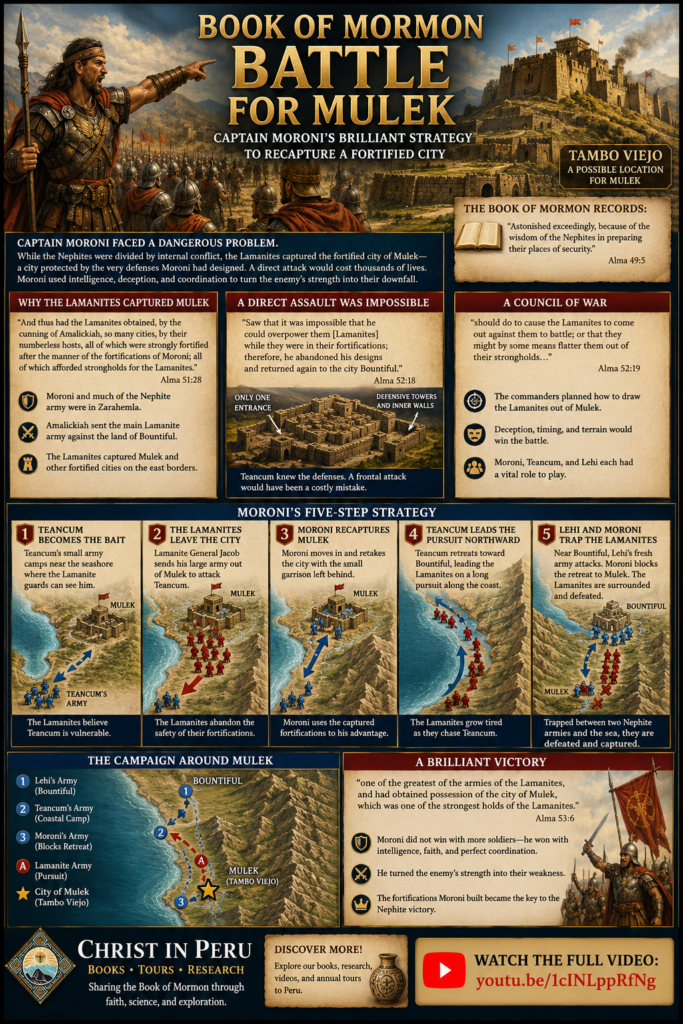
Captain Moroni faced a dangerous problem.
The city of Mulek had been protected by sophisticated fortifications built under his own direction. But while the Nephite nation was weakened by internal conflict, the Lamanites captured the city and turned those defenses against the people who had constructed them.
A direct attack could have cost Moroni thousands of soldiers.
Instead, he developed an elaborate strategy to draw the Lamanite army out of Mulek, separate it from the city, exhaust its troops, and surround it with multiple Nephite forces.
George Potter proposes that the ancient Peruvian site of Tambo Viejo may provide a possible setting for the fortified city of Mulek and that the surrounding geography closely matches the military campaign described in Alma 52.
A City Protected by Moroni’s Fortifications
Captain Moroni was one of the Book of Mormon’s greatest military commanders.
Rather than relying only on the courage of his soldiers, he transformed Nephite warfare through defensive engineering.
His forces constructed:
- Walls and earthen barriers
- Defensive towers
- Protected entrances
- Fortified cities
- Controlled access points
- Areas designed to expose attacking soldiers
The Book of Mormon states that the Lamanites were:
“Astonished exceedingly, because of the wisdom of the Nephites in preparing their places of security.”
—Alma 49:5
These were not simple walls. They were carefully planned defensive systems intended to make a smaller defending force difficult to defeat.
How Did the Lamanites Capture Mulek?
The fortifications themselves did not fail.
The city was captured because the Nephites were divided.
While Moroni and much of the Nephite army were occupied by political rebellion and conflict in the land of Zarahemla, Amalickiah sent the main Lamanite army against the eastern Nephite territories.
The Lamanites captured several fortified cities, including Mulek.
The record explains:
“And thus had the Lamanites obtained, by the cunning of Amalickiah, so many cities, by their numberless hosts, all of which were strongly fortified after the manner of the fortifications of Moroni; all of which afforded strongholds for the Lamanites.”
—Alma 51:28
Moroni’s own defensive designs now protected his enemies.
Why a Direct Assault Was Impossible
The Nephite commander Teancum understood the city’s defenses.
His troops may even have participated in building them.
When Teancum examined the situation, he realized that attacking the city directly would be disastrous.
The Book of Mormon says that he:
“Saw that it was impossible that he could overpower them while they were in their fortifications; therefore, he abandoned his designs and returned again to the city Bountiful.”
—Alma 52:18
This decision reveals discipline.
Teancum was a courageous warrior, but he did not confuse bravery with recklessness. He recognized that even excellent soldiers could be destroyed by a well-designed defensive position.
Tambo Viejo as a Candidate for Mulek
Potter proposes the archaeological site of Tambo Viejo, near Peru’s southern coast, as a possible candidate for Mulek.
The site reportedly possessed several defensive characteristics that resemble Moroni’s fortifications.
These included:
- A limited or singular main entrance
- Defensive walls
- Guard towers
- Inner barriers
- Narrow areas that could trap attackers
- Elevated positions from which defenders could attack intruders
According to the script, even if an enemy force successfully passed through the outer entrance, it could become trapped between inner walls and defensive towers.
For a commander familiar with the design, the danger would have been obvious.
This could explain why Teancum refused to launch a frontal assault and waited for Moroni’s reinforcements instead.
The Council of War
When Moroni arrived, he did not immediately order an attack.
He gathered Teancum and the chief captains into a council of war.
They discussed how they might:
“Cause the Lamanites to come out against them to battle; or that they might by some means flatter them out of their strongholds.”
—Alma 52:19
The key to victory was not breaking through Mulek’s defenses.
It was convincing the Lamanites to abandon them.
This required deception, coordination, timing, and a detailed understanding of the surrounding terrain.
The Geography Around Mulek
The Book of Mormon provides several geographical details about the battle.
Mulek was close enough to the sea that Lamanite guards could observe Teancum’s army camped near the seashore.
Moroni’s force moved secretly past the city during the night, apparently on its western side.
The city of Bountiful was located farther north.
These details suggest a narrow coastal corridor with:
- The sea on one side
- Mountains or rugged terrain on the other
- Mulek positioned south of Bountiful
- A route along the shore connecting the two cities
The battle map included on page 3 of the script illustrates this proposed arrangement. Teancum is positioned near the coast, Moroni waits south of Mulek, and Lehi’s fresh army remains near Bountiful to the north.
Step One: Teancum Becomes the Bait
The plan began with Teancum placing a smaller force near the seashore.
His army was positioned close enough to be seen by the Lamanite guards.
To the Lamanites, Teancum appeared vulnerable.
When their commander, Jacob, learned that a relatively small Nephite force was nearby, he sent his armies out of Mulek to attack it.
The bait worked.
The Lamanites left behind the safety of the fortifications and pursued Teancum’s troops northward along the coast.
Step Two: Moroni Retakes the City
Once the main Lamanite force departed, only a limited number of soldiers remained behind to defend Mulek.
Moroni then moved against the city.
Because he knew the fortifications and because most of the defenders had left, he could regain control without launching the kind of costly frontal assault that Teancum had rejected.
The plan turned the strength of Mulek’s defenses into a weakness.
The fortifications could protect the Lamanites only while they remained inside them.
Once they left, Moroni could seize the city and use those same defensive works to prevent their return.
Step Three: Teancum Leads the Pursuit Northward
Teancum did not attempt to defeat the pursuing army immediately.
Instead, he withdrew northward toward Bountiful.
This forced the Lamanites to march a significant distance.
As the pursuit continued, their troops became increasingly tired.
The Lamanites believed they were chasing a smaller army toward an easy victory. In reality, Teancum was leading them directly toward another prepared Nephite force.
Step Four: Lehi’s Fresh Army Attacks
Near Bountiful, the Lamanites encountered the army commanded by Lehi.
Unlike the pursuing soldiers, Lehi’s troops were rested and prepared.
The exhausted Lamanites suddenly found themselves facing fresh Nephite forces to the north.
They attempted to retreat south toward Mulek, believing that the fortified city still offered safety.
But Moroni had already captured it.
Step Five: Moroni Blocks the Retreat
Moroni positioned his remaining soldiers between the Lamanite army and Mulek.
The Lamanites were trapped.
The Pacific Ocean limited their movement to the west, while mountains and difficult terrain restricted escape to the east.
Lehi and Teancum pressed them from the north.
Moroni blocked their return to the south.
What had begun as a Lamanite pursuit became a coordinated Nephite encirclement.
The map on page 3 depicts this north–south corridor and shows how the three Nephite forces could have worked together to close the trap.
The Final Battle
The trapped Lamanites fought fiercely.
Their commander Jacob was killed, and Captain Moroni was wounded.
Nevertheless, the Nephite strategy succeeded.
The Lamanite army was defeated and taken captive, while the city of Mulek returned to Nephite control.
The Book of Mormon later describes the victory by stating that Moroni had defeated:
“One of the greatest of the armies of the Lamanites, and had obtained possession of the city of Mulek, which was one of the strongest holds of the Lamanites.”
—Alma 53:6
Moroni achieved this victory with a force smaller than the army occupying Mulek because he used intelligence and geography rather than brute strength.
Why the Strategy Was So Effective
Moroni’s plan depended on several coordinated elements:
Knowledge of the Fortifications
The Nephite commanders understood exactly how Mulek’s defenses worked.
They knew a direct assault would fail, but they also knew the city would become vulnerable if most of its soldiers left.
Deception
Teancum’s small force appeared to be an easy target.
The Lamanites did not realize they were being drawn away from their defensive position.
Geography
The coastal corridor limited the Lamanites’ ability to escape once Moroni blocked the southern route.
Timing
Moroni, Teancum, and Lehi had to coordinate their movements carefully.
If one army moved too early or too late, the Lamanites might discover the trap or escape.
Fatigue
Teancum forced the Lamanites to pursue him far enough that they arrived near Bountiful exhausted.
They then faced Lehi’s fresh army before turning back toward Moroni.
Division of Forces
Moroni did not use every soldier for the same purpose.
Each unit had a specific responsibility:
- Teancum drew the enemy away.
- Moroni recaptured Mulek and blocked the retreat.
- Lehi confronted the exhausted army from the north.
This was a carefully planned combined operation.
A Lesson in Leadership
The battle for Mulek reveals why Captain Moroni is remembered as an exceptional leader.
He did not rely only on personal courage.
He:
- Consulted with other commanders
- Used defensive intelligence
- Studied the landscape
- Assigned clear responsibilities
- Avoided unnecessary casualties
- Anticipated the enemy’s response
- Adapted when direct attack was impossible
His victory resulted from preparation and cooperation.
The account also highlights Teancum’s judgment and Lehi’s reliability. Moroni’s strategy worked because each commander performed his assignment with precision.
Does Tambo Viejo Prove the Location of Mulek?
Tambo Viejo contains features that make the comparison interesting.
The site lies near Peru’s southern coast and contains architecture interpreted as defensive or administrative.
The surrounding region includes a narrow zone between the Pacific coast and the Andes, potentially matching the corridor described in the Book of Mormon.
However, mainstream archaeology does not identify Tambo Viejo as the Book of Mormon city of Mulek.
The proposed identification is based on Potter’s interpretation of:
- Location
- Fortifications
- Entrances
- Towers
- Proximity to the sea
- Relationship with a proposed Bountiful
- The terrain needed for Moroni’s military strategy
These parallels deserve investigation, but they do not establish the identification as archaeological fact.
A Battle That Fits the Landscape
Even without proving the precise location, the Mulek account contains impressive military detail.
The text describes:
- A heavily fortified city
- A commander refusing a suicidal assault
- A council of war
- An army used as bait
- A nighttime troop movement
- A coastal pursuit
- A fresh army waiting near another city
- The recapture of an enemy stronghold
- The blocking of a retreat
- A final battle in a restricted corridor
These details form a coherent military operation.
Potter argues that the coastal geography near Tambo Viejo and Nazca offers a physical landscape in which the operation could have unfolded much as the Book of Mormon describes.
Watch the Full Video
To learn more about Captain Moroni’s strategy, the fortifications of Mulek, the archaeological site of Tambo Viejo, and the proposed battle route along Peru’s southern coast, watch the complete video:
Book of Mormon Battle for Mulek — Watch on YouTube
You can also visit ChristInPeru.com to explore our books, research, videos, and annual tours to Peru.