
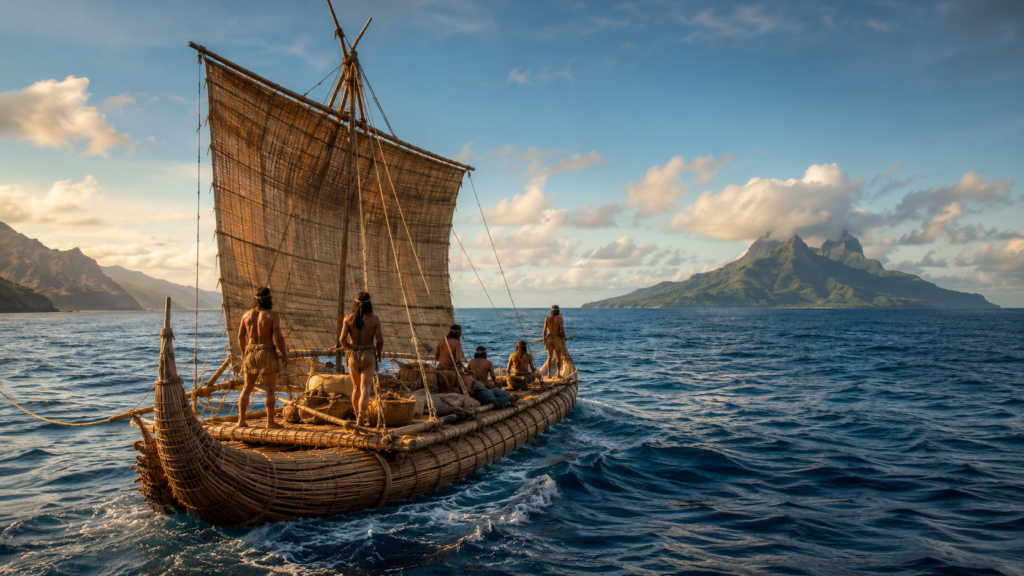
Could people from the Book of Mormon have reached Hawaii and other Polynesian islands?
For many readers of the Book of Mormon, that question is both fascinating and meaningful. According to George Potter’s research, there is a compelling combination of prophetic statements, historical clues, maritime evidence, and scientific findings that suggest a possible connection between ancient peoples in the Americas and Polynesia.
Early Church Teachings About Hagoth and Polynesia
In 1851, while serving a mission in Hawaii, Elder George Q. Cannon taught that the Polynesian people included descendants of Book of Mormon peoples.
Later, as a counselor in the First Presidency, George Q. Cannon continued to be associated with that idea. In addition, Brigham Young wrote to the Hawaiian king that among the ancestors of the Polynesians were the people of Hagoth.
President Joseph F. Smith also spoke clearly to Hawaiian Church members, telling them that they were some of Hagoth’s people, and that there was “no perhaps” about it.
President Heber J. Grant reinforced this belief in the dedicatory prayer of the Hawaii Temple, referring to descendants of Lehi in Hawaii.
These statements have been deeply meaningful to many Latter-day Saints in Polynesia and have encouraged continued interest in the relationship between Book of Mormon peoples and the islands of the Pacific.
Who Was Hagoth?
Hagoth is mentioned in the Book of Mormon as a builder of ships who launched voyages from the west coast of the Americas. His story appears in Alma 63, where we read that he built an “exceedingly large ship” and that many people departed into the land northward by sea.
Because some of those voyagers were never heard from again, many have wondered where they went.
One long-standing idea is that Hagoth and later voyagers may have traveled into the Pacific and eventually reached Polynesia, including Hawaii and perhaps other islands.
As George Potter explains, Hagoth may have opened ancient trade routes between South America and Polynesia. He further suggests that such routes may have continued for generations, possibly even into Inca times.
The Maritime Skills of Ancient Andean Peoples
One reason this theory continues to attract interest is the extraordinary maritime ability of ancient peoples along the Pacific coast of South America.
Research cited by Potter points to the high level of pre-Columbian seafaring skill in the Andes. One especially interesting example involves the Inca ruler Tupa Inca Yupanqui.
According to historical accounts, Tupa Inca Yupanqui traveled overland to the mouth of the Guayas River in present-day Ecuador, then embarked by raft or barge and sailed into the Pacific Ocean for more than a year. Some accounts say he returned claiming to have visited distant islands called Hahua Chumpi and Niña Chumpi.
Some researchers have noted the intriguing similarity between “Hahua” or “Hawa” and “Hawaii,” especially when combined with descriptions that may suggest volcanic islands or a “ring of fire.” While such parallels are not conclusive proof, they are certainly interesting and add to the broader discussion.
Whatever the exact destination, the account suggests that the Inca possessed enough maritime knowledge and confidence to send their king deep into the Pacific Ocean for an extended journey. That fact alone speaks volumes about their nautical capability.
Modern Experiments That Support Ancient Possibilities
The idea that ancient South Americans could have crossed the Pacific is not based on theory alone. Several modern expeditions have demonstrated that such voyages were technically possible using pre-Columbian-style vessels.
In 1947, Norwegian explorer Thor Heyerdahl sailed the Kon-Tiki, a balsa raft, from Peru to the Tuamotu Islands in Polynesia. His famous voyage proved that a simple raft built with ancient-style technology could survive and travel across the Pacific.
In 1997, Gene Savoy built a replica of an Inca balsa vessel and sailed it to Hawaii with a crew of seven, demonstrating that ancient Andean maritime technology was capable of making such a journey.
Then, in 1999, American explorer Phil Buck sailed a pre-Columbian-style reed ship called the Viracocha from Chile to Easter Island, further reinforcing the idea that long-distance Pacific navigation by South Americans was within the realm of possibility.
These experiments do not prove that Hagoth specifically sailed to Hawaii. However, they do show that such a voyage was technologically possible.
Is There Scientific Evidence?
In addition to historical traditions and maritime demonstrations, Potter points to scientific evidence that may support ancient contact between South America and Polynesia.
One of the strongest areas of interest is DNA research. Studies have found genetic links between some indigenous South American populations and Polynesian groups. While scholars continue to debate the direction and timing of these movements, the presence of shared ancestry strongly suggests contact between the two regions before European colonization.
Another commonly discussed piece of evidence is the sweet potato. The sweet potato is a South American plant, yet it was widely known and cultivated across Polynesia long before European contact. Even more interesting, the name for sweet potato in parts of Polynesia—kumara—closely resembles the Quechua term kumar.
Some researchers see this linguistic and agricultural connection as evidence that people or goods traveled from South America into Polynesia.
Potter’s script also mentions other plants, such as pineapple and paw paw, as well as the pre-Columbian presence of the Polynesian chicken in South America, all of which have been discussed as possible indicators of ancient transoceanic contact.
Taken together, these clues suggest that the Pacific may have been more interconnected in ancient times than many once believed.
Why South America Makes More Sense Than Mesoamerica or North America
Potter also argues that if Hagoth sailed into Polynesia, South America provides a more likely point of origin than either Mesoamerica or North America.
According to this view, the Maya developed mainly short-distance coastal trade routes, especially along the Gulf of Mexico between Veracruz and Honduras. Their vessels were largely dugout canoes, useful for coastal, lake, and river travel, but of limited utility for long oceanic voyages into the Pacific.
Likewise, in North America, while many indigenous peoples developed excellent canoes and kayaks, there is little evidence of a broad oceangoing maritime tradition comparable to what is seen in the Andean world.
By contrast, ancient South Americans demonstrated repeated use of balsa rafts and sophisticated maritime technology suited to longer Pacific journeys. If Hagoth or his descendants reached Polynesia, Potter suggests that South America is the strongest candidate for the origin of those voyages.
A Thought-Provoking Possibility
The relationship between Hagoth, Polynesia, and the peoples of South America remains a subject of interest, faith, and ongoing exploration.
For believers, statements from early Church leaders provide important spiritual context. For researchers, ancient traditions, seafaring history, experimental voyages, botanical evidence, animal dispersal, and DNA studies offer fascinating data to consider.
None of these elements alone settles every question. But together, they create a thought-provoking picture—one in which ancient voyages across the Pacific were not only possible, but perhaps part of a much larger story than we once imagined.
If Hagoth and his people did sail into Polynesia, their story may help explain not only an intriguing chapter in Book of Mormon interpretation, but also a remarkable connection between the ancient Americas and the islands of the Pacific.
Watch the Full Video
If you would like to learn more, watch the full video here:
YouTube: https://www.youtube.com/watch?v=hkQcJbBqjmo
You can also visit ChristInPeru.com to learn more about our books, research, and annual tours to Peru.