
One of the most significant, and often overlooked, aspects of modern research on the Book of Mormon is the explicit academic endorsement given by Hugh W. Nibley to the work of George Potter, particularly regarding the Arabian route of Lehi as presented in the book Lehi in the Wilderness.
Hugh Nibley (1910–2005) was among the most influential scholars of the twentieth century in the study of the ancient world within the context of the Book of Mormon. A professor of classical studies and ancient languages, Nibley was fluent in Greek, Latin, Hebrew, Arabic, Egyptian, and Akkadian, and was widely respected for his mastery of primary sources, intellectual rigor, and willingness to confront critical scholarship directly. Unlike many religious defenders, Nibley did not avoid academic criticism; rather, he deliberately engaged it, even when doing so meant addressing the most vulnerable aspects of sacred texts.
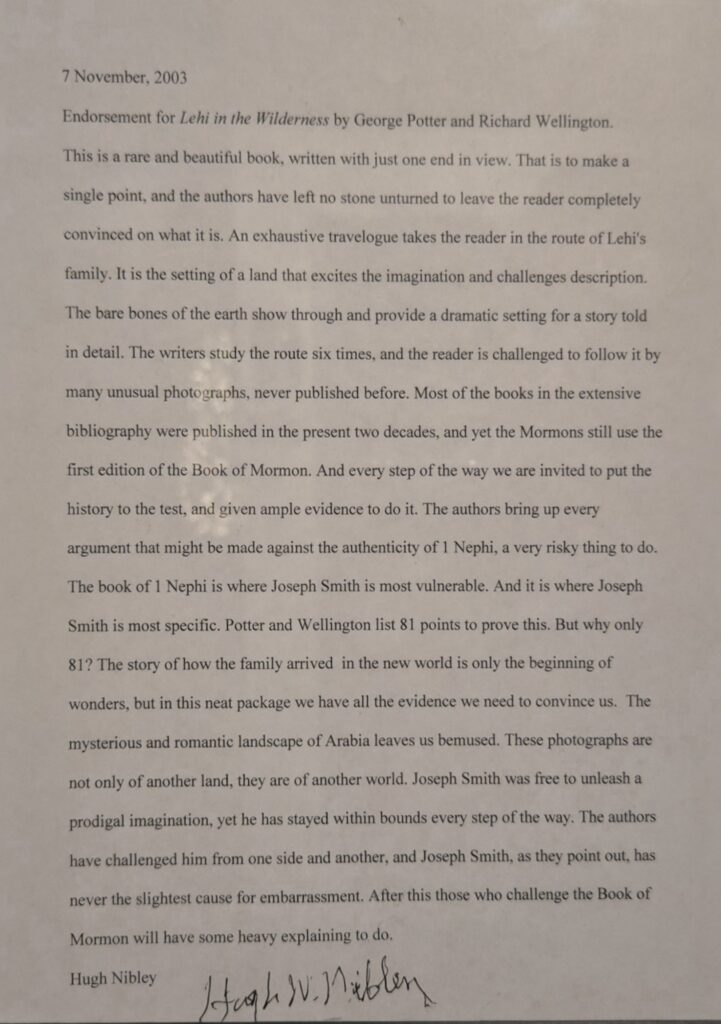
Within this context, the fact that Hugh Nibley issued a formal, written endorsement, dated November 7, 2003, in support of Lehi in the Wilderness by George Potter and Richard Wellington, is of particular importance. This document is not a passing comment or a casual reference, but a detailed evaluation of the authors’ methodology, evidence, and conclusions.
In his endorsement, Nibley characterizes the book as a rare and carefully constructed work, designed to make a single, testable claim and to support it with exhaustive research. He notes that the authors follow the route of Lehi’s family through Arabia using real geography, historical records, and a substantial collection of previously unpublished photographs. Nibley emphasizes that Potter and Wellington physically studied the route multiple times and invite the reader to “put the history to the test”, a practice he regards as intellectually risky but methodologically sound.
Most notably, Nibley highlights that the authors deliberately confront every major argument that could be raised against the authenticity of 1 Nephi. He stresses that 1 Nephi represents the point at which Joseph Smith would be most vulnerable if the narrative were fictional, precisely because of its high level of geographical, cultural, and narrative specificity. Rather than weakening the text, Nibley argues that this scrutiny strengthens it.
A key passage from Nibley’s endorsement states:
“The book of 1 Nephi is where Joseph Smith is most vulnerable. And it is where Joseph Smith is most specific. Potter and Wellington list 81 points to prove this… After this those who challenge the Book of Mormon will have some heavy explaining to do.”
Nibley further observes that if Joseph Smith had been operating with an unchecked or purely imaginative narrative, clear and repeated errors would be expected when describing such a complex and unfamiliar region as southern Arabia. Instead, Nibley concludes that the account remains within remarkably accurate bounds at every step, even under sustained critical examination.
This endorsement carries particular weight because Hugh Nibley was not known for offering uncritical approval. Throughout his career, he was openly critical of weak apologetic approaches and consistently demanded high standards of evidence, coherence, and historical plausibility. His support of Potter’s work therefore represents a substantial academic validation, not merely a faith-based affirmation.
At Christ in Peru, this document is presented not as an appeal to authority alone, but as a key component within a broader dialogue that integrates faith, history, geography, and empirical investigation. The convergence of field research, textual analysis, and serious scholarly endorsement reinforces the position that the Book of Mormon can be examined with intellectual rigor without diminishing its spiritual significance.
The original signed endorsement by Hugh Nibley is presented below as direct historical evidence of this academic support.
7 November, 2003
Endorsement for Lehi in the Wilderness by George Potter and Richard Wellington.
This is a rare and beautiful book, written with just one end in view. That is to make a single point, and the authors have left no stone unturned to leave the reader completely convinced on what it is. An exhaustive travelogue takes the reader in the route of Lehi’s family. It is the setting of a land that excites the imagination and challenges description. The bare bones of the earth show through and provide a dramatic setting for a story told in detail. The writers study the route six times, and the reader is challenged to follow it by many unusual photographs, never published before. Most of the books in the extensive bibliography were published in the present two decades, and yet the Mormons still use the first edition of the Book of Mormon. And every step of the way we are invited to put the history to the test, and given ample evidence to do it. The authors bring up every argument that might be made against the authenticity of 1 Nephi, a very risky thing to do.
The book of 1 Nephi is where Joseph Smith is most vulnerable. And it is where Joseph Smith is most specific. Potter and Wellington list 81 points to prove this. But why only 81? The story of how the family arrived in the new world is only the beginning of wonders, but in this neat package we have all the evidence we need to convince us. The mysterious and romantic landscape of Arabia leaves us bemused. These photographs are not only of another land, they are of another world. Joseph Smith was free to unleash a prodigal imagination, yet he has stayed within bounds every step of the way. The authors have challenged him from one side and another, and Joseph Smith, as they point out, has never the slightest cause for embarrassment. After this those who challenge the Book of Mormon will have some heavy explaining to do.
Hugh Nibley