
After traveling more than two thousand miles through one of the harshest desert regions on earth, Lehi’s family finally arrived at a place unlike anything they had encountered during their journey.
Nephi called it Bountiful because of its abundant fruit and wild honey.
There, along the coast of Arabia, Nephi built the ship that would carry his family to the promised land.
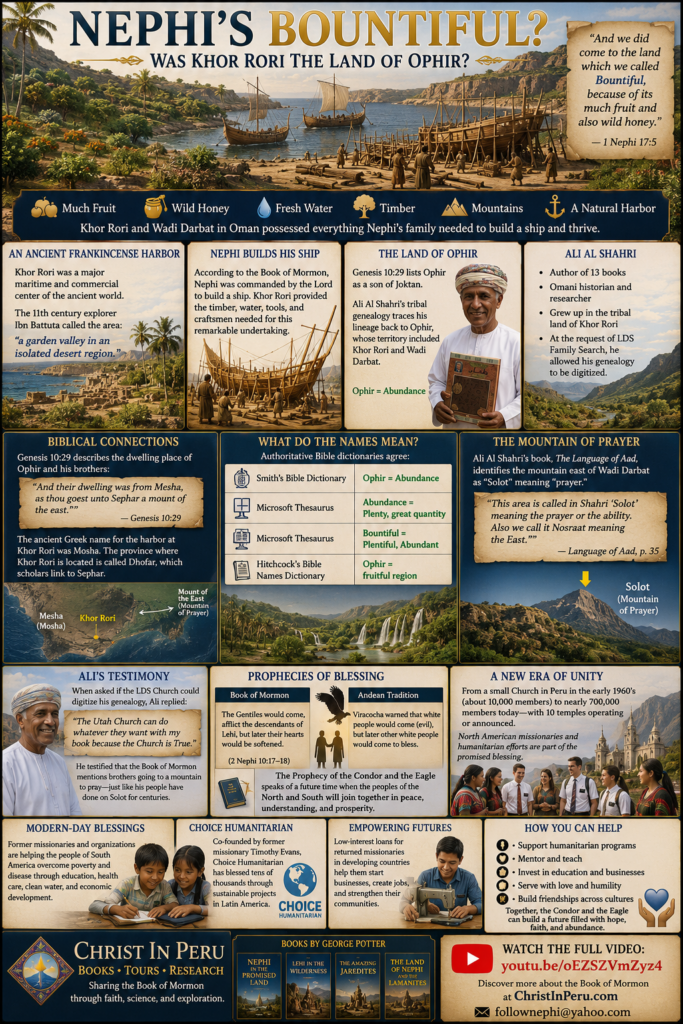
George Potter proposes that this place was the ancient frankincense harbor of Khor Rori, located near Wadi Darbat in modern Oman.
His argument is based not only on the region’s fertility, natural harbor, timber, fresh water, and honey, but also on an intriguing connection with the biblical land of Ophir.
A Land Called Bountiful
The Book of Mormon explains:
“And we did come to the land which we called Bountiful, because of its much fruit and also wild honey.”
—1 Nephi 17:5
After years of hunger, danger, and hardship in the wilderness, the arrival at Bountiful represented a dramatic change.
The location needed to provide everything required for the family’s survival and for the construction of a large ocean-going vessel.
A serious candidate for Bountiful should therefore include:
- Fresh water
- Fruit
- Wild honey
- Fertile land
- Timber
- Mountains
- Ore or access to metal
- A protected harbor
- A place suitable for building and launching a ship
Potter argues that Khor Rori and the neighboring Wadi Darbat satisfy this unusual combination.
Khor Rori: An Ancient Frankincense Harbor
Khor Rori was an important maritime and commercial center in southern Arabia.
The harbor was connected with the frankincense trade and provided access to both inland resources and the Arabian Sea.
Unlike much of the surrounding desert, the region around Wadi Darbat contains:
- Seasonal streams
- Green vegetation
- Trees
- Grazing land
- Agricultural areas
- Fruit-bearing plants
- Natural water sources
Historical accounts also describe the area as exceptionally fertile compared with the dry lands around it.
The script notes that the medieval traveler Ibn Battuta referred to the region as a garden-like valley within an isolated desert environment.
Wild Honey in Wadi Darbat
One of the Book of Mormon’s most specific details is the presence of wild honey.
Wadi Darbat remains known for honey and beekeeping.
The combination of flowers, water, trees, and seasonal vegetation creates favorable conditions for bees.
This does not independently prove that Wadi Darbat was Nephi’s Bountiful, but it adds another point of correspondence between the scriptural description and the physical landscape.
Why the Name “Bountiful” Matters
Joseph Smith translated the place-name into the English word Bountiful.
Potter asks whether the original local name may have carried a similar meaning.
His investigation led him to the biblical name Ophir.
Several older reference works associate Ophir with concepts such as:
- Abundance
- Plenty
- Fruitfulness
- A fruitful region
The script presents the following chain of meaning:
- Ophir means abundance.
- Abundance means plenty or great quantity.
- Bountiful means plentiful or abundant.
- Some biblical name dictionaries define Ophir as a fruitful region.
Under this interpretation, Ophir and Bountiful may express a similar idea.
Who Was Ophir?
Ophir appears in the Bible as one of the sons of Joktan.
Genesis 10 lists Joktan’s descendants and states that their territory extended from Mesha toward Sephar, a mountain of the east.
Ophir later became associated in biblical tradition with a wealthy region known for gold and valuable trade goods.
The precise historical location of Ophir remains debated.
Proposed locations have included southern Arabia, eastern Africa, India, and other maritime regions.
Potter argues that local genealogical traditions in southern Oman provide evidence connecting Ophir’s descendants with the Salalah coastal plain and the region around Khor Rori.
Ali Al Shahri and the Local Tradition
A major part of Potter’s investigation involves Omani historian Ali Al Shahri.
Al Shahri has written numerous books about the history, language, genealogy, and traditions of the Indigenous people of southern Oman.
He grew up in the region associated with Wadi Darbat and Khor Rori and belongs to a local tribal tradition connected with the area.
Potter and Al Shahri became friends through their shared interest in ancient history, language, and the maritime heritage of southern Oman.
During one visit, Al Shahri gave Potter a copy of his book The Language of Aad.
A Genealogy Tracing Back to Joktan
Inside the book, Potter found a genealogy that traced Al Shahri’s tribal ancestry into the ancient past.
The genealogy reportedly included three sons of Joktan named in Genesis, including Ophir.
Potter was especially surprised to see that the traditional territory associated with Ophir included the western side of Wadi Darbat and the harbor region near Khor Rori.
The map shown in the presentation identifies tribal divisions in the Salalah area and connects one of them with the name Ophir.
This is a local genealogical and linguistic tradition, not a conclusion accepted universally by biblical historians. Still, it provides an intriguing regional connection between Ophir and Potter’s proposed Bountiful.
Mesha, Mosha, and Khor Rori
Genesis states:
“And their dwelling was from Mesha, as thou goest unto Sephar a mount of the east.”
—Genesis 10:30
Potter notes that the ancient harbor at Khor Rori was known in Greek sources as Mosha.
He sees a possible connection between biblical Mesha and the ancient harbor name Mosha.
This would place the settlement of Joktan’s descendants near the same harbor where Potter believes Nephi built his ship.
The similarity of the names is suggestive, but it does not by itself establish that they refer to the same historical location.
Ancient place-names can change, overlap, or resemble one another by coincidence.
Sephar and Dhofar
Potter also connects the biblical name Sephar with Dhofar, the province of Oman in which Khor Rori is located.
Some researchers have proposed that the names may be linguistically related.
If that identification is correct, Genesis could be describing a territory extending from the harbor region toward the mountains of Dhofar.
This would place the descendants of Joktan—including Ophir—in the same broad region proposed for Nephi’s Bountiful.
Again, the connection remains debated, but it creates a coherent geographical model.
The Mountain of Prayer
Another striking detail involves a mountain east of Wadi Darbat and Khor Rori.
According to Al Shahri’s book, the mountain is associated with the Shahri word Solot, meaning prayer or the ability to pray.
The presentation identifies it as the “Mountain of Prayer.”
Al Shahri explained that local people had traditionally gone there to pray.
The location is significant because the Book of Mormon repeatedly describes Nephi and the brother of Jared going into mountains to communicate with the Lord.
The script connects this mountain with the biblical expression “a mount of the east.”
Nephi and the Mountain
In 1 Nephi 17, the Lord tells Nephi to arise and go into the mountain.
There, Nephi receives instructions concerning the construction of the ship.
The existence of a traditional mountain of prayer near Khor Rori creates a meaningful cultural and geographical parallel.
A mountain immediately accessible from the proposed harbor would have provided the kind of secluded sacred setting described in Nephi’s account.
It does not prove that Nephi prayed on that specific mountain, but it makes the landscape plausible.
Ali Al Shahri’s Response
The script recounts that Potter provided Al Shahri’s genealogical book to FamilySearch.
Representatives later asked whether Al Shahri would permit the genealogy to be digitized.
When Potter contacted him, Al Shahri reportedly replied that the Church could use his book because “the Church is true.”
Potter was surprised by the statement because Al Shahri was a devout Muslim.
When asked why he felt that way, Al Shahri pointed to the Book of Mormon descriptions of sacred mountains and compared them with the local Mountain of Prayer near Khor Rori.
This personal statement is meaningful within Potter’s account, though it should not be interpreted as an official religious declaration on behalf of Al Shahri’s tribe or community.
Ophir as a Fruitful Region
The proposed identification becomes especially interesting when the meanings are placed side by side.
Nephi described the land as:
- Filled with fruit
- Rich in honey
- Abundant enough to support the family
- Suitable for shipbuilding
Traditional reference works describe Ophir as:
- Abundant
- Plentiful
- Fruitful
- Rich in valuable resources
Potter therefore argues that Nephi may have translated or renamed a locally known land of Ophir as Bountiful because that English word captured the meaning of the place.
Could Joseph Smith Have Known This?
Potter emphasizes that Joseph Smith lived in rural nineteenth-century America and had no known access to:
- Al Shahri’s genealogy
- Tribal traditions of southern Oman
- The local Shahri language
- The Mountain of Prayer
- The proposed territory of Ophir
- Archaeological information about Khor Rori
- The relationship between Mosha, Sephar, and Dhofar
For Potter, the convergence of these details supports the authenticity of the Book of Mormon account.
Others may view the relationships as interesting but inconclusive.
The argument depends on several disputed linguistic and geographical identifications, so it should be presented as cumulative evidence rather than definitive proof.
The Physical Case for Khor Rori
The strongest argument for Khor Rori does not depend entirely on the name Ophir.
The physical location itself contains many features expected of Bountiful.
Fertile Valley
Wadi Darbat is unusually green and productive compared with the surrounding desert.
Fresh Water
The valley contains streams, pools, and seasonal waterfalls.
Fruit
The climate supports agricultural growth and orchards.
Honey
The region is still associated with honey production.
Timber
Trees and wood were available in the valleys and nearby mountains.
Ore and Metallurgy
The broader region had access to metalworking traditions and materials.
Mountain
A prominent mountain rises east of the harbor.
Natural Harbor
Khor Rori offered a protected place for constructing and launching a ship.
This combination makes it one of the most discussed candidates for Nephi’s Bountiful.
Bountiful Was More Than a Pretty Place
Nephi’s Bountiful had to support a complex engineering project.
The family likely remained there for several years while Nephi:
- Located ore
- Made tools
- Cut and prepared timber
- Designed the vessel
- Obtained ropes and sails
- Gathered food and water
- Constructed and tested the ship
- Prepared the family for departure
A picturesque beach without resources would not have been sufficient.
Khor Rori was a functioning ancient harbor surrounded by the materials and knowledge required for shipbuilding.
The Role of Local Craftsmen
The Book of Mormon emphasizes that the Lord instructed Nephi how to build the ship.
That does not necessarily mean Nephi worked in complete isolation.
He may have learned practical skills from local craftsmen while following inspired design instructions.
Khor Rori was connected with maritime trade and likely attracted:
- Shipbuilders
- Sailors
- Carpenters
- Metalworkers
- Merchants
- Rope makers
- Navigators
Such an environment would have provided Nephi access to the tools and expertise necessary to complete the vessel.
Ophir, Gold, and Trade
Biblical Ophir was famous for gold and valuable merchandise.
Khor Rori was part of a major international trading network centered on frankincense.
Goods passed through southern Arabia from Africa, India, Arabia, and the Mediterranean world.
The region’s commercial importance fits the broader biblical image of Ophir as a wealthy and abundant land.
However, biblical references to Ophir may not all describe the exact same political territory, and scholars continue to debate its location.
What the Evidence Establishes
The evidence establishes that:
- Khor Rori was an important ancient harbor.
- Wadi Darbat was fertile and supplied fresh water.
- The region contained fruit, vegetation, and honey.
- The harbor had access to shipbuilding activity.
- Local genealogical traditions connect tribes of the area with ancient names.
- The name Ophir has been associated with abundance and fruitfulness.
- A traditional mountain of prayer exists near the harbor.
- The ancient harbor was known by a name resembling Mosha.
These facts make the region worthy of serious consideration.
What the Evidence Does Not Prove
The evidence does not conclusively establish that:
- Khor Rori was the exact place Nephi called Bountiful.
- The local Ophir genealogy can be traced continuously to the biblical individual.
- Mesha and Mosha are certainly the same place.
- Sephar and Dhofar are linguistically identical.
- Nephi prayed on the Mountain of Solot.
- Joseph Smith’s word “Bountiful” directly translated the name Ophir.
These remain interpretive conclusions.
The strongest approach is to consider the total pattern while recognizing the uncertainty surrounding each individual clue.
A Remarkable Convergence
The proposed connection brings together several different types of evidence:
- Book of Mormon geography
- Biblical genealogy
- Local tribal history
- Ancient place-names
- Linguistic meaning
- Archaeology
- Agriculture
- Maritime history
- Religious tradition
Rarely does one location offer so many potential points of comparison.
For Potter, Khor Rori is not merely similar to Bountiful.
He believes it is the actual harbor where Nephi constructed his ship.
A Place of Abundance in the Desert
Perhaps the most powerful feature of Khor Rori is the contrast between the valley and the surrounding wilderness.
After crossing vast stretches of barren Arabia, Lehi’s family would have seen green hills, flowing water, fruit, trees, and a natural harbor.
It would truly have appeared bountiful.
The name would not have been poetic exaggeration.
It would have described exactly what the exhausted travelers found.
Watch the Full Video
To learn more about Khor Rori, Wadi Darbat, the land of Ophir, Ali Al Shahri’s genealogy, the Mountain of Prayer, and the proposed meaning of Bountiful, watch the complete video:
Nephi’s Bountiful — Watch on YouTube
You can also visit ChristInPeru.com to explore our books, research, videos, and tours connected with Lehi’s journey and Book of Mormon history.