
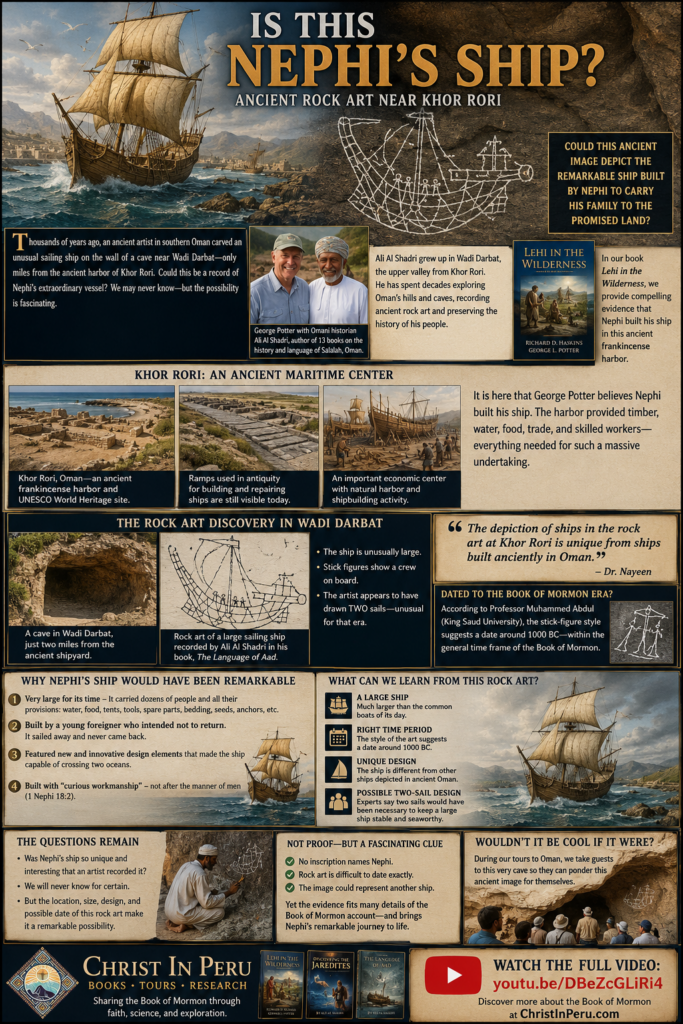
Thousands of years ago, an artist in southern Oman carved or drew the image of an unusual sailing vessel on the wall of a cave.
The artwork was discovered near Wadi Darbat, only a short distance from the ancient harbor of Khor Rori—the place George Potter proposes as the location where Nephi constructed his ship.
Could this ancient image preserve a memory of Nephi’s remarkable vessel?
There is no way to prove that identification. Yet the ship’s unusual design, estimated age, large size, and proximity to the ancient shipyard make the possibility fascinating.
Khor Rori and Nephi’s Ship
In the Book of Mormon, Nephi is commanded by the Lord to build a ship that would carry his family across the ocean to the promised land.
Nephi had no previous experience as a shipbuilder. Even so, he received divine instruction concerning the vessel’s design and construction.
He explained that the ship was not built “after the manner of men.” Instead, the Lord showed him how it should be made.
This suggests that Nephi’s vessel may have differed noticeably from the ships normally constructed in Arabia at that time.
Potter identifies Khor Rori, an ancient frankincense harbor in modern Oman, as the most likely location for Nephi’s shipbuilding project.
An Ancient Maritime Center
Khor Rori was an important economic and maritime center in antiquity.
Its natural harbor provided protection from the open sea, while the surrounding region supplied timber, fresh water, food, and access to trade networks.
The site is now part of a UNESCO World Heritage area connected with the ancient frankincense trade.
Archaeological remains at Khor Rori include evidence of maritime activity and structures associated with building, maintaining, or launching vessels.
Potter notes that ancient ramps used in connection with ships can still be seen at the site.
This makes Khor Rori more than a beautiful coastal location. It was a practical shipbuilding environment.
The Discovery in Wadi Darbat
Omani historian Ali Al Shadri introduced Potter to the rock art.
Al Shadri grew up in Wadi Darbat, the upper valley connected with Khor Rori, and has spent years studying the language, culture, and history of the Indigenous people of southern Oman.
He also explored the surrounding hills and caves, documenting ancient artwork.
In a cave approximately two miles from the proposed shipyard, he found an image of a large sailing vessel.
The illustration later appeared in his book The Language of Aad.
The location is significant because the artwork was not discovered hundreds of miles away. It was found within the immediate cultural and geographical environment of the ancient harbor.
Why Nephi’s Ship Would Have Attracted Attention
Nephi’s vessel would likely have been a remarkable sight.
It was apparently built by a foreign young man who did not belong to the local maritime community.
The ship also had to carry a large group of passengers, including:
- Nephi and his wife
- Lehi and Sariah
- Laman and Lemuel and their families
- Sam and his family
- Jacob and Joseph
- Ishmael’s descendants
- Zoram and his family
- Food and fresh water
- Tents and bedding
- Tools and spare materials
- Seeds and other supplies
The exact number of people is unknown, but the vessel may have carried several dozen passengers.
A ship of that capacity would have been unusually large for a private family expedition.
A Vessel That Never Returned
Most ships entering or leaving an ancient harbor would have been part of established trade routes.
Sailors, merchants, and dockworkers would have expected them to return.
Nephi’s ship was different.
It was built for a one-way journey into the unknown. Once it sailed away, it apparently never came back.
That alone could have made it memorable to the local people.
A foreign family constructing a large, experimental vessel and then disappearing over the horizon would have been the ancient equivalent of a major local event.
“Curious Workmanship”
The Book of Mormon describes Nephi’s ship as being made with “curious workmanship.”
In the language of Joseph Smith’s era, curious could mean skillful, unusual, intricate, or ingeniously designed.
The vessel may therefore have contained features unfamiliar to local shipbuilders.
Nephi said:
“Now I, Nephi, did not work the timbers after the manner which was learned by men, neither did I build the ship after the manner of men; but I did build it after the manner which the Lord had shown unto me.”
—1 Nephi 18:2
The ship was not necessarily supernatural in appearance. It still had to float, sail, and survive storms.
Yet its engineering may have differed enough from ordinary local vessels to attract attention.
What Does the Rock Art Show?
The artwork depicts a large sailing ship with several unusual characteristics.
The vessel appears significantly larger than the smaller boats associated with the region.
Human stick figures are shown aboard it, providing a rough sense of scale.
The artist also appears to have represented more than one sail.
Potter argues that these features make the vessel stand out from ordinary ancient Omani ship depictions.
The illustration on the first page of the script shows the ship’s curved hull, elevated ends, rigging, possible crew members, and complex sail arrangement.
A Large Ship for Its Time
The Book of Mormon vessel needed to transport an extended family across multiple bodies of water.
It would have required enough capacity for passengers and supplies, while still being seaworthy.
The rock-art ship appears large when compared with the human figures drawn aboard it.
That does not establish that it was Nephi’s ship, but it is consistent with one important requirement.
A small fishing boat or short-distance trading vessel would not have been adequate for Nephi’s voyage.
The Possible Date of the Artwork
Dating rock art is difficult.
Unless pigment or organic material can be tested directly, researchers often estimate age by comparing artistic styles, weathering, nearby archaeology, and the way human figures are represented.
The script cites the opinion of Professor Muhammed Abdul of King Saud University, who associated the stick-figure style with a broad period around 1000 BC.
That date is not exact and should be approached cautiously.
Still, it places the artwork within the general ancient world relevant to discussions of Lehi’s journey.
The image cannot currently be assigned securely to Nephi’s lifetime.
An Unusual Two-Sail Design
One of the most interesting features is the apparent use of two sails.
Potter cites maritime specialists who suggested that a vessel of Nephi’s proposed size would have needed additional sail control to remain stable and manageable.
A second sail could have helped with:
- Balance
- Steering
- Reducing stress on the mast
- Maneuvering in changing winds
- Controlling a heavy vessel
- Keeping the ship aligned in rough seas
The artist may have drawn two sails because that was exactly what was present.
Of course, rock art can be stylized or difficult to interpret. Lines that appear to represent sails might have another meaning.
Nevertheless, the possible two-sail configuration adds to the image’s uniqueness.
Built to Cross Two Seas
Nephi’s family likely had to navigate more than one major maritime environment.
They first departed from the Arabian coast and then crossed the vast ocean toward the Americas.
The ship needed to survive:
- Coastal waters
- Open-ocean waves
- Powerful winds
- Long periods without land
- Heavy cargo
- Storms
- Structural stress
- Limited opportunities for repair
This would have required a stronger vessel than many boats used for short coastal trips.
The Book of Mormon specifically emphasizes that the Lord instructed Nephi in how to construct the ship.
From a faith perspective, those inspired design features made the voyage possible.
Could an Ancient Artist Have Recorded It?
Ancient communities did not have newspapers, photography, or modern archives.
Important events were recorded through:
- Oral tradition
- Songs
- Carvings
- Paintings
- Inscriptions
- Rock art
A shipbuilder, sailor, or local observer may have wanted to preserve the image of an extraordinary vessel.
If Nephi’s ship was larger and more unusual than anything commonly seen at Khor Rori, drawing it on a cave wall would have been a natural response.
This possibility cannot be confirmed, but it is historically reasonable.
What Makes the Image Intriguing?
Several details make the rock art worthy of attention:
Its Location
The image was found near Khor Rori, Potter’s proposed site for Nephi’s shipbuilding.
Its Scale
The vessel appears unusually large compared with the human figures aboard it.
Its Design
The ship seems different from common local boats and may show multiple sails.
Its Possible Age
The artistic style may place it broadly within the ancient period.
Its Cultural Setting
Khor Rori was a real harbor with shipbuilding and maritime activity.
The Book of Mormon Description
Nephi’s ship was said to be unique, large, and built with inspired workmanship.
No single detail proves the identification. Together, however, they create an intriguing comparison.
What the Evidence Does Not Prove
It is important to be clear about the limits of the evidence.
The rock art contains no inscription naming:
- Nephi
- Lehi
- Bountiful
- Jerusalem
- The promised land
There is no direct archaeological link between the artwork and the Book of Mormon family.
Its date is approximate, and the details of the drawing are open to interpretation.
The image could depict an ordinary regional vessel, a ceremonial ship, a remembered trading craft, or even an artistic combination of several types of boats.
Calling it Nephi’s ship would go beyond what archaeology can currently establish.
Why the Possibility Still Matters
Even when evidence is not conclusive, it can help readers understand the physical world of the Book of Mormon.
The rock art demonstrates that people near Khor Rori remembered and represented large sailing vessels.
The harbor had the resources and maritime tradition necessary for ship construction.
The surrounding landscape matches many of the needs described in Nephi’s account.
For believers, the image offers a powerful visual possibility: perhaps someone who witnessed the construction or departure of an extraordinary ship chose to preserve it in stone.
Visiting the Cave
Potter includes the cave among the locations visited during his tours to Oman.
Standing near the artwork allows visitors to consider the question personally.
Was it simply another ancient ship?
Was it a vessel associated with the frankincense trade?
Or could it preserve a local memory of the unusual ship constructed by Nephi and his family?
The answer may never be known.
But the setting brings the Book of Mormon account into a real landscape of harbors, caves, valleys, trade routes, and ancient maritime activity.
A Fascinating Possibility, Not a Final Answer
The best way to approach the image is with both curiosity and caution.
It should not be presented as proof of Nephi’s ship.
At the same time, it should not be dismissed simply because its identification cannot be certain.
Archaeology often begins with questions.
The rock art near Khor Rori provides an unusual and thought-provoking clue—one that invites further study of ancient Arabian ships, artistic traditions, and the possible route of Lehi’s family.
Watch the Full Video
To learn more about the rock art, Khor Rori, Wadi Darbat, Ali Al Shadri, and the possibility that the image depicts Nephi’s ship, watch the complete video:
Is This Nephi’s Ship? — Watch on YouTube
You can also visit ChristInPeru.com to explore our books, research, videos, and tours connected with Book of Mormon history.