
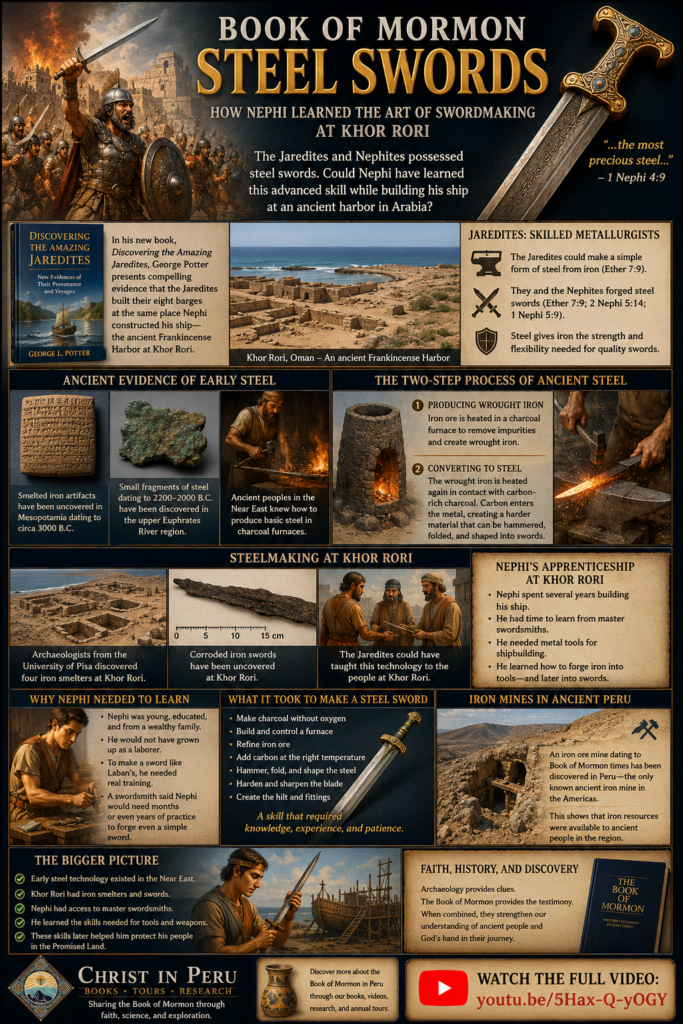
The Book of Mormon describes both the Jaredites and Nephites as people who understood advanced metallurgy.
They worked with iron, copper, gold, silver, and steel. They also manufactured weapons, including swords.
For critics, these references raise an important question:
How could Book of Mormon peoples have possessed steel swords in the ancient world?
George Potter proposes that the ancient port of Khor Rori, on the coast of Oman, may provide a practical explanation for how Nephi learned the skills needed to work iron and forge swords.
Steel in the Book of Mormon
The Book of Mormon refers to steel in several important passages.
The Jaredites are described as making weapons from steel. Nephi later states that he made swords patterned after the sword of Laban, whose blade was made from “the most precious steel.”
These references suggest that Book of Mormon steel was not merely decorative metal.
It needed to be:
- Strong enough for combat
- Flexible enough not to shatter easily
- Capable of holding a sharp edge
- Produced through controlled heating and hammering
- Worked by skilled smiths
Potter argues that this kind of technology existed in the ancient Near East before Nephi’s voyage to the Americas.
Early Iron and Steel in the Near East
Archaeological discoveries show that ancient peoples in Mesopotamia and surrounding regions worked with iron very early.
The script notes that smelted iron objects have been found in Mesopotamia dating to approximately 3000 BC.
Small fragments identified as early steel have also been discovered in the upper Euphrates region and dated to approximately 2200–2000 BC.
These findings demonstrate that iron and basic steel production were not unknown in the ancient Near East.
The technology was rare, difficult, and highly specialized, but it existed.
What Is Simple Steel?
Steel is created when iron contains a controlled amount of carbon.
Ancient smiths did not need modern factories to produce a basic form of steel.
A charcoal furnace could be used in a two-stage process.
First, iron ore was heated and reduced to create wrought iron.
The iron was then repeatedly heated in contact with carbon-rich charcoal. Through this process, carbon entered the metal and produced a harder material.
The smith could then hammer, fold, reheat, and shape the steel.
This process required knowledge, experience, and careful judgment, but it was possible with ancient technology.
Why Steel Was Important for Swords
Pure iron can be relatively soft.
A sword made from poorly prepared iron may bend, lose its edge, or fail during combat.
Adding carbon produces a material that is harder and more suitable for blades.
A successful swordsmith needed to control several factors:
- Furnace temperature
- Charcoal quality
- Oxygen flow
- Carbon absorption
- Hammering
- Folding
- Cooling
- Final sharpening
This was not a skill someone could master simply by looking at a finished sword.
It required practical training.
The Jaredite Connection
Potter’s argument begins with the Jaredites.
He proposes that they originated in Mesopotamia, where early metallurgy was already known.
The Book of Mormon says they possessed steel weapons.
Potter further proposes that the Jaredites spent time near Khor Rori before crossing the ocean.
Under this interpretation, they may have brought metalworking knowledge from Mesopotamia into southern Arabia.
The script suggests that this technology could have remained in the region and later been available to Nephi.
This is a proposed historical reconstruction rather than an established archaeological conclusion, but it offers a possible continuity between Jaredite and Nephite metallurgical knowledge.
Khor Rori: An Ancient Maritime Center
Khor Rori is an ancient harbor in present-day Oman.
It was strategically located along the Arabian coast and later became associated with the frankincense trade.
Potter identifies it as the place where Nephi may have built his ship.
The site is significant because archaeological work has uncovered evidence of ironworking, including furnaces and weapons.
According to the script, archaeologists associated with the University of Pisa discovered iron-smelting installations and corroded swords at Khor Rori.
If Nephi spent several years building his ship in a place where skilled smiths worked iron and forged weapons, he would have had both the time and opportunity to learn.
How Did Nephi Learn to Make a Sword?
Nephi was raised in a wealthy family near Jerusalem.
He could read and write, understood religious records, and appears to have received a strong education.
However, there is no indication that he grew up as a professional blacksmith.
When he left Jerusalem, he was still a young man.
Potter therefore asks how Nephi later acquired enough skill to manufacture swords after reaching the promised land.
The answer may lie in the years he spent preparing and constructing his ship.
The Sword of Laban
Nephi knew the quality of Laban’s sword firsthand.
He described its hilt as pure gold and its blade as being made from “the most precious steel.”
After arriving in the promised land, Nephi used Laban’s sword as a pattern for other weapons.
This suggests that he understood more than its general appearance.
To produce functional copies, he would have needed knowledge of:
- Blade proportions
- Forging
- Heat treatment
- Edge construction
- Metal quality
- Handles and fittings
- Balance
Possessing the sword provided a model, but it did not automatically provide the manufacturing skill.
Learning From a Master Swordsmith
The script cites the opinion of a swordsmith who explained that Nephi would have needed to work alongside an experienced craftsman for months—or possibly years—to produce even a basic sword.
Forging a high-quality blade required repeated instruction and practice.
Before making the sword itself, Nephi would have needed to learn how to:
- Produce charcoal with limited oxygen
- Build and control a furnace
- Refine iron
- Add carbon
- Judge temperature by color
- Hammer and fold the metal
- Shape the blade
- Harden and sharpen it
This kind of apprenticeship would fit naturally into a long stay at an active metalworking harbor.
Shipbuilding and Metalworking
Nephi’s ship also required tools.
Even if the vessel was mainly constructed from wood, ropes, and natural materials, Nephi likely needed cutting, shaping, drilling, and fastening tools.
The Book of Mormon states that the Lord showed Nephi where to find ore so that he could make tools.
Working beside local metalworkers would have helped him learn how to transform ore into usable implements.
Potter argues that the shipbuilding project created the perfect environment for Nephi to acquire skills that later became essential for protecting his people.
Why Khor Rori Matters
Khor Rori combines several features relevant to the account:
- A protected ancient harbor
- Maritime activity
- Access to trade networks
- Evidence of metalworking
- Iron-smelting installations
- Swords discovered archaeologically
- Enough time for Nephi to construct a large vessel
- Possible access to experienced craftsmen
This does not prove that Nephi lived there.
However, it creates a plausible historical setting in which a young, educated traveler could become proficient in metalworking and sword production.
Could Ancient Steel Survive Archaeologically?
One challenge is preservation.
Iron and early steel corrode easily, especially in humid environments.
Unlike stone or ceramics, iron objects can rust away almost completely.
A civilization may have used iron weapons without leaving large numbers of intact swords for archaeologists to recover.
This is particularly relevant in tropical or coastal regions of the Americas, where moisture and soil conditions accelerate corrosion.
The absence of surviving swords does not automatically prove that no swords ever existed.
At the same time, archaeological claims still require physical evidence and should not rely only on the possibility of decay.
Iron Mining in Ancient Peru
The script also mentions the discovery of an ancient iron ore mine in Peru dating broadly to Book of Mormon times.
This indicates that pre-Columbian people in the region extracted iron-rich material.
The discovery does not, by itself, prove that the ore was smelted into steel swords.
Iron ores may have been collected for pigments, ritual use, trade, or metal production.
Nevertheless, the mine shows that ancient Peruvians knew where to find and extract iron-bearing minerals.
Steel, Iron, or Hardened Metal?
Ancient terminology can be difficult.
A translated text may use the word steel for a hardened iron alloy without requiring modern industrial steel.
The Book of Mormon does not provide a chemical analysis of the blades.
Its language could describe:
- Low-carbon steel
- Carburized iron
- Case-hardened iron
- Pattern-welded metal
- Another high-quality iron alloy
The important point is that the material was understood as stronger and more valuable than ordinary iron.
What the Evidence Establishes
The historical and archaeological evidence shows that:
- Early ironworking existed in Mesopotamia.
- Basic steel technology existed in the ancient Near East.
- Steel could be created in charcoal furnaces.
- Swordmaking required specialized training.
- Khor Rori had an ancient metalworking tradition.
- Corroded iron weapons have been found there.
- Ancient iron ore extraction occurred in Peru.
These facts demonstrate technological possibility.
What the Evidence Does Not Prove
Archaeology has not established that:
- The Jaredites taught the people of Khor Rori to make steel.
- Nephi personally trained under a swordsmith there.
- The swords found at Khor Rori belonged to Book of Mormon peoples.
- The ancient Peruvian iron mine produced Nephite steel weapons.
- Any discovered American sword can be securely identified as Nephite.
Those conclusions remain part of Potter’s interpretive model.
The evidence supports plausibility, not direct identification.
A Practical Explanation
Potter’s theory offers a practical answer to a genuine question.
Nephi possessed Laban’s sword, but he still needed technical knowledge to reproduce it.
He spent years in a harbor where ironworking and sword production may have been practiced.
He also needed metal tools to construct his ship.
That combination of time, need, available technology, and access to craftsmen could explain how he became capable of making swords after reaching the promised land.
Prepared for the Promised Land
From a faith-based perspective, Potter sees Nephi’s training as part of divine preparation.
Nephi did not know every challenge his family would face in the new land.
He could not have fully anticipated the conflict with Laman and Lemuel or the need to defend a new settlement.
Yet the skills acquired during the shipbuilding period later became essential.
The same knowledge used to create tools for the voyage could also be used to protect his people.
A Question of Technology, Not Anachronism
The reference to steel swords should not be dismissed simply because modern readers associate steel with industrial factories.
Basic steelmaking is much older than the modern era.
The more appropriate historical question is whether people connected with Nephi’s world could have known how to carburize iron and forge blades.
The evidence from the ancient Near East shows that they could.
The remaining question is whether that technology was carried into the Americas—a possibility the Book of Mormon asserts but archaeology has not yet directly confirmed.
Watch the Full Video
To learn more about Book of Mormon swords, ancient steelmaking, Nephi’s possible training at Khor Rori, and the archaeological evidence for early metallurgy, watch the complete video:
Book of Mormon Steel Swords — Watch on YouTube
You can also visit ChristInPeru.com to explore our books, research, videos, and annual tours to Peru.