
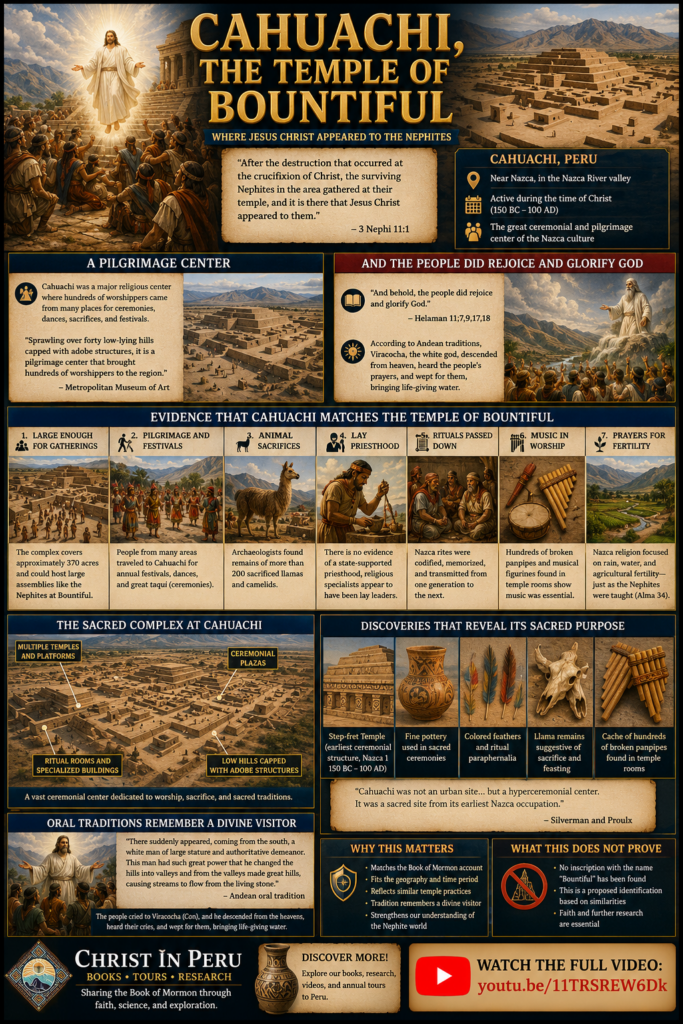
One of the most sacred events in the Book of Mormon occurred at the temple in the land of Bountiful.
After days of destruction and darkness associated with the death of Jesus Christ, the surviving Nephites gathered near a temple. There, they heard the voice of God and witnessed the resurrected Savior descend from heaven.
George Potter proposes that the vast ceremonial complex of Cahuachi, near Nazca, Peru, may provide a possible archaeological setting for this extraordinary event.
The comparison is based on Cahuachi’s date, size, pilgrimage traditions, temple rituals, animal sacrifices, religious music, prayers for agricultural fertility, and Andean traditions concerning a divine being who descended from heaven.
Christ Appears at the Temple in Bountiful
The Book of Mormon records that the surviving people gathered around the temple in Bountiful following the great destruction.
While they were discussing the events that had taken place, they heard a voice from heaven. They then saw Jesus Christ descending among them.
The temple was therefore more than a local building. It was a recognized religious gathering place large enough to receive a significant number of survivors.
Any proposed location for the temple at Bountiful should reasonably have been:
- Active during the first century AD
- Large enough for major gatherings
- Recognized as sacred
- Used by pilgrims
- Associated with organized ceremonies
- Connected with sacrifice and worship
Potter argues that Cahuachi possesses this unusual combination of features.
What Was Cahuachi?
Cahuachi was the dominant ceremonial center of the ancient Nazca world in southern Peru.
It was located along the Nazca River and spread across approximately forty low hills covered with monumental adobe structures.
Rather than functioning primarily as a densely populated city, archaeological research suggests that Cahuachi was a specialized religious and pilgrimage center.
Excavations have identified temples, platforms, plazas, ceremonial rooms, ritual objects, musical instruments, pottery, feathers, and the remains of sacrificed llamas.
The Metropolitan Museum of Art has described Cahuachi as a major ceremonial site that attracted hundreds of worshippers to the region.
A Sacred Site During the Time of Christ
Chronology is one of the strongest elements of the comparison.
The earliest major ceremonial structures at Cahuachi date to the Nazca 1 period, approximately 150 BC to AD 100.
This places the temple complex in active use during the lifetime and resurrection of Jesus Christ.
Archaeologists have identified a structure known as the Step-fret Temple, which demonstrates that Cahuachi was considered sacred from the earliest phases of Nazca occupation.
That chronological overlap does not establish that Cahuachi was the Book of Mormon temple, but it makes the comparison possible.
A Center of Pilgrimage and Gathering
Cahuachi was not simply a temple used by a small local population.
It was a pilgrimage destination.
People traveled there from surrounding areas to participate in rituals, dances, offerings, sacrifices, and religious festivals.
Historical and archaeological interpretations suggest that both ordinary people and elites assembled there at certain times of the year before returning to their homes.
This resembles the Book of Mormon description of people gathering at the temple in Bountiful.
It also recalls the pilgrimage traditions of ancient Israel, where worshippers traveled to the temple for major religious festivals.
Cahuachi’s role as a gathering center is one reason Potter considers it such an important candidate.
Large Enough for the Survivors
The ceremonial zone at Cahuachi covered hundreds of acres.
Potter estimates that the broader sacred complex occupied approximately 370 acres, providing enough room for a large assembly.
The site contained major temples, open plazas, platforms, pathways, and smaller ceremonial buildings.
Such a complex could have accommodated crowds far larger than those served by a small village shrine.
The illustrations on page 2 of the script show both a reconstruction of the sprawling pilgrimage center and one of Cahuachi’s stepped adobe structures, helping visualize the scale of the complex.
Evidence of Animal Sacrifice
The Nazca people practiced animal sacrifice at Cahuachi.
Archaeologists discovered more than sixty sacrificed llamas near one of the ceremonial mounds. Additional camelid remains were found within temple construction fill and ritual contexts.
Sacrifice also appears repeatedly in the Book of Mormon before the ministry of the resurrected Christ.
The Nephites followed the Law of Moses, which included animal offerings.
For Potter, the presence of organized sacrifice at Cahuachi creates an important religious parallel.
However, animal sacrifice was also practiced by many unrelated ancient cultures, so this feature alone cannot demonstrate a direct Nephite connection.
A Possible Lay Priesthood
The Book of Mormon describes religious leaders who were expected to support themselves rather than depend entirely on the labor of the people.
Researchers cited in the script have argued that Nazca religion may not have operated as a state-supported priestly system.
Instead, religious specialists may have functioned in a way that Potter compares with a lay priesthood.
This is not the same as proving that the Nazca practiced the Nephite priesthood.
It does, however, suggest that their religious organization may have differed from highly centralized temple states in which priests formed a permanent privileged class.
Ritual Knowledge Passed Between Generations
Cahuachi’s ceremonies appear to have followed established traditions.
Religious specialists likely memorized ritual knowledge, learned from older practitioners, and passed it to their successors.
This kind of codified ceremonial system resembles the preservation of ordinances and worship practices in scriptural communities.
The Book of Mormon states that Nephi constructed a temple patterned after the Temple of Solomon.
Potter therefore reasons that Nephite temple worship would have included formal rites transmitted through religious instruction.
Again, the similarity is conceptual rather than proof of a direct relationship.
Music as a Sacred Language
Music played a central role in Nazca religion.
Archaeologists have recovered:
- Panpipes
- Trumpets
- Drums
- Figurines of musicians
- Broken instruments stored in ritual rooms
Giuseppe Orefici described music as an essential expression of the Nazca religious spirit and a form of collective communication with the divine.
The Great Temple at Cahuachi contained hundreds of broken panpipes, likely associated with ceremonial activity.
Music was also important in the religious culture of ancient Israel.
Trumpets, harps, flutes, cymbals, and other instruments were used in connection with temple worship and sacred gatherings.
This creates another meaningful cultural parallel.
Prayers for Rain and Fertility
Agricultural fertility was a major concern in Nazca religion.
The people lived in one of the driest inhabited regions of the world. Their survival depended on water, irrigation, seasonal rainfall, and successful harvests.
Nazca ceremonies therefore included prayers and offerings related to crops, water, and fertility.
This resembles Book of Mormon teachings encouraging the faithful to pray over their fields, crops, flocks, and livelihoods.
Alma 34 teaches:
“Cry unto him over the crops of your fields, that ye may prosper in them. Cry over the flocks of your fields, that they may increase.”
Prayer for agricultural prosperity is common across many religious cultures, but it fits naturally within both the Nazca environment and the Book of Mormon religious world.
The Nazca Tradition of Viracocha
Potter considers the Nazca tradition concerning Viracocha one of the most important elements of the comparison.
According to an oral tradition recorded in the Nazca region, the people once suffered from a terrible drought.
They gathered near Cerro Blanco, which they regarded as a principal temple or sacred place, and cried out to Viracocha or Con.
The tradition says that the divine figure descended from the sky, heard the people’s cries, and wept because of their suffering.
His tears were connected with the return of water.
The account portrays the deity as:
- Having human form
- Hearing prayers
- Feeling compassion
- Descending from heaven
- Intervening on behalf of the people
- Weeping with love and concern
Potter sees strong parallels between this tradition and the Book of Mormon account of Christ descending among the people at Bountiful.
Darkness Before the Divine Appearance
Some Andean traditions also describe a period when the land was plunged into darkness before the appearance of a powerful divine visitor.
The script begins with a tradition describing a white man of great stature and authority who came after a period of darkness and possessed power over the landscape and water.
For Latter-day Saint readers, this naturally recalls the destruction and darkness described in 3 Nephi before Christ’s appearance.
The resemblance is striking, but caution is necessary.
Andean traditions were recorded long after the proposed events and passed through generations of oral transmission. Their surviving form may include multiple layers of symbolism, reinterpretation, and colonial influence.
They are best treated as cultural parallels rather than direct historical transcripts.
The Lord Weeping at Bountiful
In the Book of Mormon, Jesus Christ expresses profound compassion for the people.
He blesses them, heals the sick, ministers to children, prays, and weeps.
The Nazca tradition likewise portrays Viracocha as a compassionate heavenly being who heard the suffering of the people and wept for them.
Potter interprets this as a preserved cultural memory of Christ’s visit.
Mainstream historians and archaeologists do not identify Viracocha or Con with Jesus Christ, but for believers the parallel is spiritually significant.
Similarities Between Cahuachi and the Temple at Bountiful
The proposed comparison includes several elements.
Correct General Period
Cahuachi was active during the first century AD.
Major Religious Complex
It contained temples, ceremonial platforms, ritual rooms, and open gathering spaces.
Pilgrimage Center
People traveled there for worship and religious festivals.
Capacity for Large Assemblies
The complex extended across a vast area and could receive substantial crowds.
Animal Sacrifice
Llamas and other camelids were sacrificed in ritual contexts.
Organized Ritual Tradition
Ceremonies were codified and transmitted between generations.
Religious Music
Panpipes, drums, trumpets, and other instruments were used in worship.
Agricultural Prayer
Rituals focused on rain, water, crops, and fertility.
Tradition of a Descending God
Nazca oral traditions describe Viracocha or Con descending from heaven in response to the people’s prayers.
Together, these features make Cahuachi an intriguing candidate within Potter’s South American model.
What Archaeology Actually Establishes
Archaeology firmly establishes that Cahuachi was:
- A major Nazca ceremonial center
- Active during the time of Christ
- A place of pilgrimage
- Associated with animal sacrifice
- Used for music and ritual
- Large enough for substantial gatherings
- Connected with agricultural and fertility concerns
It does not establish that the site was called Bountiful.
No inscription naming Jesus Christ, Nephi, Bountiful, or the Nephites has been discovered there.
The identification remains a faith-based geographical proposal.
Cahuachi Was Not a Typical City
One feature that makes Cahuachi especially interesting is that it was not primarily an ordinary urban center.
Its purpose was overwhelmingly ceremonial.
This matches the emphasis of the Book of Mormon scene, in which the people gathered specifically at the temple.
The sacred complex, rather than residential neighborhoods or political offices, dominated the site.
Its “hyperceremonial” character may make it more suitable as a proposed temple setting than a conventional ancient city.
A Landscape of Sacred Mountains
Cahuachi lies near Cerro Blanco, one of the largest sand dunes in the world and an important sacred landmark in Nazca tradition.
The surrounding landscape includes:
- Desert plains
- River valleys
- Mountains
- Ceremonial pathways
- Geoglyphs
- Sacred hills
- Water sources
For the Nazca, religion was inseparable from the physical landscape.
Mountains, water, fertility, ancestors, temples, and celestial forces formed part of a single sacred worldview.
Potter argues that this environment provides a meaningful setting for the events described at Bountiful.
Evidence, Faith, and Responsible Interpretation
The comparison between Cahuachi and the temple at Bountiful is provocative, but it should be framed carefully.
The archaeological evidence is real.
The proposed Book of Mormon identification is interpretive.
Respecting that distinction strengthens the article rather than weakening it.
Readers can appreciate the remarkable features of Cahuachi without claiming more than the evidence supports.
For believers, the site may provide a powerful setting in which to consider the Book of Mormon account. For archaeologists, it remains one of the greatest ceremonial centers of ancient Peru.
An Invitation to Discover Cahuachi
Cahuachi offers visitors a rare opportunity to stand in a landscape where thousands of ancient worshippers once gathered.
Its monumental adobe structures, ceremonial plazas, desert surroundings, and connection with Nazca religion make it one of Peru’s most fascinating sacred sites.
Whether or not it was the temple at Bountiful, it helps modern readers imagine how a large ancient American religious gathering could have taken place during the first century AD.
Watch the Full Video
To learn more about Cahuachi, the Nazca religious tradition, Viracocha, ancient pilgrimage practices, and the proposed connection with the temple at Bountiful, watch the complete video:
Book of Mormon Bountiful Temple — Watch on YouTube
You can also visit ChristInPeru.com to explore our books, research, videos, and annual tours to Peru.