
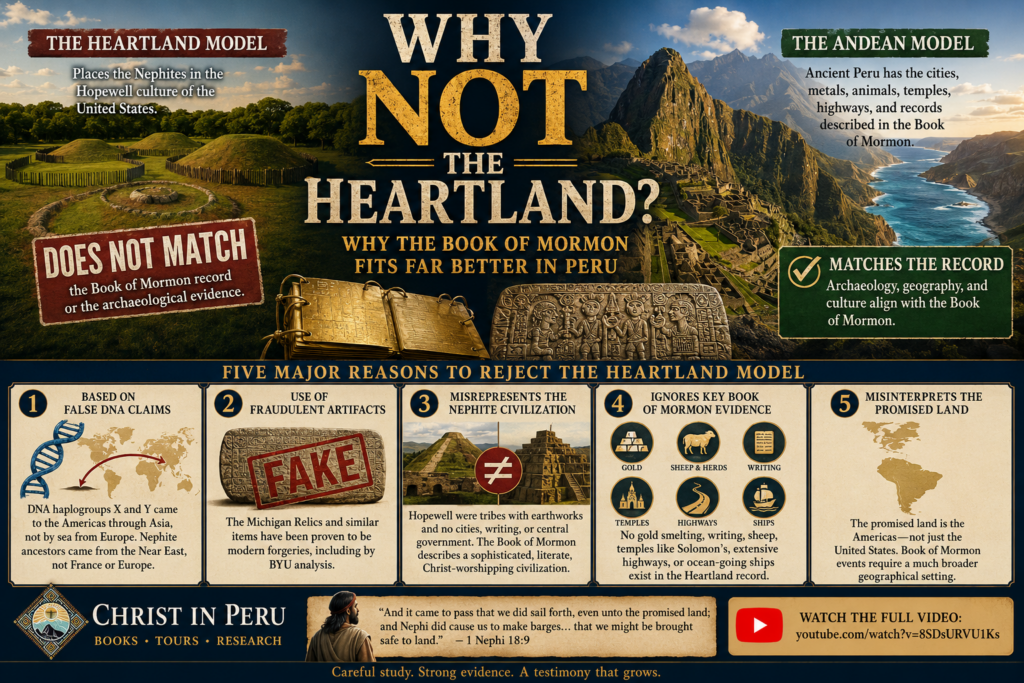
Among Latter-day Saints, one well-known theory places major Book of Mormon events in the interior of the United States, especially in areas associated with the ancient Hopewell culture.
This proposal is often called the Heartland model.
Supporters point to geography, early Church history, Native American traditions, DNA claims, and artifacts they believe connect the Book of Mormon with the northeastern and central United States.
George Potter argues that this model contains serious problems.
In his view, the Heartland theory does not adequately match the civilization described in the Book of Mormon and relies too heavily on disputed evidence.
What Is the Heartland Model?
The Heartland model generally places the lands of the Nephites and Lamanites in the eastern or central United States.
Many versions of the theory identify the Hopewell culture with Book of Mormon peoples.
The Hopewell tradition existed across parts of eastern North America during a period that overlaps with part of the Book of Mormon chronology. Hopewell communities are known for large earthworks, long-distance trade, ceremonial centers, and skilled craftsmanship.
Because of this chronological overlap, some researchers have proposed that the Hopewell people may have been connected with the Nephites.
Potter believes that chronology alone is not enough.
He argues that a proposed setting should also match the Book of Mormon’s descriptions of government, cities, technology, agriculture, animals, literacy, temples, highways, metallurgy, and maritime activity.
Problem One: DNA Claims
Some Heartland advocates have argued that certain genetic markers among Native American populations demonstrate migration from Europe to North America before Columbus.
The script particularly discusses mitochondrial haplogroups sometimes identified as X and Y.
According to the argument criticized in the video, these genetic markers are presented as evidence that ancient people sailed directly from Europe into North America.
Potter rejects this interpretation.
He notes that genetic ancestry shared between ancient Europeans and Native Americans may reflect populations that mixed in Asia before migrating into the Americas.
In other words, the presence of distant western Eurasian ancestry does not necessarily demonstrate a direct voyage from Europe across the Atlantic.
He also argues that neither the Jaredites nor Lehi’s family originated in France or western Europe. The Book of Mormon places their origins in Mesopotamia and Jerusalem.
Therefore, even a demonstrated ancient European connection would not automatically identify a population as Jaredite or Nephite.
Haplogroup X and the Book of Mormon
Haplogroup X has received particular attention in debates about Book of Mormon geography.
Some proponents claim that the Native American branch of haplogroup X is connected to ancient populations in Europe.
However, genetic lineages contain distinct subgroups. The presence of the same broad haplogroup in two regions does not necessarily mean that one population recently descended from the other.
Potter argues that the Native American form of haplogroup X reflects an ancient Asian migration route rather than a transatlantic voyage by Book of Mormon peoples.
DNA evidence is complex, and it cannot normally identify a specific historical individual such as Lehi or a particular scriptural civilization without securely identified comparative remains.
For that reason, broad genetic similarities should be treated cautiously.
Problem Two: Questionable Artifacts
Another major concern involves objects known as the Michigan Relics.
These artifacts were said to contain unusual symbols, biblical scenes, and inscriptions suggesting that a Judeo-Christian civilization once existed in ancient North America.
Heartland supporters have sometimes cited them as evidence for Book of Mormon peoples.
However, the relics have long been widely regarded as modern fabrications.
Potter notes that investigators and scholars—including researchers associated with Brigham Young University—have examined the objects and concluded that they are not authentic ancient artifacts.
The inscriptions mix writing systems and artistic styles in ways that do not fit a genuine ancient culture. Their discovery stories and manufacturing history have also raised serious concerns.
A Book of Mormon geography model becomes weaker, not stronger, when it depends on artifacts that specialists consider fraudulent.
Problem Three: The Hopewell and Nephite Civilizations Were Different
The central argument against the Heartland model is that the Hopewell culture does not closely resemble the Nephite civilization described in the Book of Mormon.
The Book of Mormon portrays the Nephites as a highly organized society with:
- Kings and chief judges
- Large named cities
- Written records
- Temples
- Extensive agriculture
- Metallurgy
- Long-distance highways
- Large armies
- Domesticated herds
- Ocean-going ships
- Complex religious institutions
Potter argues that the archaeological record of the Hopewell does not contain this complete combination of traits.
Cities and Central Government
The Book of Mormon repeatedly refers to major urban centers such as Zarahemla, Nephi, Bountiful, and many others.
These places had rulers, judges, armies, markets, religious leaders, and surrounding territories.
The Hopewell world, by contrast, is generally understood as a network of communities connected through trade, ritual, and shared cultural practices.
They created impressive earthworks and ceremonial sites, but archaeologists do not typically describe them as a single centralized empire with large cities comparable to the urban societies portrayed in the Book of Mormon.
This difference is important.
Ceremonial mounds alone do not establish the existence of a Nephite-style political system.
Gold and Metalworking
The Book of Mormon frequently mentions gold, silver, copper, iron, and other metals.
Gold plates are central to the origin of the record itself.
The Nephites are described as working with metals for tools, weapons, ornaments, construction, and wealth.
Hopewell artisans skillfully used native copper, which could be hammered into ornaments, breastplates, and ceremonial objects.
Potter’s criticism is that evidence for smelting gold, silver, and iron on the scale expected from Book of Mormon descriptions has not been found in the Heartland for the relevant time period.
Working naturally occurring copper is technologically different from mining ore and operating furnaces to smelt several metals.
This creates a significant challenge for the model.
Written Language
The Book of Mormon describes a literate society.
Its peoples maintained:
- Historical records
- Religious writings
- Government documents
- Genealogies
- Letters
- Prophetic texts
- Engraved metal records
A recognizable writing system would therefore be expected in any proposed Nephite civilization.
The Hopewell culture is categorized as prehistoric because there is no securely identified native written language from that society.
Symbols and artistic designs existed, but symbolic imagery is not the same as a full writing system capable of recording lengthy histories and sermons.
Potter considers this one of the strongest objections to identifying the Hopewell as Nephites.
Sheep, Herds, and Shepherds
The script draws attention to the Book of Mormon’s repeated use of pastoral terminology.
It mentions:
- Sheep fourteen times
- Herds twenty-two times
- Shepherds seventeen times
The Nephites are described as maintaining flocks, herds, and domesticated animals.
By contrast, the Hopewell economy is generally characterized as horticultural, hunting-based, and connected with wild resources.
Dogs were domesticated, but Potter argues that archaeological evidence does not show a Heartland pastoral economy involving sheep, goats, pigs, or horses during Book of Mormon times.
A society with shepherds and large herds would be expected to leave substantial animal remains, enclosures, tools, and environmental evidence.
Silk and Costly Apparel
The Book of Mormon describes silk, fine-twined linen, and costly apparel.
Heartland populations produced clothing from animal hides and plant fibers such as nettle and hemp-like materials.
These products could be skillfully made, but Potter questions whether they match the Book of Mormon’s descriptions of luxurious textile industries.
In the Andes, by comparison, ancient civilizations produced extremely fine cotton, alpaca, and vicuña textiles that Spanish observers sometimes compared to silk.
For Potter, the contrast in textile sophistication weighs against the Heartland model.
Temples Like Solomon’s Temple
Nephi wrote that he constructed a temple after the manner of the Temple of Solomon, though not with the same precious materials.
This suggests an architectural structure with rooms, courts, ritual spaces, and an organized priesthood.
Heartland supporters sometimes identify large earthen mounds as Nephite temples.
Potter argues that this comparison is too broad.
The existence of ceremonial earthworks does not show that they followed the architectural or religious pattern of Solomon’s Temple.
To make that identification persuasive, more specific evidence would be needed.
A Network of Highways
The Book of Mormon describes roads and highways connecting cities, lands, and places.
These references suggest an organized transportation system built and maintained across a large civilization.
The Hopewell created paths and some monumental alignments. One well-known proposed ancient route may have extended for dozens of miles.
However, Potter argues that this does not equal the extensive city-to-city highway network described in the Book of Mormon.
By contrast, ancient Andean societies—especially the Inca—constructed enormous road systems spanning mountains, valleys, deserts, and administrative centers.
Ocean-Going Ships
The story of Hagoth presents another challenge.
Hagoth built large ships that transported families, supplies, and settlers northward.
Church traditions have also connected Hagoth’s people with Polynesia.
The Heartland is located thousands of miles from the Pacific Ocean.
A population living there would first have needed to cross an enormous distance before building and launching Pacific vessels.
Furthermore, from much of North America, reaching Hawaii would not naturally be described simply as sailing northward.
Heartland cultures also left no recognized tradition of constructing large ocean-going ships.
Potter considers a Pacific coastal setting far more compatible with Hagoth’s voyages.
Cities That Were Sunk, Burned, or Buried
The Book of Mormon describes catastrophic destruction at the time of Christ’s death.
Cities were burned, buried, sunk into the sea, and covered by earth.
These events presuppose the existence of substantial cities in geologically active areas.
Potter argues that the Hopewell record does not contain evidence of cities destroyed in these specific ways.
Because the Hopewell did not build the kinds of large urban centers described in the text, there would be no corresponding record of such cities disappearing.
Problem Four: Claims About Early Church Leaders
Heartland proponents sometimes argue that Joseph Smith and early Church leaders clearly taught a North American geography.
The historical record, however, contains many different statements and interpretations.
Potter points to early Latter-day Saint traditions that placed Lehi’s landing on the western coast of South America.
He cites B. H. Roberts and a statement attributed to Harold B. Lee indicating that Lehi’s followers were believed to have arrived in South America.
Historical statements about Book of Mormon geography are not always consistent, and the Church has not canonized an official map.
Selective quotations can therefore be misleading when used to claim unanimous support for one theory.
Joseph Smith and Geography
Joseph Smith made or was associated with comments that have been interpreted in support of more than one geographical model.
Some statements connect Book of Mormon events with North America, while others express interest in discoveries in Central or South America.
This may reflect a broad understanding of the Book of Mormon as a history connected with the American continent rather than a precise modern map.
For that reason, no single isolated statement should be treated as a complete geographical revelation unless it was clearly presented as such.
Problem Five: The Meaning of the Promised Land
The Heartland model sometimes equates the Book of Mormon’s “land of promise” exclusively with the United States.
Potter argues that this interpretation is overly narrow.
In Latter-day Saint usage, the promised land often refers broadly to the Americas.
The Book of Mormon itself describes the land as part of a much larger divine inheritance, not simply the territory of one modern nation.
Identifying the promised land exclusively with the United States may also unintentionally minimize the place of Canada, Mexico, Central America, South America, and the Caribbean in the religious history of the Western Hemisphere.
Patriotism should not replace careful textual interpretation.
The Danger of Overstating Weak Evidence
Potter expresses concern that weak arguments can harm faith rather than strengthen it.
Young readers may initially accept dramatic DNA claims, disputed artifacts, or oversimplified archaeological comparisons.
Later, when they discover that the evidence is far less secure than they were told, they may feel misled.
This is an important caution for every Book of Mormon geography model.
Faith does not require exaggerating evidence.
Serious research should acknowledge uncertainty, distinguish fact from interpretation, and avoid presenting speculation as proof.
Does the Heartland Model Have Any Strengths?
The Heartland model does draw attention to genuine and impressive features of ancient North America.
The Hopewell and related cultures created:
- Monumental earthworks
- Long-distance exchange networks
- Sophisticated art
- Skilled copper craftsmanship
- Complex ceremonial traditions
- Large communal gathering places
These achievements deserve respect and careful study.
The question is not whether the Hopewell were advanced or important. They clearly were.
The narrower question is whether their archaeology matches the specific civilization described in the Book of Mormon.
Potter’s answer is no.
Why Potter Favors Peru
Potter proposes Peru and the broader Andean region as a stronger candidate because ancient South America contained many features emphasized in the Book of Mormon:
- Large cities and kingdoms
- Centralized governments
- Gold, silver, copper, and sophisticated metallurgy
- Advanced textile industries
- Herds and pastoral traditions
- Monumental temples
- Vast highway networks
- Written or record-keeping systems
- Large armies
- Pacific maritime traditions
- Geologically active landscapes
The existence of these features does not by itself prove that the Book of Mormon occurred in Peru.
However, Potter argues that the Andean world offers a closer cultural and technological comparison than the Hopewell Heartland.
A Model Should Be Tested, Not Protected
Book of Mormon geography remains an open subject of study and interpretation.
No private theory should be protected from criticism simply because it is popular or emotionally meaningful.
A serious model should be tested against:
- The text of the Book of Mormon
- Archaeology
- Geography
- Chronology
- Climate
- Languages
- Agriculture
- Animals
- Technology
- Warfare
- Transportation
- Religious practices
When evidence conflicts with a model, researchers should revise or abandon the model rather than force the evidence to fit.
A More Careful Conversation
The debate over Book of Mormon geography can easily become divisive.
Different models often involve deeply held religious convictions, regional identity, and personal experiences.
A better approach is to compare evidence respectfully.
The Hopewell civilization should not be diminished simply because it may not fit a Nephite model. Likewise, scholars and believers should not be attacked for proposing alternative settings.
The goal should be understanding, not winning.
Potter’s challenge to the Heartland model is an invitation to look more carefully at the civilizations of ancient Peru and the possibility that the Book of Mormon’s cultural world may align more closely with South America.
Watch the Full Video
To learn more about DNA claims, the Michigan Relics, the Hopewell culture, Nephite civilization, and the arguments against the Heartland model, watch the complete video:
Why Not the Heartland? — Watch on YouTube
You can also visit ChristInPeru.com to explore our books, research, videos, and annual tours to Peru.