
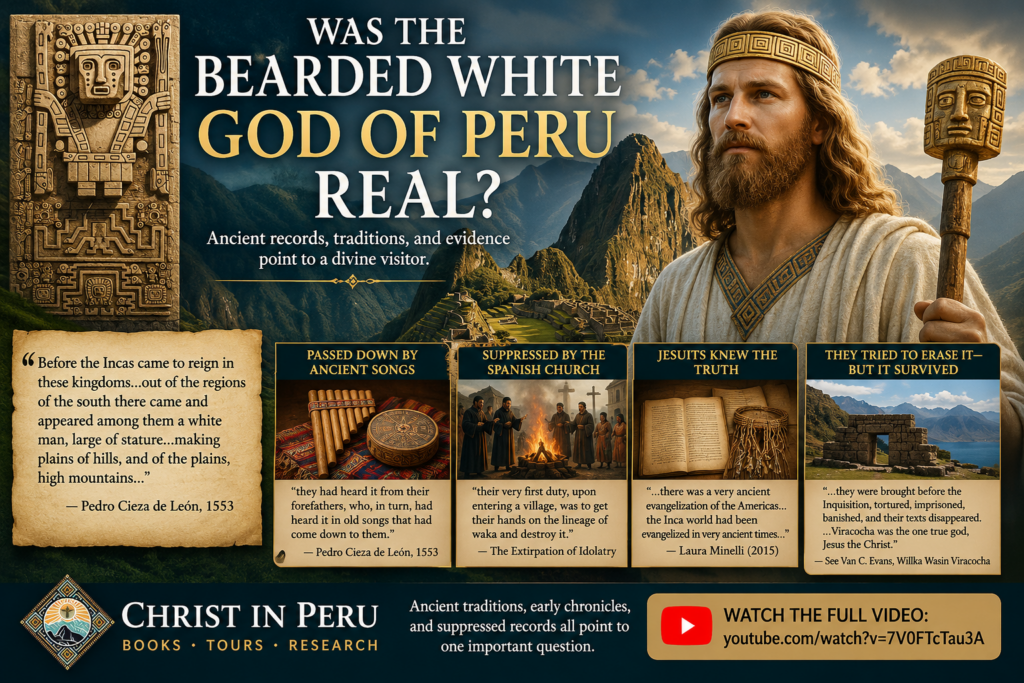
For centuries, traditions from the Andes have described a powerful divine figure known as Viracocha—a creator, teacher, and culture hero associated with light, order, and the origin of civilization.
Some accounts describe him as tall, bearded, and light-skinned. According to these traditions, he appeared among the people, performed extraordinary works, taught them, and then departed.
For Latter-day Saint readers, these stories naturally raise an important question:
Could the Andean traditions of Viracocha preserve a memory of Jesus Christ’s ministry among the ancient inhabitants of the Americas?
George Potter argues that the Viracocha tradition existed before the Spanish conquest and cannot simply be dismissed as a story invented under Catholic influence.
Was Viracocha Invented After the Spanish Conquest?
One skeptical explanation suggests that Indigenous people created or reshaped the story of Viracocha after the arrival of Spanish priests.
According to this theory, descriptions of a bearded or fair-skinned god may have been introduced to make Andean traditions more compatible with Christianity.
Potter strongly rejects that explanation.
He points to some of the earliest Spanish chroniclers, who recorded that Indigenous people believed the Viracocha tradition had been passed down from their ancestors through ancient songs and oral histories.
Rather than describing a recently created colonial story, these accounts present Viracocha as a figure from a distant age—one remembered long before the Incas came to power.
Pedro Cieza de León’s Account
One of the most important early sources is the Spanish chronicler Pedro Cieza de León.
Writing only about twenty years after the conquest of Peru, Cieza de León recorded traditions that he said predated both Spanish rule and the rise of the Inca Empire.
He described an ancient period of darkness and hardship, followed by the appearance of the sun from the region of Lake Titicaca.
After this event, according to the tradition, a remarkable man came from the south.
Cieza de León wrote that this man was described as white, large in stature, and worthy of great respect. He was said to possess extraordinary power, transforming the landscape and bringing water from the rocks. The people called him the Maker of all things.
When asked how they knew this story, the Indigenous informants reportedly explained that they had heard it from their forefathers, who had preserved it in old songs.
This detail is important because it presents the belief as an inherited tradition rather than a story created to satisfy Spanish missionaries.
Did Catholic Priests Encourage Belief in Viracocha?
The claim that Viracocha was invented to please Catholic priests faces another difficulty: many colonial priests actively opposed Indigenous religious traditions.
Spanish missionaries frequently attempted to destroy shrines, sacred images, ritual objects, and religious records connected with pre-Columbian beliefs.
Potter argues that the colonial Church did not encourage the worship of Viracocha. Instead, many priests considered Indigenous traditions dangerous and sought to eliminate them.
Missionary campaigns known as the extirpation of idolatry were designed to identify and destroy local sacred practices.
According to material quoted in the script, missionaries were instructed to investigate the religious traditions of each community and remove sacred objects associated with local worship.
This suggests that the survival of the Viracocha tradition cannot easily be explained as something created to gain approval from Catholic authorities.
Did Some Priests Believe the Incas Had Ancient Christian Traditions?
The story becomes even more complex when considering reports that some Jesuit scholars believed Andean religion contained traces of an earlier form of Christianity.
The script refers to documents sometimes associated with the Quito Manuscript, in which Quechua-speaking Jesuits reportedly recorded discussions with Andean sages and examined information connected with khipus.
According to the interpretation presented by anthropologist Laura Minelli, some Jesuits concluded that the Inca world may have experienced a very ancient evangelization.
They allegedly believed that the Incas should not be viewed simply as pagans, but as a people whose religion had retained elements resembling Christianity.
This interpretation remains debated and should not be treated as universally accepted by historians. Nevertheless, it illustrates that at least some colonial observers believed Andean religion contained traditions that could not be explained solely by post-conquest Catholic influence.
The Destruction of Indigenous Religious Records
The Spanish conquest transformed the religious landscape of the Andes.
Temples were destroyed or converted. Sacred objects disappeared. Religious specialists were punished, and many traditional records were lost.
Potter cites the argument that colonial authorities deliberately removed evidence linking the Inca world to traditions that resembled Christianity.
Some priests who defended Indigenous religious knowledge or questioned official policies reportedly faced investigation, imprisonment, exile, or censorship.
Because so much Indigenous material was destroyed, modern researchers must often rely on incomplete colonial accounts, surviving oral traditions, archaeological remains, and documents written by outsiders.
That makes the study of Viracocha difficult—but it also means that the absence of records cannot automatically be used to prove that the tradition never existed.
Was the Viracocha Tradition Widespread?
Another argument presented in the video is that the memory of a powerful creator or civilizing figure was not limited to one isolated village.
Related traditions were recorded across large areas of South America, including regions that are now part of Colombia, Ecuador, Peru, Bolivia, Brazil, Paraguay, Argentina, and Chile.
The names and details vary from culture to culture. It would therefore be misleading to assume that every story refers to the same historical individual.
Still, the wide distribution of creator figures, traveling teachers, and divine visitors is significant.
Potter interprets these traditions as possible cultural memories of visits by Jesus Christ to ancient South America.
From a faith-based perspective, this possibility is especially meaningful because the Book of Mormon teaches that the resurrected Christ ministered among peoples in the Americas.
What Does Archaeology Show?
The archaeological record contains many pre-Columbian images of supernatural or divine figures.
Some are shown with staffs, rays, elaborate headdresses, or human-like faces. One of the most famous examples is the central figure on the Gateway of the Sun at Tiwanaku in Bolivia.
Other representations appear in Andean textiles, ceramics, stone carvings, temple art, and ceremonial objects.
Potter argues that many of these images depict Viracocha and demonstrate that devotion to this figure existed long before the Spanish conquest.
However, interpreting ancient images requires caution.
Archaeologists do not universally agree that these figures depict one historical person, nor do they generally identify them as Jesus Christ. Some are interpreted as creator deities, weather gods, solar figures, ancestors, or symbols of political and religious authority.
The archaeological evidence clearly confirms the existence of powerful pre-Columbian religious traditions. The identification of those traditions with Christ remains a theological interpretation rather than an established archaeological conclusion.
The Temple, Statue, and Shield of Viracocha
Colonial accounts describe important sacred objects and places associated with Viracocha.
These reportedly included a major temple, a life-sized image, and a sacred emblem or shield in Cusco.
Potter also points to the great temple complex traditionally connected with Viracocha and to religious imagery found around Lake Titicaca.
These references strengthen the case that Viracocha was not a minor figure invented after the conquest. He occupied an important place in Andean religious memory.
The destruction or disappearance of many objects during the colonial period makes it difficult to reconstruct exactly how he was understood by different communities.
Could Viracocha Have Been Jesus Christ?
The strongest conclusion of the video is a religious one.
Potter believes that Viracocha was a real divine visitor and identifies him as Jesus Christ.
He sees several parallels:
- Viracocha was remembered as a creator.
- He was associated with light and the restoration of order.
- He reportedly possessed extraordinary power.
- He taught and traveled among the people.
- His memory survived through generations.
- Some traditions describe him as different in appearance from the people around him.
- Early colonial observers recognized similarities between his story and Christianity.
These parallels are intriguing, especially for believers in the Book of Mormon.
Yet they do not constitute definitive historical proof. The surviving traditions were recorded through colonial translators, often many centuries after the events they describe, and their wording may reflect both Indigenous and European concepts.
The possibility that Viracocha traditions preserve a memory of Christ is therefore best understood as a faith-based interpretation supported by selected historical and cultural parallels.
A Question Worth Exploring
The real question is not simply whether every detail in later Viracocha stories should be taken literally.
The more important issue is whether ancient Andean peoples possessed a profound pre-Christian tradition concerning a creator, teacher, and divine visitor.
The earliest colonial records strongly suggest that they did.
Those traditions existed in Indigenous memory, sacred places, ritual practices, and pre-Columbian art. They were not merely the product of modern speculation.
Whether Viracocha was Jesus Christ remains a matter of faith, interpretation, and continuing research.
For Latter-day Saints, the possibility provides a compelling way to examine the Book of Mormon alongside the religious heritage of the Andes.
Watch the Full Video
To learn more about the historical accounts of Viracocha, the writings of Pedro Cieza de León, colonial attempts to suppress Indigenous traditions, and the possible connection with Jesus Christ, watch the complete video:
Was the Bearded White God of Peru Real? — Watch on YouTube
You can also visit ChristInPeru.com to learn more about our books, research, videos, and annual tours to Peru.