
Have you ever seen something that made you wonder whether it could be more than just a coincidence?
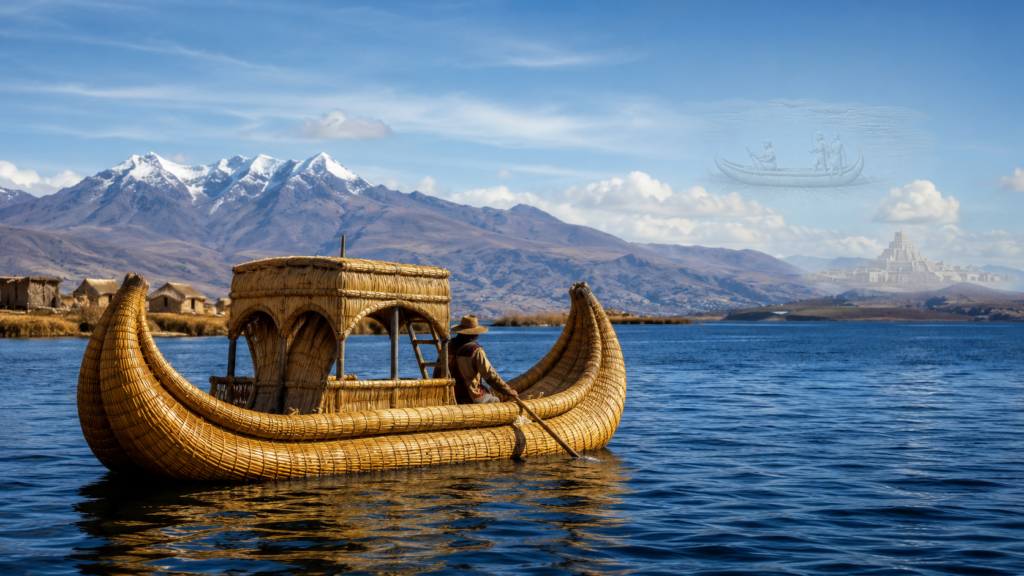
For George Potter, that moment occurred while he was serving as a missionary in Bolivia and saw Lake Titicaca for the first time. On its waters, he encountered a living tradition that appeared to connect the Andes with a technology used thousands of years ago on the other side of the world: boats constructed from bundles of reeds.
This immediately raised an intriguing question:
What were boats resembling those of ancient Mesopotamia doing in the middle of the Andes, more than 12,500 feet above sea level?
An Ancient Tradition That Remains Alive
Lake Titicaca is located between Peru and Bolivia at an elevation of approximately 12,500 feet, or 3,800 meters, above sea level.
For generations, communities in the region—especially the Uros people—have used totora reeds to construct floating islands, homes, and boats. The boat-building process involves gathering, compressing, and tying together large quantities of reeds until they form a structure capable of floating and traveling across the lake.
Despite the arrival of modern materials and technology, skilled artisans continue to preserve the traditional knowledge needed to build these distinctive vessels.
What makes this tradition especially fascinating is that ancient civilizations in Mesopotamia also constructed boats from reeds using visually similar techniques.
The Reed Boats of Mesopotamia
In ancient Sumer and other areas of Mesopotamia, marshes and aquatic plants were essential to everyday life. Reeds were used to build homes, household objects, and boats for fishing, transportation, and trade.
Ancient images and models show vessels with elevated, curved ends. This design helped maintain the shape of the boats and gave them a distinctive twin-peaked appearance.
In his book Discovering the Amazing Jaredites, George Potter examines these ancient vessels and proposes that some of their characteristics can be compared with the description of the ships built by the Jaredites in the Book of Mormon.
From this perspective, the maritime technology of the ancient Near East may provide useful historical context for imagining how Jaredite vessels could have been constructed.
Caral and the Ancient Civilizations of Peru
Another important part of this investigation is the ancient civilization of Caral, located along the north-central coast of Peru.
Caral is recognized as one of the oldest urban civilizations in the Americas. Its development began thousands of years ago, during a period contemporary with some of the early civilizations of Egypt and Mesopotamia.
The existence of an advanced society in Peru during this ancient period is particularly interesting to those who study possible geographical settings for events described in the Book of Mormon.
Potter proposes that people associated with the Jaredites may have initially settled near the Pacific coast, possibly in areas connected with the civilization of Caral. According to his interpretation, some groups may later have migrated toward the Altiplano and Lake Titicaca during the time of the great Jaredite drought.
By analyzing the ages and reigns of the Jaredite kings, Potter places this migration at approximately 1600 BC. This period is significant because it corresponds generally with the time archaeologists believe the Lake Titicaca region began to experience increasing settlement and cultural development.
This proposal represents the author’s interpretation of religious texts, chronology, archaeology, and cultural similarities. It is not presented as a conclusion accepted by mainstream archaeology, but it offers an interesting line of inquiry for those exploring the Book of Mormon through history, geography, and scientific investigation.
Similar Technologies in Mesopotamia and the Andes
One of the most striking comparisons between ancient Mesopotamia and the Andes is the use of reeds to construct boats.
In parts of the Middle East, reeds are still used today to build traditional vessels. Likewise, totora reeds continue to be used by boat builders around Lake Titicaca in both Peru and Bolivia.
The similarities include:
- Boats constructed from tightly bound bundles of reeds
- Elevated and curved ends
- Decorative figures or animal heads placed on the bow
- Specialized techniques for maintaining the vessel’s shape
- The use of locally available plants for transportation and navigation
These similarities do not necessarily prove that direct contact occurred between Mesopotamia and ancient South America. Different societies can develop comparable solutions when they have access to similar materials and face similar environmental challenges.
Nevertheless, the resemblance between the two boat-building traditions is remarkable and continues to raise questions about the skills, migrations, and maritime capabilities of ancient peoples.
Thor Heyerdahl and the Ra Expeditions
The famous Norwegian explorer Thor Heyerdahl was among the first modern researchers to publicly compare the reed boats of Lake Titicaca with those of ancient Mesopotamia.
Heyerdahl wanted to demonstrate that ancient people possessed vessels capable of completing long-distance ocean voyages.
In 1969, he launched his first reed ship, named Ra, from the coast of Morocco. The vessel had been constructed with the help of traditional boat builders from Lake Chad in Africa.
However, during the Atlantic crossing, the ship began to lose its structural integrity. The crew was eventually forced to abandon the vessel before completing the journey.
Heyerdahl did not give up.
For his second attempt, he sought the assistance of experienced Indigenous boat builders from Lake Titicaca in Bolivia. Rather than relying exclusively on builders from Africa or the Middle East, Heyerdahl turned to artisans who had inherited generations of knowledge about working with tightly bundled reeds.
These Bolivian craftsmen helped construct a new vessel called the Ra II, designed as a replica inspired by ancient reed ships.
In 1970, the Ra II successfully crossed the Atlantic Ocean and arrived in Barbados after a journey of several thousand miles.
The expedition did not prove that a particular ancient migration had taken place. However, it demonstrated that a properly constructed reed vessel could survive a long journey across the open ocean.
It also revealed the extraordinary skill of the traditional boat builders from Lake Titicaca.
More Than a Coincidence?
The reed boats of Lake Titicaca provide a fascinating example of ancient knowledge that remains alive in the modern world.
Their similarities to the vessels of Mesopotamia invite us to consider several possibilities. Perhaps comparable environments led ancient societies to develop similar technologies independently. Perhaps knowledge traveled farther than modern researchers once believed. Or perhaps there are still important chapters of human history waiting to be discovered.
For students of the Book of Mormon, these boats are especially significant because they provide a real-world example of how ancient people could have built large and durable vessels using natural materials.
They do not independently prove the Book of Mormon narrative, but they can help readers better understand the technological possibilities available to ancient civilizations.
Experience the Reed Boats of Lake Titicaca
A visit to Lake Titicaca is much more than an opportunity to see one of the most beautiful landscapes in the Andes.
It is also an opportunity to encounter a remarkable tradition of ancient engineering. Visitors can see how totora reeds are gathered, prepared, tied together, and transformed into vessels capable of navigating the waters of the lake.
Through our annual tours to Peru, travelers can explore places connected with archaeology, ancient history, and possible Book of Mormon settings. One of the highlights is the opportunity to visit Lake Titicaca and experience its famous reed boats firsthand.
Watch the Full Video
To learn more about the reed boats of Mesopotamia, the traditional vessels of Lake Titicaca, Thor Heyerdahl’s expeditions, and their possible connection with the Jaredite account, watch the full video:
Reed Ships: Discovering the Book of Mormon Through Science and Exploration
You can also visit ChristInPeru.com to learn more about our books, research, and annual tours to Peru.