
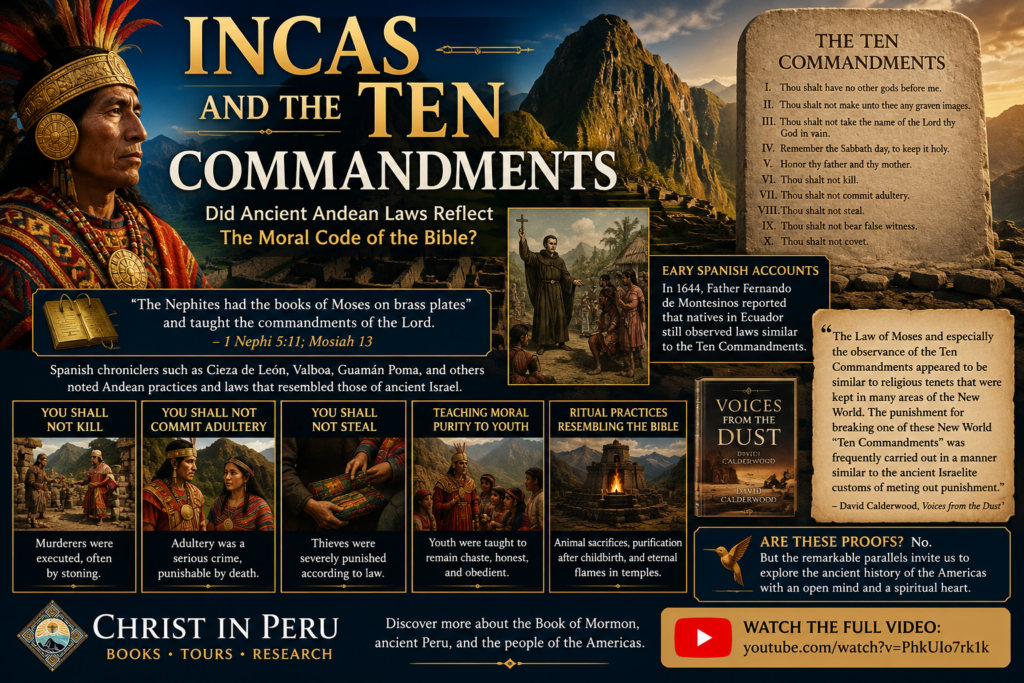
Imagine exploring a remote part of the South American rainforest and encountering a community whose moral laws appeared remarkably similar to the Ten Commandments.
According to accounts discussed by George Potter, something like this was reported nearly four centuries ago in the region of present-day Ecuador. Early Spanish chroniclers and missionaries encountered Indigenous traditions that reminded them of laws and religious practices found in the Old Testament.
Could these similarities preserve traces of ancient Israelite teachings in the Americas?
For readers of the Book of Mormon, the question is especially interesting because the Nephites possessed the brass plates, which contained the writings of Moses, and they continued to teach the commandments of God in the promised land.
The Law of Moses in the Book of Mormon
The Book of Mormon explains that Lehi’s family brought the brass plates from Jerusalem.
According to 1 Nephi 5, these records included:
- The five books of Moses
- A history of Israel
- The words of the prophets
- Genealogical records
The Nephites therefore would have known the Law of Moses, including the Ten Commandments.
In Mosiah 13, the prophet Abinadi teaches the commandments to King Noah and his priests. His sermon closely follows the biblical commandments concerning worship, idolatry, reverence for God, the Sabbath, parents, murder, adultery, theft, false witness, and coveting.
The Book of Mormon presents these laws as a continuing part of Nephite religious life.
Spanish Reports From the Andes
The video points to early Spanish historians who believed that certain Andean laws and customs resembled those of ancient Israel.
Among the chroniclers mentioned are:
- Pedro Cieza de León
- Miguel Cabello Valboa
- Felipe Guamán Poma de Ayala
- Fernando de Montesinos
These writers recorded information about Indigenous religion, law, morality, ritual, and social organization during the early colonial period.
Their descriptions were influenced by their own European and Christian worldview, so they must be interpreted carefully. Still, their writings preserve valuable observations about traditions that existed when Spanish rule was first being established.
According to the argument presented in the video, Montesinos encountered Indigenous people who were still observing a set of moral principles comparable to the Ten Commandments.
Other chroniclers also identified similarities between Andean customs and practices described in the Old Testament.
Moral Laws in Inca Society
The Inca Empire maintained a highly organized legal system.
Its laws emphasized obedience, social order, family responsibilities, work, loyalty, and respect for state and religious authority.
The script highlights several offenses that received serious punishment in Inca society:
- Murder
- Adultery
- Theft
- Sexual misconduct
- Religious violations
- Rebellion against authority
Some punishments were extremely severe and could include execution.
David Calderwood, quoted in the source material, argues that moral laws resembling the Ten Commandments appeared in different parts of the pre-Columbian Americas. He also notes that punishments for violating these laws were sometimes carried out in ways comparable to ancient Israelite practices.
These similarities form the central basis of the comparison between Inca law and the commandments preserved in the Bible and the Book of Mormon.
“You Shall Not Murder”
The commandment against murder was reflected in Inca law through severe penalties for unlawful killing.
Murder threatened not only an individual life but also the order of the community and the authority of the state.
Those found guilty could face execution.
This resembles the seriousness with which murder was treated under the Law of Moses and in the Book of Mormon, where intentional killing was considered one of the gravest possible offenses.
However, the existence of laws against murder is not unique to Israelite or Andean civilization. Nearly every organized society develops rules against unlawful killing.
The more meaningful question is whether the broader combination of laws, punishments, and religious practices creates a recognizable pattern.
“You Shall Not Commit Adultery”
Inca society also treated adultery as a serious violation.
Marriage and family order were closely connected with social stability. Adultery could therefore be punished harshly, sometimes by death.
The video compares this practice with penalties found in the Old Testament, where adultery was treated as both a moral and communal offense.
The Book of Mormon also strongly condemns sexual immorality. Prophets repeatedly taught chastity and warned that serious sexual sins could damage individuals, families, and societies.
The Inca concern with marital fidelity therefore provides another cultural parallel, though not proof of direct Israelite influence.
“You Shall Not Steal”
The Inca state depended on cooperation, labor, taxation, agriculture, and the careful distribution of resources.
Theft undermined this system.
According to the script, thieves were severely punished. In some cases, penalties could be much more severe than those imposed in modern legal systems.
This strong prohibition resembles the commandment “You shall not steal.”
It also reflects a broader Andean moral ideal sometimes summarized through traditional sayings encouraging people not to steal, lie, or be lazy.
Although the exact antiquity and wording of these formulas are debated, they reflect the importance of honesty and responsibility in Andean cultural memory.
Sexual Morality and the Education of Youth
The video also argues that the Incas taught young people to remain morally pure.
Education in the Inca world was closely connected with preparation for one’s social and religious responsibilities.
Young people were expected to obey authorities, fulfill assigned duties, respect family structures, and maintain conduct considered appropriate for their role.
This emphasis on moral formation parallels Book of Mormon teachings directed toward children and young adults.
Prophets such as Alma counseled their sons to avoid immorality, remember the commandments, and develop spiritual discipline.
Ritual Practices Resembling the Old Testament
The comparison is not limited to moral laws.
The script mentions several Andean practices that early Spanish observers associated with the Law of Moses:
- Animal sacrifice
- Ritual purification after childbirth
- Sacred fires maintained in temples
- Religious specialists
- Purity regulations
- Severe penalties for breaking sacred laws
These similarities are intriguing because they involve more than general ethical rules.
Animal sacrifice, ritual cleanliness, and sacred temple fire all appear in the religious systems of ancient Israel.
Nevertheless, similar practices also developed independently in many cultures. Sacrifice, purification, and sacred fire are widespread religious phenomena.
The challenge is determining whether the Andean examples represent direct historical transmission, common human religious patterns, or later interpretations by Christian chroniclers.
The Eternal Flame
The script refers to the keeping of a sacred or eternal flame in Andean temples.
Fire played an important role in Inca religion, especially in ceremonies connected with the sun, sacrifice, purification, and state ritual.
The maintenance of sacred fire invites comparison with biblical temple traditions, where fire had ceremonial significance and was not to be treated casually.
For believers exploring a Book of Mormon setting in South America, such parallels may appear especially meaningful.
From a historical perspective, however, sacred fire alone cannot establish a connection with ancient Israel because many unrelated religions preserved perpetual or ceremonial flames.
Cleanliness After Childbirth
The video also notes reports of ceremonial practices following childbirth.
The Law of Moses contained detailed regulations concerning childbirth, purification, and the return of a mother to ritual participation.
Some Andean societies likewise practiced periods of separation, cleansing, or ceremonial reintegration after birth.
These customs may have practical, social, symbolic, or religious explanations.
Their resemblance to Old Testament purity laws is worth examining, but it should not be presented as definitive evidence without further documentation.
Animal Sacrifice
Animal sacrifice was common in the ancient Andes.
Llamas and other animals were offered in important ceremonies connected with agriculture, political authority, divination, temples, and major events.
The Israelites also offered animal sacrifices under the Law of Moses.
For Book of Mormon readers, this comparison is relevant because the Nephites continued performing sacrifices according to the Law of Moses until the coming of Jesus Christ.
After Christ’s resurrection, the Book of Mormon teaches that animal sacrifice was replaced by the offering of a broken heart and a contrite spirit.
Andean animal sacrifice therefore creates an interesting point of comparison, although the meanings and rituals were not necessarily the same.
Similarity Does Not Automatically Mean Direct Connection
It is important to distinguish resemblance from proof.
Laws against murder, adultery, and theft appear in many civilizations because societies require basic rules to survive.
Likewise, sacrifice, ritual cleansing, and sacred fire developed in many religious systems without direct contact with ancient Israel.
Early Spanish chroniclers may also have described Indigenous traditions using familiar biblical categories. When they encountered an unfamiliar law or ritual, they sometimes compared it with something they already knew from Christianity or the Old Testament.
Their accounts remain valuable, but they were not neutral modern anthropological reports.
Why the Parallels Matter to Book of Mormon Readers
The significance of these similarities lies in their combined pattern.
The Book of Mormon describes an ancient American civilization that inherited:
- The books of Moses
- The Ten Commandments
- Animal sacrifice
- Temple worship
- Ritual purity traditions
- Prophetic teaching
- Laws regulating morality and social behavior
The Andes contained civilizations with complex legal systems, temple rituals, sacrifices, sacred fires, moral instruction, and severe penalties for certain violations.
These parallels do not independently prove that the Incas were descendants of the Nephites or that their laws came directly from the brass plates.
They do demonstrate, however, that religious and social practices resembling parts of the Old Testament could exist in ancient American settings.
For believers, that cultural plausibility is meaningful.
Were the Incas Practicing the Ten Commandments?
The answer depends on how the question is understood.
The Incas did not preserve a known written tablet containing the biblical Ten Commandments in their familiar form.
There is also no mainstream archaeological consensus that Inca law derived directly from Moses or ancient Israel.
What the historical record does show is that the Incas maintained strong laws against murder, adultery, theft, and other conduct regarded as destructive to society.
They also practiced rituals that some early Spanish writers compared with Old Testament traditions.
Calling these laws “the Ten Commandments” is therefore an interpretation based on similarities rather than a firmly established historical identification.
An Invitation to Explore
The relationship between the Book of Mormon and ancient South America continues to inspire research, travel, and religious reflection.
The Andean world offers an extraordinary record of temples, legal systems, sacred traditions, moral teachings, and highly organized civilizations.
Studying these cultures does not require dismissing either faith or historical caution.
Instead, it invites us to examine the sources carefully, acknowledge the limits of the evidence, and consider why certain parallels have captured the attention of believers and explorers for generations.
Watch the Full Video
To learn more about Inca law, early Spanish chroniclers, the Ten Commandments, and possible connections with Book of Mormon culture, watch the complete video:
The Incas and the Ten Commandments — Watch on YouTube
You can also visit ChristInPeru.com to learn more about our books, research, videos, and annual tours to Peru.