
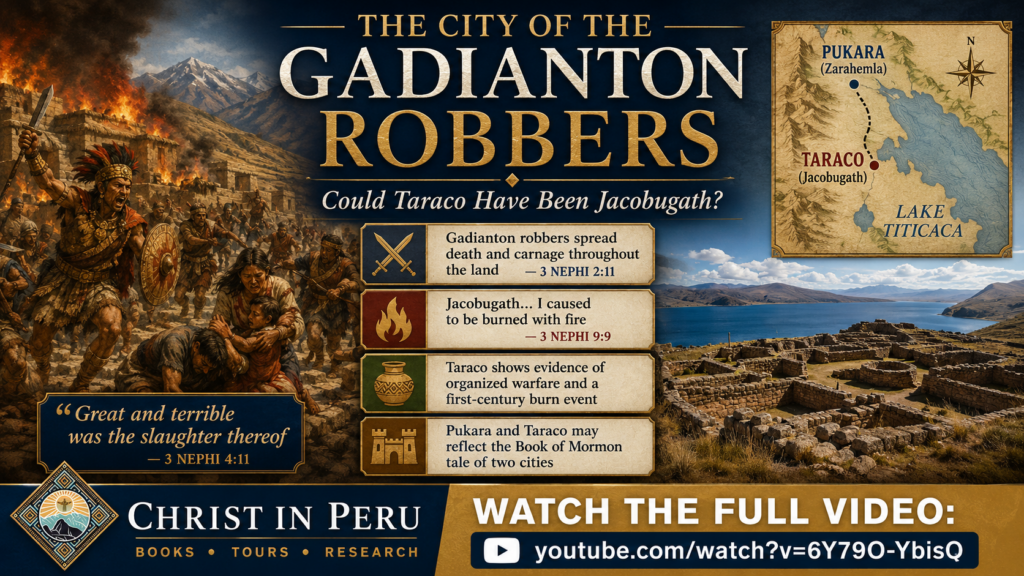
The Book of Mormon describes the Gadianton robbers as one of the most dangerous forces in Nephite history.
They were more than ordinary thieves. They formed a secret organization held together by oaths, political ambition, violence, and the pursuit of wealth. Over time, they became powerful enough to destroy cities, challenge governments, and force both Nephites and Lamanites to unite against them.
George Potter proposes that recent archaeological research in the northern Lake Titicaca Basin may offer a possible real-world setting for this conflict.
In particular, he compares the ancient city of Taraco with the Book of Mormon city of Jacobugath, a stronghold associated with the Gadianton robbers.
The Rise of the Gadianton Robbers
By the early first century AD, the Gadianton robbers had become a major military and political threat.
The Book of Mormon states:
“And it came to pass in the thirteenth year since the birth of Christ there began to be wars and contentions throughout all the land; for the Gadianton robbers had become so numerous, and did slay so many of the people and did lay waste so many cities, and did spread so much death and carnage throughout the land, that it became expedient that all the people, both the Nephites and the Lamanites, should take up arms against them.”
—3 Nephi 2:11
The robbers operated through secret combinations and used murder, plunder, intimidation, and political infiltration to gain influence.
According to the Book of Mormon, they became especially successful when the Nephites themselves fell into pride and wickedness.
Jacobugath: A City of Unusual Wickedness
The city of Jacobugath is mentioned in connection with a group led by King Jacob.
When Nephite society collapsed into factions, Jacob and his followers established themselves as an independent people.
The city later received one of the strongest condemnations in the Book of Mormon.
Speaking after the destruction associated with His death, the Lord declared:
“And behold, that great city Jacobugath, which was inhabited by the people of king Jacob, have I caused to be burned with fire because of their sins and their wickedness, which was above all the wickedness of the whole earth.”
—3 Nephi 9:9
Jacobugath was therefore not merely a troubled settlement. It was described as a great city and as a center of extraordinary corruption.
Potter identifies it as the likely stronghold of the Gadianton robbers.
The Nephite Response
By approximately AD 15, the Gadianton robbers were confident enough to demand the surrender of the Nephite government.
Their leader sent a threatening letter to Lachoneus, the chief governor, promising destruction if the people refused to join them.
Lachoneus did not surrender.
Instead, he responded through faith, organization, and preparation.
He:
- Called upon the Lord for strength.
- Gathered the people and their herds.
- Constructed defensive fortifications.
- Appointed guards.
- Encouraged the people to repent.
- Prepared them to defend themselves as one united population.
The military commander Gidgiddoni also rejected the idea of pursuing the robbers into their mountain territory.
Instead, he declared:
“We will prepare ourselves in the center of our lands, and we will gather all our armies together, and we will not go against them, but we will wait till they shall come against us.”
—3 Nephi 3:21
This strategy deprived the robbers of easy targets and forced them into open battle.
A War of Enormous Scale
When the Gadianton armies finally attacked, the resulting conflict was catastrophic.
The Book of Mormon describes the slaughter as greater than any previously known among the descendants of Lehi:
“Great and terrible was the slaughter thereof, insomuch that there never was known so great a slaughter among all the people of Lehi since he left Jerusalem.”
—3 Nephi 4:11
The robbers were defeated and forced to retreat.
The Nephite armies pursued them toward the borders of the wilderness.
Potter argues that the geography of this campaign may correspond with the northern Lake Titicaca Basin, where mountain wilderness, large ancient settlements, and evidence of organized warfare all appear within a relatively compact region.
Pukara and Taraco
The archaeological comparison centers on two important ancient sites:
- Pukara, which Potter proposes as a candidate for Zarahemla.
- Taraco, which he proposes as a candidate for Jacobugath.
Both were major settlements in the northern Titicaca Basin during the relevant general period.
According to the script, Pukara may have had a population of approximately 10,000 people, while Taraco may have contained around 5,000 inhabitants.
For the ancient Andes, both would have qualified as substantial urban centers.
They were also located close enough to have competed for land, resources, trade, and political influence.
Archaeological Evidence of Organized Warfare
Archaeologists Charles Stanish and Abigail Levine studied warfare and political development in the Titicaca Basin.
Their research describes a cultural landscape shaped by organized raiding and violent competition between emerging political centers from approximately 500 BC to AD 400.
The study cited in the script states:
“It is precisely such a cultural landscape that provides the fertile ground for the emergence of first-generation states. In this article, we focus on a case of organized raiding and warfare between competing polities in the Titicaca Basin of southern Peru from ca. 500 BCE to AD 400 as a major factor in first-generation state formation.”
This description is significant because the Book of Mormon portrays the Gadianton robbers as an organized military and political force rather than a loose collection of criminals.
Was Taraco Destroyed by Pukara?
The archaeological evidence suggests that Taraco suffered a major violent destruction.
Research cited in the script proposes that Pukara may have attacked Taraco, killed many people, and ended its role as a major political power.
One summary states:
“Their results suggest Pukara waged a violent war against Taraco, possibly killing hundreds with their weapons before burning the state to the ground.”
This creates a striking parallel with the Book of Mormon account of the Nephite armies defeating the Gadianton robbers and driving them back toward their strongholds.
Potter interprets Pukara as Zarahemla and Taraco as Jacobugath.
Under this model, the war between the two ancient centers may reflect the conflict described in 3 Nephi.
Geography of the Proposed Model
The script also emphasizes geography.
Jacobugath would likely have been south of Zarahemla because the robbers are described as coming “up” to battle and then retreating back toward their territory.
Taraco is located southeast of Pukara near Lake Titicaca.
Potter interprets this location as consistent with:
- A robber stronghold near a wilderness.
- A major city south of Zarahemla.
- A location near an “east sea,” which he identifies with Lake Titicaca.
- A route by which armies could descend from mountainous territory into open battle.
This arrangement is central to his argument.
Wealth, Raiding, and Social Inequality
The Gadianton robbers became powerful by stealing, raiding, murdering, and controlling wealth.
The Book of Mormon also describes serious social inequality shortly before Christ’s visit.
By AD 29, the Nephites were:
“Lifted up unto pride and boastings because of their exceeding great riches.”
—3 Nephi 6:10–14
Archaeological evidence from Taraco indicates the existence of high-status residential areas and luxury goods before the city’s destruction.
Stanish and Levine reported that a high-status section of Taraco was burned during the first century AD and that economic activity declined dramatically afterward.
Potter interprets this evidence as consistent with a city enriched by raiding, political power, and social inequality.
A City Burned in the First Century AD
One of the strongest parallels is the evidence that Taraco was intentionally burned.
According to the archaeological description, the fire was so intense that parts of the adobe superstructure melted.
Thatched roofs and wooden beams were completely carbonized, suggesting a rapid and violent destruction event rather than gradual abandonment.
The script emphasizes that radiocarbon evidence places the destruction in the first century AD.
This chronological overlap is what makes Taraco especially interesting within Potter’s model.
Jacobugath, according to the Book of Mormon, was also burned during the first century AD.
Was Taraco Rebuilt?
The Book of Mormon suggests that cities destroyed during the Gadianton wars were later rebuilt.
Jacobugath must have existed again by the time of Christ’s death because it was specifically named among the cities destroyed at that time.
The archaeological record at Taraco shows several phases of construction and rebuilding.
Potter interprets this as another correspondence:
- Taraco was attacked and burned.
- It later recovered.
- It was burned again or experienced another major destruction.
- Its political and economic character changed afterward.
Although the exact sequence remains a matter of archaeological interpretation, the rebuilding pattern adds to the proposed comparison.
The Decline of Luxury Goods
After the burn event, archaeologists found a dramatic decrease in finely decorated pottery at Taraco.
The proportion reportedly fell from approximately 12 percent to 2 percent.
The researchers interpreted this as evidence of a major shift in ritual and political activity.
Potter links this change with the society described in 4 Nephi.
After Christ’s ministry, the people were united and had all things in common. The record states that there were no rich or poor among them.
Under Potter’s interpretation, Taraco’s decline in luxury production and increased agricultural focus could reflect a shift toward greater equality after the destruction and rebuilding of Jacobugath.
The Tale of Two Cities
The video ultimately presents a comparison between two cities:
Zarahemla and Pukara
Both are presented as large, influential political centers.
In the Book of Mormon, Zarahemla experienced cycles of righteousness and wickedness but remained central to Nephite government and defense.
Potter identifies Pukara as a possible archaeological counterpart.
Jacobugath and Taraco
Both are presented as rival cities associated with warfare, wealth, destruction, and burning.
Jacobugath was ruled by King Jacob and described as exceptionally wicked.
Taraco was a major center that appears to have been violently attacked and burned during the same broad era.
Potter sees this as a possible archaeological reflection of the conflict between Zarahemla and the Gadianton stronghold.
What the Archaeology Does—and Does Not—Prove
The archaeological evidence demonstrates several important facts:
- Pukara and Taraco were major ancient centers.
- Warfare and organized raiding occurred in the Titicaca Basin.
- Taraco had high-status residential areas.
- The city experienced a severe burn event.
- Its political and economic influence declined afterward.
- Luxury production decreased significantly.
What archaeology does not establish is that Taraco was called Jacobugath or that its inhabitants were Gadianton robbers.
Those identifications are Potter’s interpretation based on geography, chronology, warfare, destruction, and social patterns.
Mainstream archaeologists do not identify Taraco as a Book of Mormon city.
Still, the parallels make it a compelling site for those exploring a possible Andean setting for the Book of Mormon.
A City Worth Investigating
Taraco provides an unusual combination of characteristics:
- A large population.
- Proximity to another major political center.
- Evidence of violent warfare.
- A high-status district.
- A first-century burn event.
- Rebuilding and economic change.
- Decline in luxury goods after destruction.
These characteristics closely resemble several elements in the Book of Mormon’s account of Jacobugath and the Gadianton wars.
They do not settle the question, but they invite further study.
Watch the Full Video
To learn more about the Gadianton robbers, Jacobugath, the archaeological discoveries at Taraco, and the proposed connection with Pukara and Zarahemla, watch the complete video:
The City of the Gadianton Robbers — Watch on YouTube
You can also visit ChristInPeru.com to explore our books, research, videos, and annual tours to Peru.