
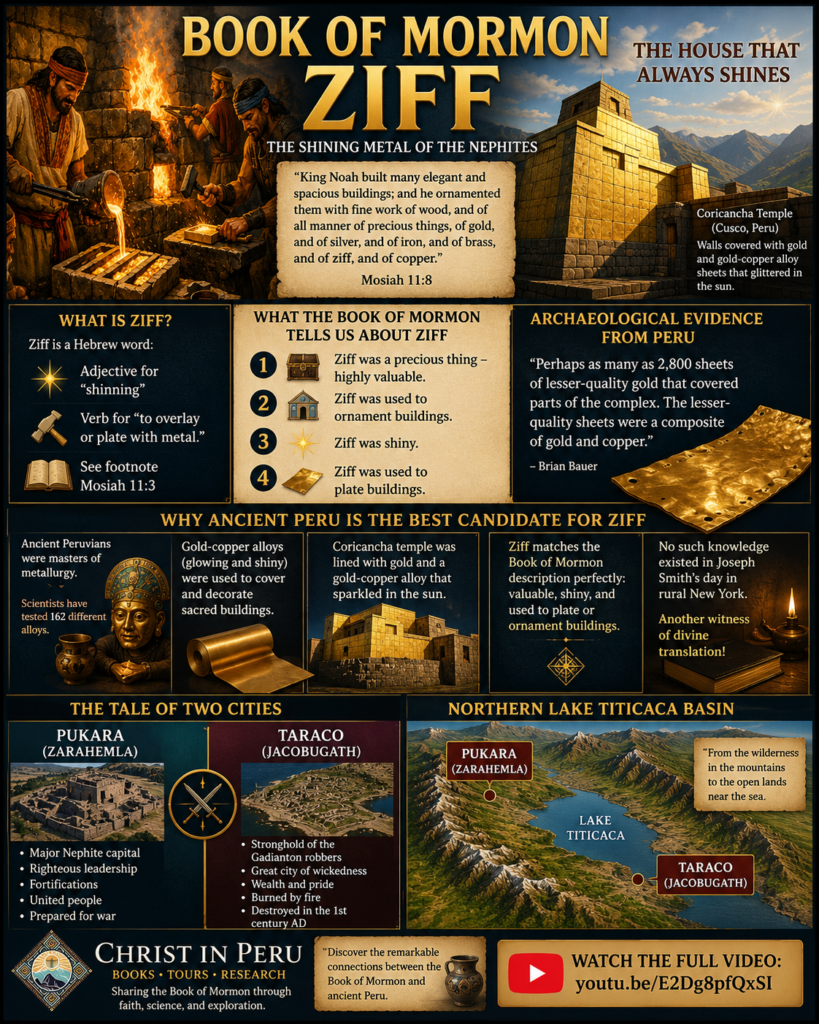
The Book of Mormon describes the Nephites as skilled metalworkers.
They worked with gold, silver, copper, iron, brass, and even forms of steel. But the record also mentions a mysterious material called ziff.
What exactly was ziff?
Unlike gold, silver, or copper, the word has no familiar modern English meaning. George Potter proposes that ziff may have been a brilliant gold-and-copper alloy used in ancient Peru to cover and decorate important buildings.
Where Does the Book of Mormon Mention Ziff?
Ziff appears in the account of King Noah, who used the wealth of his people to construct elaborate buildings.
Mosiah 11:8 states:
“King Noah built many elegant and spacious buildings; and he ornamented them with fine work of wood, and of all manner of precious things, of gold, and of silver, and of iron, and of brass, and of ziff, and of copper.”
This passage gives several clues.
Ziff was:
- Considered valuable
- Listed among metals
- Used ornamentally
- Associated with luxurious buildings
- Distinct from gold, silver, brass, iron, and copper
That last point is especially important. If ziff were simply another name for copper or brass, there would be little reason to list it separately.
Was Ziff a Metal or an Alloy?
Potter argues that ziff may not have been a single metallic element.
Instead, it may have been an alloy—a material created by combining two or more metals.
When Joseph Smith translated the Book of Mormon in 1829, familiar alloys such as brass and pewter already had established English names. Yet the translation preserves the unfamiliar term “ziff.”
This may suggest that the original material did not have an exact English equivalent familiar to Joseph Smith.
The Book of Mormon itself does not define the substance, so any identification remains interpretive. Still, the context strongly suggests a valuable, decorative metallic material.
The Proposed Hebrew Connection
The script also presents a possible Hebrew connection.
It associates the word ziff with meanings related to:
- Shining
- Brightness
- Overlaying
- Plating with metal
The presentation summarizes ziff as something shiny and used to ornament or plate buildings.
Potter argues that this meaning fits the way King Noah used the material.
Ziff was not merely a metal stored as wealth. It was part of the visual splendor of his buildings.
The exact linguistic origin of the Book of Mormon term remains debated, and it should not be treated as a universally accepted Hebrew translation. Nevertheless, the association with brightness and plating provides an interesting clue.
Ancient South American Metallurgy
Ancient South Americans were extraordinarily skilled metallurgists.
Pre-Columbian artisans in Peru and Bolivia worked with:
- Gold
- Silver
- Copper
- Tin
- Arsenic
- Platinum
- Bronze
- Gold-copper alloys
- Silver-copper alloys
They did not always value metals for practical strength alone.
Color, brilliance, sound, reflectivity, and religious symbolism were often just as important.
Andean metalworkers deliberately altered the proportions of gold, copper, and silver to produce different colors and surface effects.
Some objects only appeared to be made from pure gold. Their cores could contain copper-rich alloys whose surfaces had been treated to create a golden shine.
This sophisticated technology makes ancient Peru a plausible place to search for a material matching the Book of Mormon’s description of ziff.
Why Mix Gold and Copper?
Pure gold is beautiful, but it is also soft and expensive.
Mixing gold with copper offers several advantages:
- It makes the material harder.
- It reduces the amount of pure gold required.
- It allows large decorative sheets to be produced more economically.
- It creates colors ranging from brilliant yellow to reddish gold.
- It preserves a highly reflective appearance.
For rulers and temple authorities, a gold-and-copper alloy could create the visual impression of enormous wealth while using less pure gold.
Such a material would reasonably qualify as a “precious thing.”
Coricancha: The Shining Temple of Cusco
Potter connects ziff with the famous Coricancha temple in Cusco.
Coricancha was one of the most important religious structures in the Inca world. It is commonly associated with solar worship, although the script also connects its earlier religious history with Viracocha.
According to colonial descriptions, parts of the temple were covered with metallic sheets.
The eastern-facing wall was reportedly lined with plates of high-quality gold, while other sections were decorated with sheets containing gold and copper.
When sunlight struck the metal-covered walls, the temple would have produced a dazzling effect.
The script notes a traditional interpretation of the temple’s name as:
“The House That Always Shines.”
Whether this was its literal original name or a later traditional explanation, the phrase captures the visual effect of the metallic architecture described by colonial sources.
Thousands of Metal Sheets
Archaeologist Brian Bauer is quoted in the script as describing a very large number of metallic sheets taken from the Coricancha complex.
The presentation states:
“Perhaps as many as 2,800 sheets of lesser-quality gold that covered parts of the complex. The lesser-quality sheets were a composite of gold and copper.”
This description closely matches the characteristics Potter associates with ziff.
The material was:
- Valuable
- Shiny
- Made partly from gold
- Combined with copper
- Formed into sheets
- Used to cover and decorate a sacred building
That does not prove the alloy was called ziff, but the functional comparison is striking.
Ziff as Architectural Plating
The Book of Mormon states that King Noah ornamented his buildings with ziff.
The Peruvian gold-copper sheets were likewise architectural decorations rather than ordinary tools or weapons.
This may explain why ziff appears in a list of luxurious construction materials.
King Noah’s buildings were designed to display wealth, authority, and pride. Shining metallic panels would have served that purpose perfectly.
They could have covered walls, doorways, columns, sacred objects, or decorative features.
In this interpretation, ziff may not describe a metal by its chemical composition. It may instead identify a particular kind of brilliant plated material or decorative alloy.
Was Ziff Tumbaga?
One possible comparison is tumbaga, a name commonly used for pre-Columbian gold-and-copper alloys.
Tumbaga could contain widely varying proportions of gold and copper.
Andean metalworkers used surface-enrichment techniques to remove copper from the outer layer, leaving the object with the appearance of nearly pure gold.
This made it possible to create impressive golden objects and sheets using relatively small quantities of gold.
The Book of Mormon never uses the word tumbaga, and the script does not claim the terms are linguistically identical.
However, tumbaga demonstrates that ancient American civilizations possessed exactly the kind of shiny, valuable gold-copper material Potter proposes for ziff.
Why Would Joseph Smith Preserve an Unfamiliar Word?
Potter argues that Joseph Smith used familiar English names whenever an equivalent existed.
The translation says gold, silver, iron, brass, and copper because those terms were readily available.
The preservation of “ziff” may therefore indicate that the original term referred to something for which Joseph Smith had no precise English word.
This is possible, although translators may preserve unfamiliar terms for many reasons.
The word could represent:
- A specific alloy
- A decorative metal treatment
- A culturally unique material
- A technical metallurgical term
- A transliterated word from the original record
The Book of Mormon offers too little information to determine which explanation is correct.
Did Joseph Smith Know Hebrew?
The script emphasizes that Joseph Smith translated the Book of Mormon years before formally studying Hebrew.
His organized Hebrew studies began in Kirtland during the 1830s, after the Book of Mormon had already been published.
Potter views the proposed Hebrew meaning of ziff as evidence of inspired translation.
From his faith-based perspective, Joseph Smith could not have independently known an obscure Hebrew term associated with shining or metallic plating.
This conclusion depends on accepting the proposed linguistic connection. Because the etymology is debated, it is best presented as an apologetic argument rather than settled linguistic proof.
What the Evidence Establishes
The evidence clearly establishes that ancient Peruvians:
- Produced sophisticated metal alloys
- Combined gold and copper
- Created brilliant decorative surfaces
- Formed metal into thin sheets
- Covered important structures with metallic panels
- Valued shine and color as symbols of sacred and political power
The Book of Mormon describes ziff as a precious material used to ornament buildings.
These facts create a plausible cultural parallel.
What the Evidence Does Not Establish
No surviving Andean inscription identifies a gold-copper alloy by the name ziff.
Archaeologists do not recognize ziff as the established ancient Peruvian name for tumbaga or any other alloy.
The direct identification therefore remains Potter’s proposal.
It is based on:
- The context in Mosiah
- The possible Hebrew meaning
- The shining quality of the material
- Its architectural use
- Ancient Peruvian gold-copper metallurgy
The comparison is intriguing, but it should not be presented as an archaeological certainty.
A Material That Fits the Description
Even with those cautions, the Peruvian alloy fits the Book of Mormon description remarkably well.
It was precious.
It was shiny.
It could be formed into plates.
It was used to cover and ornament buildings.
It was distinct from pure gold and pure copper because it combined both.
For readers exploring a South American Book of Mormon setting, this makes the metalwork of the ancient Andes especially relevant.
Faith, Translation, and Ancient Technology
The mystery of ziff illustrates a broader challenge in translating ancient records.
A translator may encounter objects, plants, animals, or materials that do not have simple equivalents in the target language.
Sometimes the best option is to use a descriptive word. In other cases, an original term may be preserved.
Potter believes ziff is one such example.
He sees the word as evidence that the Book of Mormon reflects a genuine ancient culture with metallurgical knowledge beyond what Joseph Smith would have encountered in rural New York.
Others may regard the connection as suggestive but unproven.
Either way, the gold-and-copper alloys of ancient Peru provide a fascinating context for understanding how a shining material could have been used to decorate King Noah’s buildings.
Watch the Full Video
To learn more about ziff, Hebrew word meanings, ancient Peruvian metallurgy, the Coricancha temple, and the gold-copper sheets used to ornament its walls, watch the complete video:
Book of Mormon Ziff — Watch on YouTube
You can also visit ChristInPeru.com to explore our books, research, videos, and annual tours to Peru.