
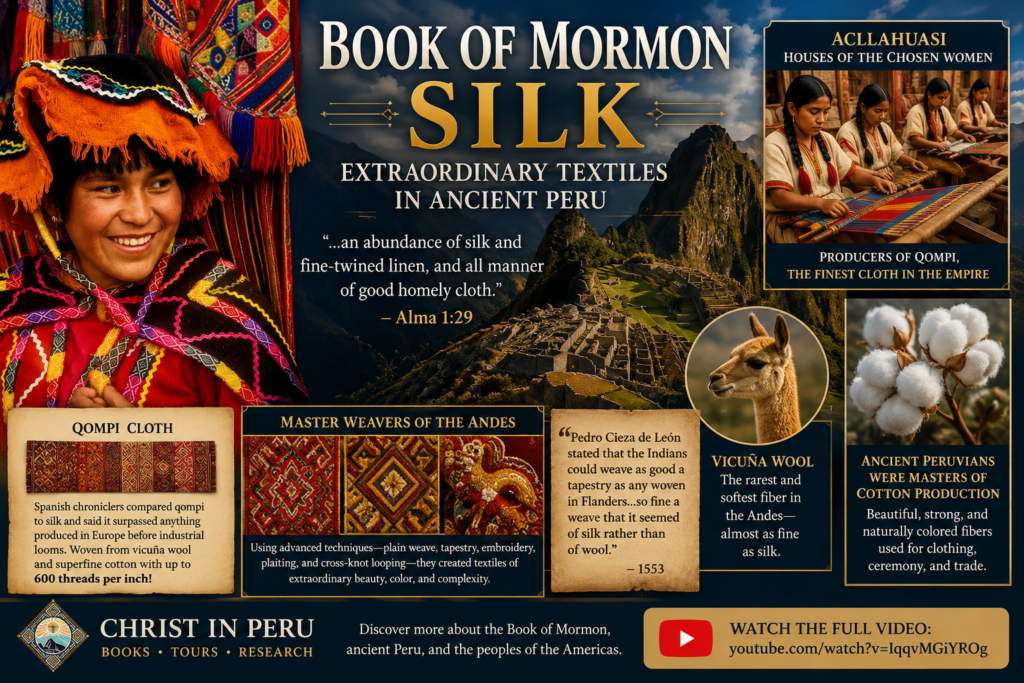
The Book of Mormon describes prosperous societies that possessed “an abundance of silk and fine-twined linen, and all manner of good homely cloth.”
For some readers, the word silk creates an immediate question. Traditional silk is associated with fibers produced by silkworms in Asia. How, then, could ancient peoples in the Americas have possessed material described with that word?
George Potter proposes that the extraordinary textile traditions of ancient Peru provide an important cultural and historical context for understanding these passages.
Long before the arrival of the Spanish, Andean civilizations produced some of the finest woven fabrics in the ancient world. Their textiles were not only practical clothing. They were expressions of wealth, rank, religion, identity, and political authority.
Silk and Fine-Twined Linen in the Book of Mormon
The Book of Mormon refers several times to fine fabrics and expensive clothing.
Alma 1:29 describes the Nephites as having:
“An abundance of silk and fine-twined linen, and all manner of good homely cloth.”
The Jaredites are also described as possessing silks and fine-twined linen in Ether 9:17.
Later, Nephite pride was connected with wealth, silk, fine linen, and costly apparel. Among the Zoramites, expensive clothing helped distinguish the rich from the poor.
These passages suggest that textiles played an important role in Book of Mormon society. Clothing could indicate prosperity, religious pride, social status, and exclusion.
Ancient Peru provides a particularly striking example of a civilization in which textiles carried exactly this kind of meaning.
The Acllahuasi: Houses of Skilled Weavers
When the Spanish arrived in Peru, they encountered a highly organized textile industry.
Important Inca cities contained an Acllahuasi, commonly translated as the “House of the Chosen Women.” These institutions housed selected young women known as acllas, who were trained in spinning, weaving, food preparation, and religious service.
The acllas produced textiles for:
- The Inca ruler and royal family
- Nobles and government officials
- Temples and sacred ceremonies
- Diplomatic gifts
- Military and political rewards
These compounds functioned as both religious institutions and state-controlled workshops.
The finest cloth produced there was known as qompi, also written as qumpi or cumbi. It was made from extremely fine fibers, including vicuña wool and high-quality cotton.
The presentation accompanying the script emphasizes that Spanish observers compared this fabric to silk because of its extraordinary softness, density, and quality.
Vicuña Wool: Soft as Silk
The vicuña is a wild Andean camelid related to the llama and alpaca.
Its wool is exceptionally soft, fine, and rare. In the Inca world, vicuña fiber was highly valued and often reserved for royalty and the highest levels of society.
Father Bernabé Cobo described the clothing of the Inca ruler as being made from the finest wool and the best cloth produced in the empire. He noted that much of it was made from vicuña wool, which he compared to silk.
This comparison is important.
The material was not necessarily silk in the narrow modern sense of fiber produced by an Asian silkworm. Instead, it was a remarkably soft, luxurious thread that could reasonably be described as silk-like by European observers.
George Potter recalls receiving a vicuña-wool poncho during his mission in Peru and describes the material as feeling as soft as silk.
The Cotton Tradition of Ancient Peru
Ancient Peruvians were also masters of cotton production.
Cotton was domesticated independently in only a few regions of the world. Two domesticated cotton species originated in the Americas, while two others developed in the Old World.
On the coast of Peru, cotton became one of the foundations of civilization.
The dry coastal climate preserved ancient textiles that might have disappeared in wetter environments. Archaeologists have recovered cloth, nets, cords, bags, ceremonial garments, and intricately decorated fabrics from extremely early Peruvian sites.
Historian Charles C. Mann observed that South American cotton once grew along both the Pacific and Atlantic coasts. Some varieties naturally produced fibers in colors such as pink, blue, brown, and yellow.
This meant that Andean weavers had access not only to soft fibers but also to naturally colored material suitable for complex textile production.
Textiles in Caral and Norte Chico
The civilization of Caral, also known as part of the Norte Chico tradition, developed along the coast of Peru thousands of years ago.
Cotton textiles were essential to its economy.
Cotton was used to produce fishing nets, clothing, containers, cords, decorative objects, and trade goods. Because coastal communities depended heavily on fishing, strong cotton nets allowed them to harvest marine resources on a large scale.
Textiles also became a medium for visual art and a means of storing and exchanging wealth.
This is significant because it demonstrates that sophisticated textile production in Peru began long before the Inca Empire.
The Incas inherited and expanded traditions that had already developed over thousands of years.
How Fine Were Andean Textiles?
Spanish chroniclers were astonished by the quality of Andean weaving.
Pedro Cieza de León wrote that Indigenous weavers could produce tapestries comparable to those of Flanders. He observed that some fabrics were woven so finely that they appeared to be silk rather than wool.
Andean textile artists used many complex techniques, including:
- Plain weave
- Double cloth
- Gauze
- Tapestry weaving
- Plaiting
- Embroidery
- Cross-knot looping
- Three-dimensional textile construction
Some surviving fabrics display remarkable thread counts, precise geometric patterns, vivid colors, and imagery of animals, plants, supernatural beings, and political symbols.
In many cases, Andean textiles required more labor and skill than objects made of gold or silver.
They were among the most valuable products of the ancient Andes.
Clothing as a Symbol of Social Status
The Book of Mormon frequently connects clothing with class and social distinction.
The rich wore costly apparel, while the poor could be judged by the roughness or coarseness of their clothing.
Ancient Andean society used textiles in a similar way.
The quality of a person’s clothing could reveal:
- Social position
- Political office
- Ethnic identity
- Religious role
- Regional affiliation
- Relationship to the Inca state
Fine qompi cloth was restricted to elites, while ordinary people wore less elaborate textiles.
Clothing was therefore not simply a practical necessity. It communicated a person’s place in society.
This cultural pattern closely resembles the Book of Mormon’s descriptions of silk, fine-twined linen, costly apparel, and social pride.
What Did “Silk” Mean in the Translation?
Potter argues that the Book of Mormon’s use of the word silk does not necessarily require Asian silkworm fiber.
The Book of Mormon was translated into the English language of Joseph Smith’s time. A translator may use a familiar English term to describe a material that shares important characteristics with that term.
The 1828 edition of Noah Webster’s dictionary connected the word “silk” more broadly with thread and linked it to an Arabic root.
Potter proposes that the original concept may have referred to soft or exceptionally fine thread rather than exclusively to material produced by silkworms.
Under this interpretation, Andean vicuña wool or exceptionally fine cotton could fit the descriptive meaning of silk in the Book of Mormon translation.
This is an interpretive argument rather than a universally accepted linguistic conclusion, but it offers one possible explanation for the wording.
Fine-Twined Linen and Andean Cloth
The term fine-twined linen may also be broader than the modern image of European flax linen.
In scriptural language, linen can sometimes function as a general term for fine woven cloth.
Ancient Peru possessed advanced spinning and twisting techniques that allowed artisans to produce strong, lightweight, and exceptionally fine threads.
Cotton fibers could be spun, doubled, twisted, dyed, and woven into fabrics of extraordinary quality.
From this perspective, the phrase “fine-twined linen” may describe finely prepared woven material rather than requiring a specific European plant fiber.
Were Andean Textiles Unique in the Americas?
Other civilizations in the Americas also produced impressive textiles.
Mesoamerican peoples wove fine cotton cloth and created elaborate garments. However, Potter argues that the scale, preservation, technical range, and quality of Andean textiles are especially remarkable.
The dry climate of coastal Peru has preserved thousands of textile examples, allowing researchers to study techniques that might otherwise have been lost.
Ancient North American peoples also produced cloth from plant fibers, bark, nettles, hemp-like plants, and animal skins. Yet the archaeological record does not show the same concentrated tradition of extremely fine luxury textiles found in the Andes.
For Potter, this makes ancient Peru a strong cultural candidate for understanding Book of Mormon descriptions of silk and costly apparel.
Evidence, Interpretation, and Faith
The existence of extraordinary textiles in ancient Peru is well established.
Andean civilizations produced fine cotton, vicuña wool, complex tapestries, ceremonial garments, and fabrics that Spanish chroniclers compared to silk.
What remains interpretive is the direct connection between these textiles and the Book of Mormon.
Archaeology does not identify Inca or pre-Inca textiles as specifically Nephite or Jaredite. Nor does the presence of silk-like cloth independently prove a South American Book of Mormon setting.
However, the evidence does show that ancient American societies—especially those of the Andes—possessed fabrics that could reasonably be described as silk-like, finely twisted, luxurious, and costly.
That makes the Book of Mormon’s textile descriptions culturally plausible within an ancient American setting.
A Living Tradition
The textile heritage of Peru is not only archaeological.
Modern Quechua and Aymara communities continue to preserve ancient weaving traditions. Artisans still spin alpaca, llama, sheep, cotton, and sometimes vicuña fibers.
They use natural dyes, traditional patterns, hand looms, and techniques passed from one generation to another.
Visitors to Peru can see clothing that reflects centuries of continuity, adaptation, and cultural memory.
These living traditions provide a vivid window into a world in which textiles were among society’s most important and meaningful possessions.
Watch the Full Video
To learn more about silk in the Book of Mormon, vicuña wool, ancient Peruvian cotton, the acllas, qompi cloth, and the textile traditions of the Andes, watch the complete video:
Book of Mormon Silk — Watch on YouTube
You can also visit ChristInPeru.com to learn more about our books, research, videos, and annual tours to Peru.