
When people talk about the language of the Incas, the quick answer is usually Quechua. It was the administrative and widely spoken tongue of the empire. But several scholars have long suggested that the Inca nobility used another, more exclusive language—one reserved for the royal class, often called their “particular” or “private” language in colonial sources. The leading hypothesis today is that this language was Puquina (also spelled Pukina).
What Puquina Was and Why It Matters
Puquina was a language once spoken around Lake Titicaca and associated with the ancient culture of Tiwanaku. Its genetic affiliation remains uncertain, though researchers have proposed distant connections with the Arawakan family and deep contact with both Quechua and Aymara. Traces of Puquina survive in southern Andean place names, in the vocabulary of Uru-Chipaya peoples, and possibly in the ritual language of the kallawayas.
The main surviving documentation comes from early colonial liturgical texts, such as Luis Jerónimo de Oré’s Rituale seu Manuale Peruanum (1607), which included prayers and baptismal formulas in Puquina. Modern linguists have used these fragments to reconstruct some aspects of its sounds and grammar.
The scholarly consensus today accepts two main points: first, Puquina was indeed a distinct language once widely spoken around the Titicaca-Tiwanaku heartland; and second, it deeply influenced Quechua and Aymara through centuries of contact.
The “Language of the Incas” Among the Nobility
Peruvian linguist Rodolfo Cerrón-Palomino, in Las lenguas de los incas: El puquina, el aimara y el quechua (2013), argued that the “particular language” mentioned by early chroniclers and Inca Garcilaso de la Vega is best identified as Puquina rather than Quechua or Aymara.
This interpretation doesn’t deny the reach of Quechua as a lingua franca but proposes a bilingual elite: Quechua for administration and daily communication, Puquina for sacred, dynastic, or ceremonial use—what some sources call qhapaq simi (“the noble speech”).
Such a hypothesis fits historical clues locating the Incas’ mythical origins near Lake Titicaca and Tiwanaku, the cradle of Puquina. Later researchers have followed Cerrón-Palomino’s lead, suggesting that the royal family maintained a sacred linguistic code derived from that ancient tongue.
The “Five-Language Portal” of Andahuaylillas
In the town of Andahuaylillas, near Cusco, the Church of San Pedro Apóstol is famous for its richly decorated Baroque interior—and for a remarkable detail on its baptistry entrance: a carved inscription of the baptismal formula “I baptize thee in the name of the Father, and of the Son, and of the Holy Ghost” written in five languages.
According to local historians and the official Ruta del Barroco Andino project, the five languages are Latin, Spanish, Quechua, Aymara, and Puquina. Heritage organizations such as the World Monuments Fund also refer to this “Five Language Gate.”
This multilingual inscription demonstrates that 17th-century missionaries were addressing a diverse population whose members still understood multiple native tongues—including one distinct from Quechua and Aymara. It suggests that Puquina remained alive, at least among some groups, early in the colonial period—alive enough to warrant inclusion in a sacred text on the church façade.
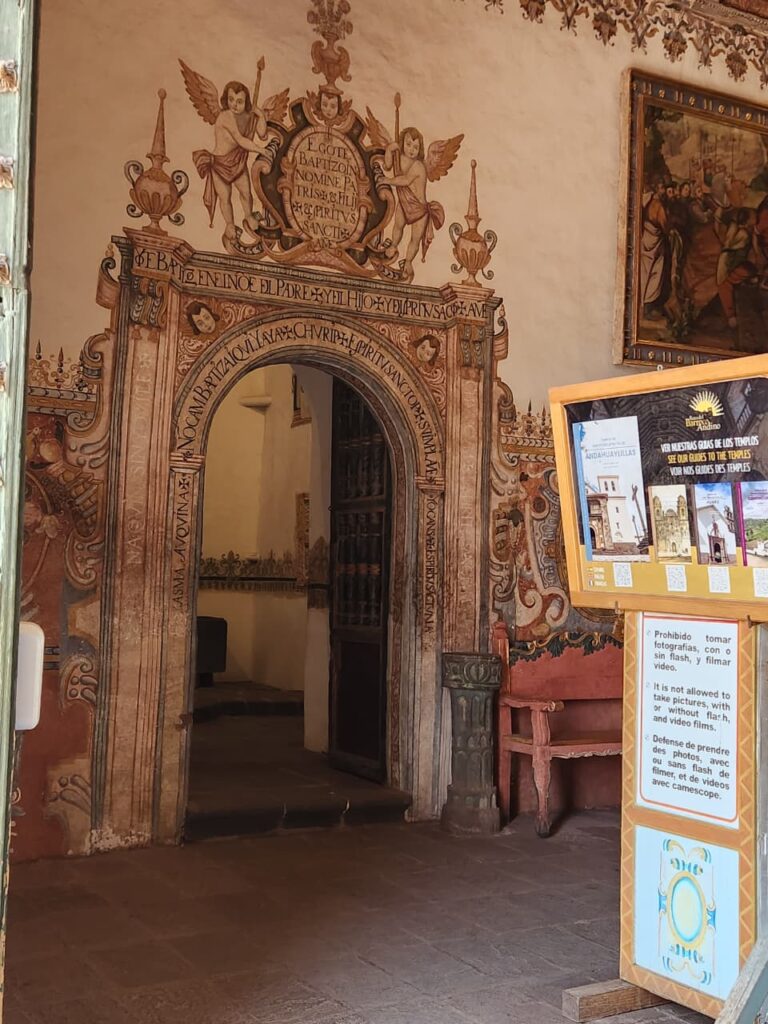
Photo: Rudy Chalco – InkaTraces
A Lost and Sacred Language in the Book of Mormon: George Potter’s Andean View
George Potter, known among Latter-day Saint readers for his geographic research on the Book of Mormon, locates much of the Nephite narrative in the Andean regions of South America—specifically Chile, Peru, and Bolivia—drawing on archaeological and colonial studies.
In interviews, Potter goes beyond geography and points out that the Incas “had a private language which they only spoke among themselves, separate from the one they used with their subjects.”
“They have two different languages that are spoken of by the Incas. They had their private language, which they only spoke to themselves. But the people they conquered, the people they worked with, they had what they called the popular language.”
— George Potter, Gospel Tangents Podcast (2023)
This remark resonates with passages in the Book of Mormon that describe the Nephites preserving “the language of our fathers” so that they could “interpret the records” (Mosiah 28:11; 29:2-3) and that their scriptures were written in a form of speech unknown to later peoples: “the language which they understood not” (Jacob 4:1-2).
If the lands of the Book of Mormon were indeed in the central Andes—as Potter proposes—the existence of an elite ritual language like Puquina offers a credible historical parallel. It shows that an ancient, sacred, and later-forgotten language could coexist with widely spoken tongues. Potter’s Andean hypothesis thus implies that the Nephites’ “language of their fathers” may have been a similarly hidden or lost linguistic tradition—one whose echoes might survive faintly in the Andes, just as Puquina does.
Underlying Links: Prestige, Sacred Speech, and Multilingualism
Three common threads tie together the Puquina debate, the Andahuaylillas portal, and Potter’s Andean interpretation:
- Prestige and sacred function. If Puquina served as the high language of the Inca elite, its presence in sacred contexts like baptismal inscriptions is consistent with that role. Religious formulas in multiple languages reflect both evangelizing strategy and lingering reverence for prestige speech.
- Real multilingualism. Colonial evangelization in the Andes adapted to linguistic diversity. The Five-Language Portal is not an oddity but a visual record of that coexistence. It confirms that, beyond Quechua and Aymara, Puquina still mattered enough to appear on the church walls.
- Geographical continuity. The Titicaca–Cusco corridor repeatedly appears as the cradle of high Andean civilization. If part of the Book of Mormon’s story took place there, as Potter suggests, then this linguistic mosaic offers a realistic backdrop—a setting of continuity, stratified languages, and sacred preservation.
Caution and Perspective
Linguists remain cautious for good reasons. The surviving documentation of Puquina is fragmentary, making full reconstruction impossible. The term “particular language” in colonial sources might have referred to a ritual register rather than a wholly separate tongue. And some materials labeled “Puquina” may actually reflect other minor languages such as Uru-Chipaya.
Thus, while the Andahuaylillas portal provides striking evidence, it should be seen as a strong indication—not final proof—of Puquina’s elite or sacred status.
Why It Matters to Students of the Book of Mormon
The Book of Mormon portrays societies that kept records, transmitted traditions, and experienced cultural and linguistic change through conquests and migrations. The historical Andes show similar patterns: an expanding empire, multilingual administration, languages of prestige, and sacred translation across tongues.
The Five-Language Portal at Andahuaylillas captures this very dynamic—the coexistence of ancient and new languages within a sacred frame. It may not directly reveal anything about the Nephites, but it illustrates the kind of world where sacred records could be preserved, translated, and eventually obscured. In that sense, the Andes provide a living example of how divine knowledge and linguistic memory can survive through centuries of transformation.
Conclusion
Evidence today supports that Puquina was a real and influential language of the southern Andes, likely used by the Inca nobility and retained in certain sacred contexts into colonial times. Its echo endures in one of the most striking artifacts of Andean Christianity—the five-language baptismal gate of Andahuaylillas.
Cerrón-Palomino’s scholarship laid the foundation for this theory, while technical works by Adelaar and van de Kerke have detailed its linguistic features. George Potter’s Andean reading of the Book of Mormon, meanwhile, shifts the spiritual geography southward, placing the Nephite world amid the complex linguistic landscape of the Andes. Together, these perspectives invite a deeper, data-driven reflection on how sacred languages can be lost, remembered, and rediscovered.