
Until World War II, far more soldiers died from diseases and battlefield wounds than perished during the actual fighting. This certainly would have been true on ancient battlefields of the New World. We read that the Lamanites were warned by Captain Moroni, “I will command my men that they shall fall upon you, and inflict the wounds of death in your bodies, that ye may become extinct” (Alma 44:7). Even during the American Civil War, which took place after the Book of Mormon was published, survival rates for battlefield wounded were disheartening. The US National Institutes of Health reports that there were 175,000 extremity wounds to Union soldiers during the Civil War. Of these, 30,000 required amputation with a 26.3% mortality rate.[1] In contrast, it appears that the Nephi battlefield doctors exhibited incredible skills in saving their warriors. Take for example the Ammonite stripling warriors of whom all 2,066 incurred many battlefield wounds yet none of them expired thanks to immediate battlefield treatment of their wounds and their faith in God.
And it came to pass that after the Lamanites had fled, I immediately gave orders that my men who had been wounded should be taken from among the dead, and caused that their wounds should be dressed.
And it came to pass that there were two hundred, out of my two thousand sixty, who had fainted because of the loss of blood; nevertheless, according to the goodness of God, and to our great astonishment, and also the joy of our whole army, there was not one soul of them who did perish; yea, and neither was there one soul among them who had not received many wounds. (Alma 57:24:25)
There are several other instances in the history of the Lamanite wars where Nephites were severely wounded in battle but survived (Alma 3:22; Alma 49:23-24; Alma 52:35).
Undoubtedly one of the reasons for the high survival rates among the Nephite wounded is that their commanders understood the importance of receiving “immediate” treatment for wounds (Alma 57:24). During the American Civil War doctors only learned this need for urgency as the war progressed. “As the war went on, it was noticed that if amputation was done within 24 hours, mortality was lower than if performed after more than 48 hours.”[2]
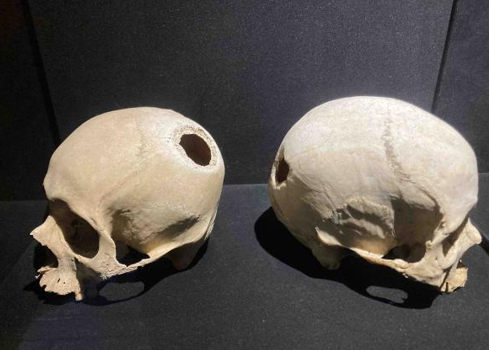
Of particular interest are the battlefield wounds to the head. Book of Mormon period Andean doctors practiced advanced brain surgery techniques, which were later improved upon by their descendants. The ancient Andean doctors had significantly higher survival rates for brain operations than did the American Civil War doctors. As reported in the Smithsonian Magazine:
For the study, Tulane University bioarchaeologist John Verano, who literally wrote the book on Inca cranial surgery, and bioarchaeologist Anne Titelbaum of the University of Arizona teamed up with University of Miami neurologist David Kushner to look at surgery success rates over time. With its high elevation and dry climate, Peru is full of well-preserved ancient skulls. In fact, according to a press release, about 800 trepanned prehistoric skulls have been found in Peru, more than the rest of the world combined. The researchers examined the skulls, looking at the edges of the hole. If the edge had been “remodeled,” or healed significantly, the team considered the surgery a success. If the edge of the hole was ragged without signs of healing, they assumed the patient didn’t survive the surgery or died soon after.
Using that metric, they examined various periods of Peruvian trepanation. Wade reports that over the course of 2,000 years, the Inca and their ancestors got progressively better at skull surgery. Of the 59 skulls dated between 400 B.C.E. to 200 B.C.E. only about 40 percent of the patients’ skulls showed signs of survival. That rate of survival increased to 53 percent in the analysis of 421 skulls found dating between 1000 C.E. to 1400 C.E. During the Inca period, from 1400 C.E. to 1500 C.E. 75 percent to 83 percent of the 160 skulls examined showed signs of survival.
During the Civil War, by comparison, the mortality rate from skull surgery was between 46 and 56 percent. The study appears in the journal World Neurosurgery.
“There are still many unknowns about the procedure and the individuals on whom trepanation was performed, but the outcomes during the Civil War were dismal compared to Incan times,” Kushner says in the release. “The question is how did the ancient Peruvian surgeons have outcomes that far surpassed those of surgeons during the American Civil War?”
Kushner says there are signs that the technique evolved over the centuries. The succession of skulls shows that over time the Peruvian surgeons learned to avoid areas of the skull that would produce excessive bleeding. They also figured out that smaller holes were more survivable than larger holes. And most importantly, it appears their surgeries became shallower, avoiding perforating the dura, or the thick membrane that covers the brain. In fact, some patients appear to have survived multiple surgeries, with one skull showing five trepanation holes.[3]
Of all the numerous ancient civilizations of the Americas, only the doctors of the Andes are known to have exhibited such advanced surgery technology. Not only did they perform cranial surgeries, they were very proficient in this practice. So how did the ancient Peruvian doctors learn to perform brain surgery? The answer to that questions could be another proof that the fair-skinned Peruvians originated from the land of Jerusalem. As noted before, the prevailing culture in Palestine at the time of Lehi was Greek. The Greeks were the masters of the eastern Mediterranean in 600 BC and shared their technology with their allies. As reported by Novo Scriptorium:
Cranial surgery in Greece predates Hippocrates by many centuries. The oldest skeletal evidence of trepanation discovered to date was in a Minoan ossuary in Crete (Early Minoan to Middle Minoan period, 2200–1720 BC). Trepanned skulls belonging to different periods have also been unearthed in Delphi (Middle Bronze Age period, 1700–1750 BC), the Peloponnese (Late Helladic period, 1400–1060 BC), Crete (8th century BC), Abdera (7th century BC), and in many other regions, indicating a wide geographic as well as a prolonged chronological distribution. Fabbri et al. presented a case of cranial trepanation that was performed at the beginning of the 5th century BC, in a Greek colony in Sicily.[4]
Evidence of trepanation surgery in ancient Israel was recently discovered at Megiddo. The skull dates back 3,500 years.[5] Thus, the Book of Mormon provides a possible explanation as to how the ancient Peruvians knew how to perform cranial surgeries. This information also provides a possible insight into who was aboard the ships of Nephi and Mulek. One of the passengers was could have been a physician. Since Mulek was a royal prince, it is likely that a doctor would have been a member of his entourage.
[1] Reilly, Robert F., MD “Medical and surgical care during the American Civil War, 1861-1865”, US National Library of Medicine, National Institutes of Health, Baylor University Medical Center Proceedings, Dallas, Taxes, accessed September 2018.
[2] Ibid.
[3] Daley, Jason, “Inca Skull Surgeons Had Better Success Rates than American Civil War Doctors,” Smithsonian Magazine, June 13, 2018, https://www.smithsonianmag.com/smart-news/inca-head-crackers-had-better-success-rates-civil-war-surgeons-180969324/ accessed 27 July 2018.
[4] Trepanation (Primitive Neurosurgery) in the Ancient Greek World, Novo Scriptorium, https://novoscriptorium.com/2019/06/28/trepanation-primitive-neurosurgery-in-the-ancient-greek-world/.
[5] Lidmen, Melanie, “Square hole in an ancient skull: Middle East’s earliest brain surgery found in Israel,” Archaeology, February 24, 2023, https://www.timesofisrael.com/earliest-brain-surgery-in-the-middle-east-uncovered-at-megiddo/.